

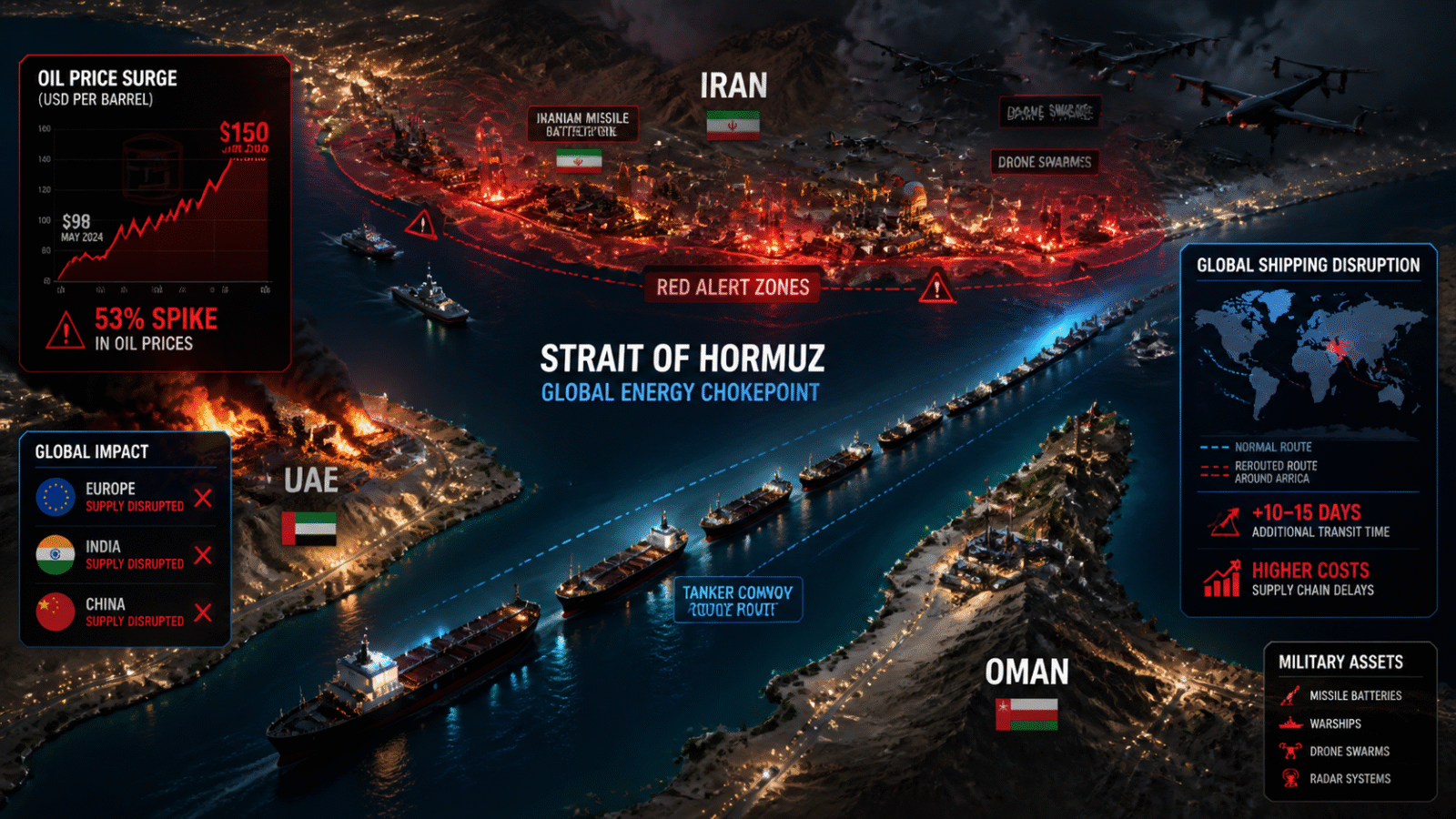

At 3:12 a.m., the captain of a Singapore-bound oil tanker sat motionless in the Gulf, staring at an email written in clipped bureaucratic English. The message had arrived from a newly created Iranian authority. Before his ship could pass through the Strait of Hormuz, the narrow artery carrying nearly a fifth of the world’s oil, he would need authorization.
Crew details. Cargo manifest. Insurance disclosures. Payment instructions.
Until approval arrived, the vessel would wait.
Around him, dozens of ships floated in the dark water between Iran and Oman, their navigation lights blinking across the horizon like a stalled highway at sea. Some turned back. Others slowed to conserve fuel. Traders in London and Singapore watched oil futures jump before sunrise. Refiners in Asia recalculated delivery schedules. Governments quietly opened emergency meetings.
For decades, the Strait of Hormuz functioned as one of the few pieces of global infrastructure the world assumed would always remain open. That assumption is now cracking.
Iran’s decision to formalize a permit-based transit system through the Strait of Hormuz marks a major shift in global maritime power politics. Tehran has established what it calls the Persian Gulf Strait Authority, requiring ships to seek approval before crossing the waterway.
This is not merely a bureaucratic exercise. It is a geopolitical message.
The strait sits at the center of the global energy system. Roughly 20 percent of the world’s oil and large volumes of liquefied natural gas move through the narrow passage between the Persian Gulf and the Arabian Sea.
By introducing permits, inspections, and transit fees, Iran is attempting to transform Hormuz from an international shipping lane into a controlled gateway one where access can be slowed, monetized, or selectively restricted depending on political alignment.
The implications stretch far beyond the Middle East.
Iran’s strategy appears rooted in a simple calculation: if Western sanctions can squeeze Iran’s economy, Tehran can squeeze the world’s energy supply chain.
Reports suggest some vessels are now being asked to pay substantial transit-related fees, while others face additional scrutiny tied to cargo origin, ownership structures, or political affiliations.
Iran has also signaled that “friendly” nations may receive smoother access. India-linked vessels, for example, were reportedly told they could transit under certain security conditions. Meanwhile, lawmakers in Tehran have floated proposals to permanently restrict Israeli-linked ships and tighten rules for countries viewed as hostile.
In practice, this creates a tiered maritime system:
- Friendly states receive managed access.
- Neutral states face delays and higher costs.
- Adversaries risk outright denial.
That approach mirrors how modern geopolitical power increasingly works not through formal declarations of war, but through selective friction. A delayed tanker. A blocked insurance certificate. A stalled shipment of fuel during planting season.
The goal is pressure without full-scale escalation.
International maritime law was never designed for this exact moment.
Under the United Nations Convention on the Law of the Sea, ships generally retain the right of “transit passage” through international straits like Hormuz. But Iran and the United States have long disputed how those rules apply.
Iran argues that because the strait overlaps with its territorial waters, it retains broad regulatory authority. Western governments counter that no single country can effectively privatize or weaponize a global shipping corridor.
The problem is enforcement.
International courts can issue opinions. They cannot escort tankers through contested waters.
That leaves the real enforcement power with navies, sanctions, insurers, and energy markets.
Oil traders understand something politicians often ignore: markets do not wait for wars to officially begin.
Even partial disruption in Hormuz can ripple through gasoline prices, shipping insurance, fertilizer costs, aviation fuel, and food supply chains. LNG shipments to Asia become vulnerable. European energy planners grow anxious. Emerging economies face inflation shocks.
The fear is not only closure. It is unpredictable.
A fully closed strait would trigger immediate global panic. But a selectively restricted strait one where approvals vary by politics, fees fluctuate, and military tensions simmer creates something potentially more durable: chronic instability.
That instability itself becomes leverage.
Iran appears to understand that perfectly.
The Strait of Hormuz is no longer just a shipping lane. It is becoming a toll gate in a new era of economic warfare.
Iran’s permit system signals a broader transformation in how nations project power: not only with missiles and sanctions, but with chokepoints, paperwork, and control over the infrastructure the global economy depends on.
For years, the world treated Hormuz as an untouchable international artery. Tehran is now testing whether it can become something else entirely, a checkpoint where geopolitics decides who gets through, how fast, and at what price.
Read Also / Pakistan Blinked: The Risky Bet Behind Islamabad’s Decision to Wait Out the LNG Crisis







Leave a comment