

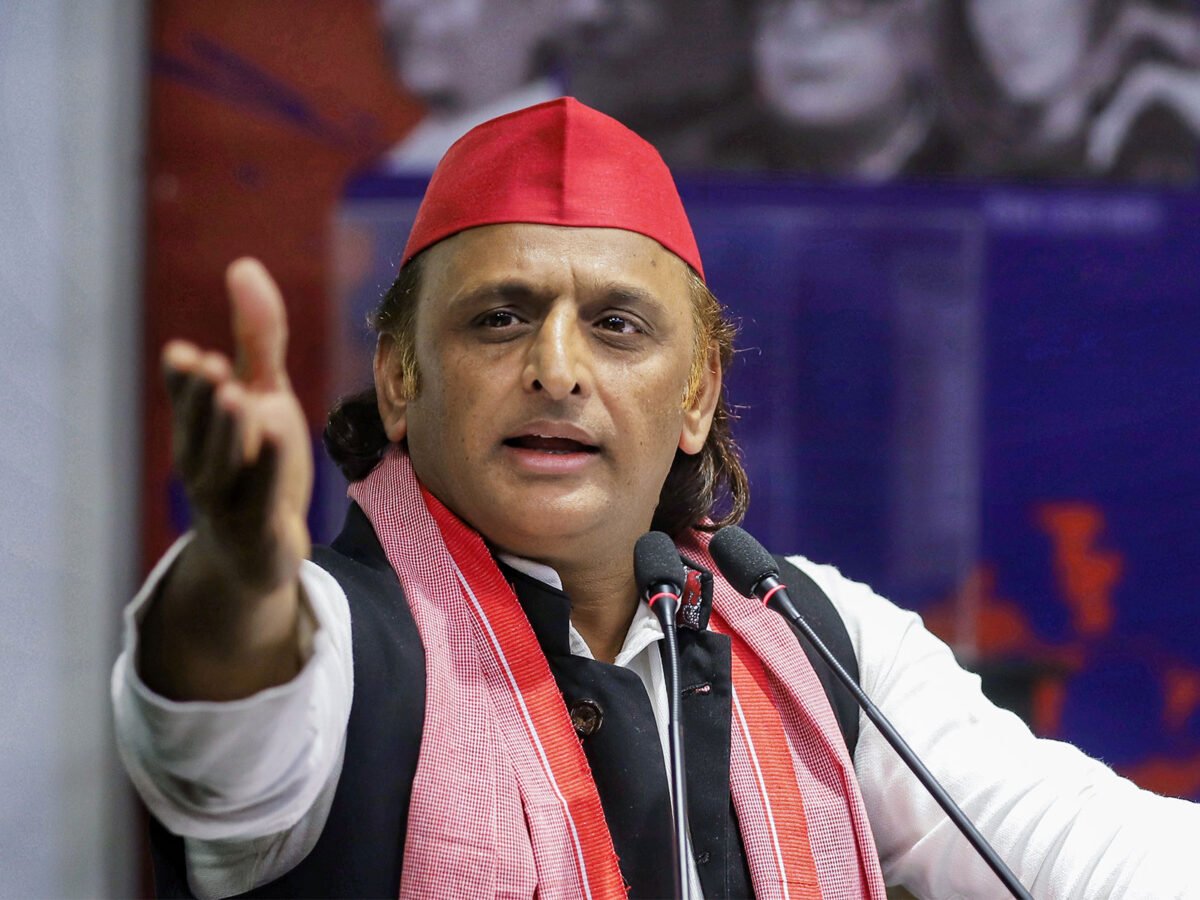

The rain had just started outside the rally grounds in Lucknow when a party worker climbed onto a plastic chair and began shouting into a crackling loudspeaker. Flags whipped in the wind. Motorcycles lined the muddy roadside. On stage, Akhilesh Yadav leaned toward the microphone and delivered the kind of line designed to travel far beyond the crowd standing before him.
“India has only one crisis,” he declared. “And it is the BJP.”
The audience erupted. Young supporters waved red-and-green Samajwadi Party scarves over their heads. A few men recorded the speech on cheap Android phones, already uploading clips to WhatsApp groups before the rally had even ended. In the front rows, farmers from nearby districts listened quietly, less interested in slogans than in fuel prices, unemployment, and the rising cost of daily life.
Outside the barricades, police officers stood expressionless under raincoats as another election-season confrontation entered India’s endless political bloodstream.
The remark was not just another opposition soundbite. It captured the increasingly sharp tone of Indian politics as opposition parties attempt to redefine the national debate around governance, economic pressure, and democratic institutions under Prime Minister Narendra Modi and the Bharatiya Janata Party.
Across India, political rhetoric has hardened ahead of crucial state and national contests. The BJP continues to dominate large parts of the country politically, expanding into regions that once resisted its influence. Recent electoral gains in states like West Bengal strengthened the perception that the party remains India’s central political force despite economic anxieties and opposition criticism.
But leaders like Akhilesh Yadav are trying to turn public frustration into a broader political argument: that inflation, unemployment, social polarization, and institutional centralization are not isolated problems; they are symptoms of one dominant-party system.
That message reflects a deeper anxiety inside opposition politics. For years, anti-BJP parties have struggled to build a unified national narrative. Some focused on caste arithmetic. Others attacked economic policy. Many relied on regional identity. None consistently broke through Modi’s carefully maintained image of decisive leadership and national stability.
Now, the language is changing.
Instead of criticizing individual policies, opposition leaders increasingly frame the BJP itself as the source of India’s democratic and economic strain. Akhilesh Yadav’s statement was blunt by design. It reduced a sprawling national debate into a single political accusation, crafted for social media clips and prime-time television warfare.
The BJP, meanwhile, continues to position itself as the only party capable of maintaining political stability and national development. Modi’s leadership style combining welfare politics, Hindu nationalism, aggressive campaigning, and centralized messaging has helped the party expand beyond its traditional northern strongholds.
Yet cracks remain visible beneath the electoral victories.
Rising fuel costs, unemployment concerns, rural distress, and debates over federal power continue to give opposition parties political openings. Recent criticism surrounding fuel conservation appeals from the Prime Minister triggered immediate backlash from opposition leaders who accused the government of preparing the public for economic hardship.
In Uttar Pradesh especially, politics has become intensely personal and symbolic. Rival parties no longer merely debate policy; they question legitimacy, ideology, and even the future structure of Indian democracy. Akhilesh Yadav has repeatedly accused the BJP of attempting to reshape electoral systems and political institutions to ensure long-term dominance.
The stakes extend beyond one speech or one rally.
India is entering a political era where opposition parties are no longer asking voters to simply replace a government. They are asking whether one party has become too powerful to challenge. At the same time, BJP supporters argue that repeated electoral victories reflect public trust, not democratic erosion.
That contradiction now defines modern Indian politics.
And somewhere between the rally slogans, viral clips, and televised shouting matches lies the real question facing the country: whether voters still see India’s political future as competitive or increasingly inevitable.
Akhilesh Yadav’s attack was more than campaign rhetoric. It reflected a growing opposition strategy to frame the BJP not just as a ruling party, but as the central force shaping every major political, economic, and democratic debate in India today.






Leave a comment