

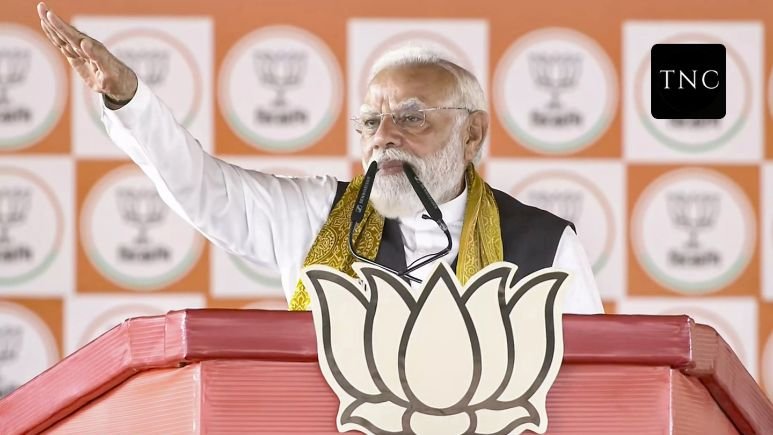

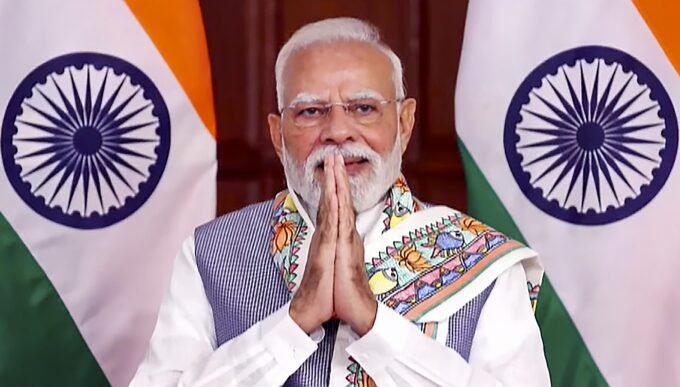
Prime Minister Narendra Modi closed out one of the most intense election campaigns West Bengal has seen in years on Monday, delivering a sweeping final pitch to voters ahead of the April 29 second-phase polling in the state’s Assembly elections. Addressing a Vijay Sankalp Sabha at Barrackpore in North 24 Parganas and later a rally at Jagatdal, Modi expressed unwavering confidence that the Bharatiya Janata Party would end 15 years of Trinamool Congress rule and form the next state government when results are declared on May 4.
In a striking public letter penned on the final day of campaigning, Modi framed his appeal in deeply personal terms, describing his weeks on the stump across the state as something close to a spiritual experience. He wrote that despite the scorching heat and the relentless schedule of rallies and roadshows, he had not felt the slightest fatigue. “These rallies and roadshows have felt like a pilgrimage to me,” he wrote. “As I moved amongst the devotees of Maa Kali, it seemed as though Maa Kali herself was continuously infusing me with fresh energy.”
The letter’s most pointed passage addressed what the BJP has consistently framed as the defining issue of this election: fear. “Our daughters desire an open sky, the freedom to soar, and, above all, they seek security. Every citizen, every family, is now determined to move forward with a singular resolve,” Modi wrote. “There has been enough fear; what is needed now is trust and what is needed now is the BJP.” The line drew an immediate response on social media and is expected to dominate political discourse in the final hours before silence descends ahead of polling.
At the Barrackpore rally, Modi predicted “poriborton” the Bengali word for change that the TMC itself famously deployed against the Left Front in 2011 — was now imminent. He told the crowd that he would return to West Bengal after May 4 for one purpose: to attend the swearing-in of a BJP Chief Minister. “The people of West Bengal are my family. I will come to West Bengal after May 4 to attend the BJP CM’s oath ceremony,” he declared. In Jagatdal, he went further, describing the scale of public support his campaign had encountered as confirmation that the political tide had turned. “I am leaving Bengal with the conviction that I will be back here for the oath-taking ceremony,” he said.
Modi used his final rally appearances to outline the BJP’s specific policy guarantees for the state, attempting to translate the party’s anti-incumbency momentum into concrete voter commitments. He promised transparency in government recruitment and employment generation through industrial growth. He said government employees would be freed from political pressure and would receive benefits under the 7th Pay Commission. He spoke of establishing creative economy labs in schools and colleges, implementing a 125-day employment guarantee scheme and extending the PM Vishwakarma Yojana to skilled workers across the state. For street vendors, he promised access to bank credit through the PM SVANidhi Yojana.
| Date / Phase | Event Description |
| Phase 1 | First phase of polling already concluded in West Bengal’s 2026 Assembly elections. |
| Apr 27 | Final day of campaigning; PM Modi addresses rallies in North 24 Parganas and pens an open letter to voters. |
| Apr 29 | Second and final phase of voting across West Bengal. |
| May 4 | Vote counting and declaration of results across all 294 Assembly constituencies. |
| May 7 | Current West Bengal Legislative Assembly’s term expires. |
The campaign has been fought across a contested landscape of issues. The BJP has leaned heavily on women’s safety, invoking the 2024 R.G. Kar Medical College rape and murder case that drew national outrage, and arguing that the TMC government failed to protect women or prosecute those responsible for political violence against the opposition. The party has also pressed the state’s long-running school recruitment scam as evidence of deep-rooted corruption under the Mamata Banerjee-led government.
The TMC, for its part, has campaigned on its welfare record and infrastructure investment, and has presented itself as the defender of Bengali identity and state autonomy against what it characterises as encroachment from New Delhi. It has also sought to portray the BJP’s rhetoric on infiltration and border security as divisive communal politics, and has questioned the legitimacy of a Special Intensive Revision of electoral rolls that removed roughly nine million names from voter lists, warning it risks disenfranchising genuine voters.
The BJP has defended the electoral roll revision as a legitimate exercise to remove bogus entries, and has made citizenship, border fencing and the Siliguri Corridor central to its national security argument in the campaign.
The TMC swept 215 of West Bengal’s 294 Assembly seats in the 2021 elections, with Chief Minister Mamata Banerjee winning a third consecutive term. Dethroning an entrenched state government with that size of a majority would be an historic undertaking, and many political analysts remain cautious about projecting a BJP wave despite the BJP’s sustained campaign effort and the Prime Minister’s personal investment of time and political capital in the state.
Modi, however, gave no quarter to caution on Monday. His message to voters in the letter and at the rallies was singular and unambiguous: the era of fear is over, change is at hand, and on May 4, Bengal would write a new chapter. Whether the electorate agrees will be known within the week.
Also Read / High Stakes in Bengal: Amit Shah Bets Big on Turnout as BJP Targets Mamata Banerjee.










Leave a comment