

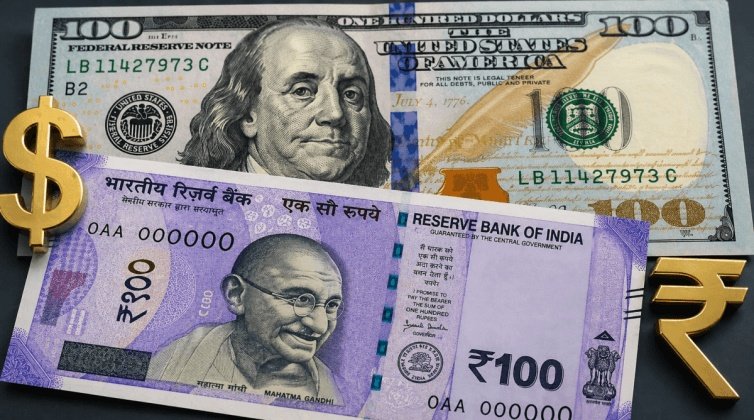

Mumbai/New Delhi: The Indian rupee weakened sharply on Tuesday, falling to ₹95.92 against the US dollar, as rising global crude oil prices increased pressure on India’s currency and raised fresh concerns about inflation and the country’s import bill. The rupee fell around 0.4% during the session, reaching its weakest level in more than a month.
The latest decline comes at a challenging time for India’s economy. International oil prices have climbed rapidly amid renewed geopolitical tensions in the Middle East, increasing the cost of energy for countries that depend heavily on imported crude.
India imports most of the crude oil it consumes, which means a sharp rise in global oil prices can quickly affect the country’s trade balance, currency and inflation outlook.
Oil Prices Put Pressure on the Rupee
The main driver behind Tuesday’s currency weakness was the increase in crude oil prices.
Brent crude rose to around $107.70 a barrel, according to Reuters, after attacks on Saudi Arabian energy infrastructure increased concerns about disruptions to global energy supplies. Oil prices have risen by nearly 20% during September, creating significant pressure on oil-importing economies.
When crude oil becomes more expensive, India needs to spend more dollars to pay for its imports. This increases demand for the US currency and can put downward pressure on the rupee.
The relationship between oil and the rupee is therefore particularly important for investors, policymakers and businesses in India.
Why the ₹95.92 Level Matters
The rupee’s move to ₹95.92 per dollar represents an important moment for the currency market because it shows how quickly geopolitical developments can affect India’s financial markets.
A weaker rupee makes imports more expensive when priced in dollars. Apart from crude oil, India imports electronics, machinery, chemicals, precious metals and other products that can become costlier when the domestic currency loses value.
At the same time, Indian companies that earn revenue in dollars can benefit from a weaker rupee because their foreign-currency earnings translate into more rupees.
However, the broader impact depends on how long the currency remains under pressure and how high global oil prices move.
RBI Steps In to Limit Volatility
The Reserve Bank of India (RBI) has taken steps to reduce excessive volatility in the foreign-exchange market.
Reuters reported that the rupee’s decline was partly limited by dollar sales by the RBI through state-run banks. The central bank has also been conducting dollar-rupee swaps to manage liquidity conditions.
The RBI’s intervention does not necessarily mean that authorities are trying to maintain a fixed exchange rate. Instead, the central bank typically aims to ensure that large and sudden movements do not create unnecessary instability in financial markets.
For businesses and investors, a more stable currency environment makes it easier to plan imports, exports, investments and borrowing.
Inflation Risk Increases
One of the biggest concerns from the latest rupee and oil moves is inflation.
Higher crude prices can raise the cost of transportation, fuel production and industrial activity. These costs can eventually move through supply chains and affect prices paid by consumers.
Economists are therefore watching whether the oil shock remains temporary or becomes a longer-lasting trend.
The rise in energy prices has also pushed up India’s government bond yields. Reuters reported that the benchmark 10-year government bond yield increased by seven basis points to 7.09% as investors assessed the potential inflation impact and the possibility of higher interest rates.
Interest Rates Could Become More Important
A prolonged period of high oil prices could complicate monetary policy.
When inflation rises, central banks generally face greater pressure to keep interest rates higher for longer. For India, that could make it more difficult to support economic growth through easier monetary policy.
Investors are already watching expectations for US interest rates closely. Higher US rates can strengthen the dollar because global investors may find dollar-denominated assets more attractive.
This creates a difficult combination for the rupee: higher oil prices increase India’s demand for dollars, while stronger US yields can increase global demand for the dollar at the same time.
Impact on Indian Consumers
The rupee’s exchange rate does not automatically determine domestic petrol or diesel prices, because retail fuel prices also depend on taxes, refining costs and other factors.
However, if crude oil prices remain elevated for an extended period, the overall cost pressure on the economy can increase.
Fuel is an important input for transportation, agriculture, manufacturing and logistics. Higher energy costs can therefore indirectly affect the prices of food, consumer goods and services.
Businesses that depend heavily on imported raw materials may also face higher costs.
Exporters May Gain Some Support
A weaker rupee is not negative for every part of the economy.
Indian exporters can benefit when the rupee depreciates because overseas revenues earned in dollars and other foreign currencies translate into more rupees.
Sectors such as information technology, pharmaceuticals and some manufacturing businesses with substantial foreign-currency earnings may therefore receive some support from currency weakness.
However, companies that rely on imported inputs may see their costs increase, reducing some of those benefits.
Global Energy Market Remains Uncertain
The biggest question for the rupee is what happens next to oil prices.
The latest surge is linked to geopolitical risks and attacks affecting major energy infrastructure. If those disruptions continue, crude prices could remain elevated and put further pressure on currencies in oil-importing countries.
On the other hand, any improvement in the geopolitical situation could reduce the risk premium in oil markets and help ease pressure on the rupee.
For India, the situation highlights the importance of maintaining sufficient foreign-exchange reserves and diversifying energy sources.
Analysts Watch ₹96 Closely
The rupee’s move toward the ₹96-per-dollar area is likely to keep investors cautious.
Reuters cited MUFG forecasting the rupee at around ₹95.50 per dollar by December 2026 and ₹96.50 by June 2027, suggesting that further gradual depreciation remains possible if current pressures persist.
These projections are not guarantees, however. Currency markets can change quickly in response to oil prices, capital flows, central-bank policy and geopolitical developments.
What Happens Next?
The coming days will be important for India’s currency and financial markets. Traders will closely monitor crude oil prices, developments in the Middle East, foreign investment flows, US monetary policy expectations and RBI actions.
For now, the rupee’s fall to ₹95.92 against the US dollar is another reminder of how closely India’s currency is linked to global energy markets.
If oil prices remain above $100 for a prolonged period, the pressure could extend beyond the forex market to inflation, government finances, businesses and household budgets. But if crude prices stabilize, some of the pressure on the rupee could ease.
For Indian policymakers, the immediate priority will be to contain excessive market volatility while limiting the wider economic impact of a renewed global oil shock.
Also Read | CAT 2026 Registration Deadline Extended to September 22













Leave a comment