

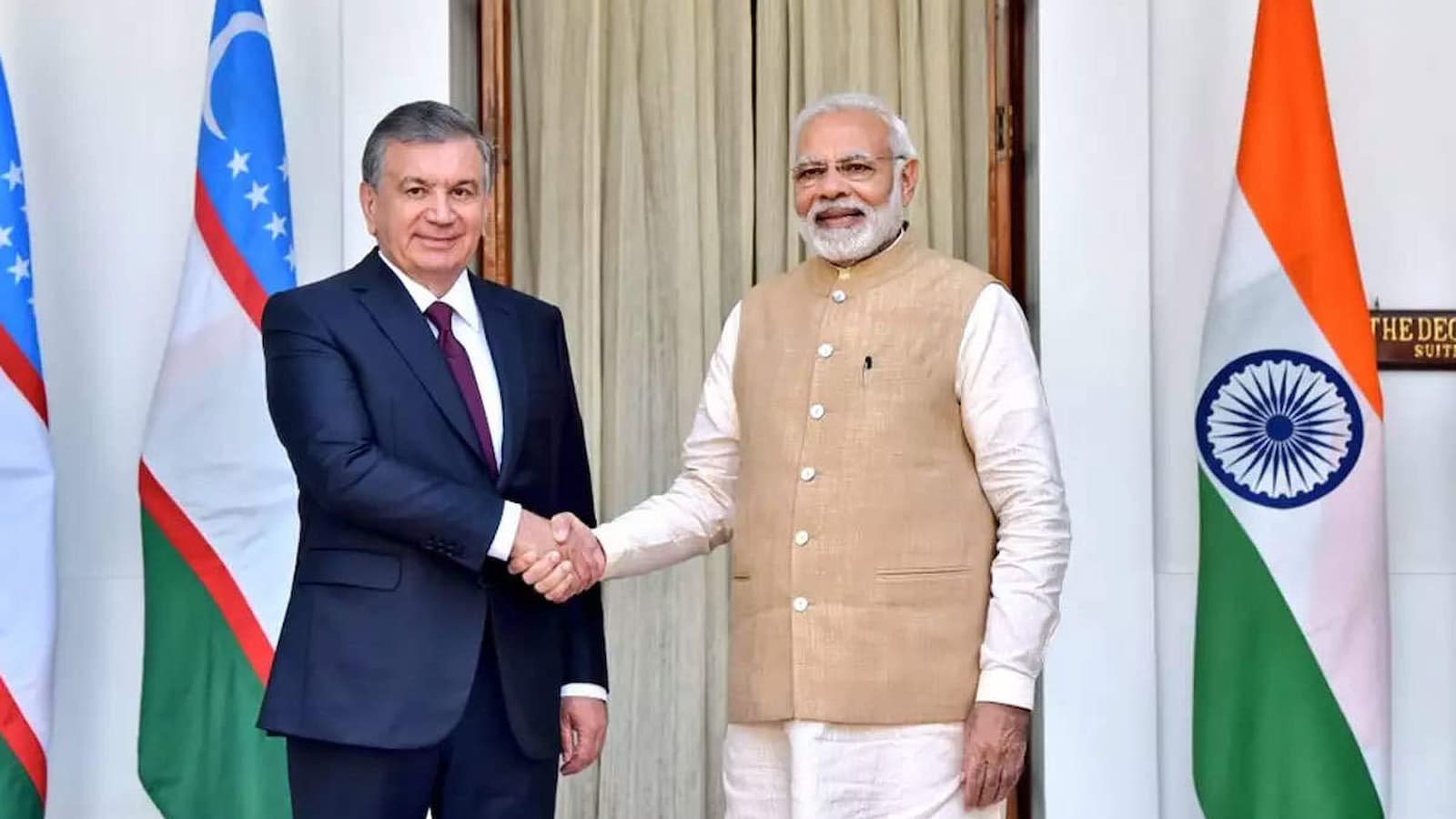

Prime Minister Narendra Modi’s Central Asia tour has placed India’s relationship with Uzbekistan in the spotlight. The visit comes at an important time as India seeks to deepen economic, strategic and diplomatic cooperation with Central Asian countries.
India and Uzbekistan share long-standing historical and cultural links. In recent years, their relationship has expanded into areas such as trade, investment, defence, energy, technology and connectivity.
The latest talks are expected to give fresh momentum to this partnership and create opportunities for closer cooperation in several important sectors.
India and Uzbekistan Strengthen Bilateral Ties
India and Uzbekistan have maintained friendly diplomatic relations for decades. Both countries have increasingly focused on expanding economic and strategic cooperation.
During Modi’s visit, discussions are focused on strengthening bilateral relations and identifying new areas for cooperation. Trade, investment, energy, education, technology and regional security are among the issues attracting attention.
The partnership is also important because Uzbekistan occupies a strategic position in Central Asia. Its location makes the country an important link between South Asia, Central Asia and wider Eurasian markets.
India sees stronger relations with Uzbekistan as part of its broader effort to increase engagement with Central Asia.
Trade and Investment Take Centre Stage
Economic cooperation is expected to remain one of the major areas of discussion.
India and Uzbekistan have been working to expand bilateral trade, but both sides see significant room for further growth. Businesses from the two countries are looking for opportunities in pharmaceuticals, agriculture, textiles, information technology, infrastructure and other sectors.
A stronger economic relationship could provide Indian companies with greater access to Central Asian markets. At the same time, Uzbekistan could benefit from Indian investment, technology and expertise.
The two countries are also exploring ways to make trade easier and improve business connectivity.
Energy Cooperation Gains Importance
Energy is another important area in the India-Uzbekistan relationship.
Central Asia has significant energy resources, including natural gas, uranium and other minerals. India, meanwhile, has growing energy requirements as its economy expands.
Long-term cooperation in the energy sector could therefore benefit both countries.
India has also shown interest in developing stable supply chains for critical resources. Greater cooperation with Uzbekistan could help diversify India’s sources of important raw materials.
However, geographical and transportation challenges remain important issues for any major energy partnership.
Defence and Security Cooperation
Security cooperation has also become increasingly important.
India and Uzbekistan have conducted joint military exercises and expanded cooperation between their defence establishments. Both countries face security concerns linked to terrorism, extremism, drug trafficking and instability in the wider region.
The situation in Afghanistan remains particularly relevant to Central Asian security discussions.
India has consistently supported regional cooperation against terrorism and violent extremism. Uzbekistan also has a strong interest in maintaining stability across its neighbourhood.
Greater intelligence sharing, military cooperation and counterterrorism coordination could therefore become important parts of the strategic partnership.
Connectivity Remains a Challenge
One of the biggest challenges for India’s relationship with Central Asia is geography.
India does not have a direct land route to Central Asia because Pakistan lies between the two regions. This makes alternative transportation corridors especially important.
India has been supporting connectivity initiatives involving Iran and Central Asia. The Chabahar Port in Iran is particularly important because it can provide an alternative route for Indian goods to reach Afghanistan and Central Asian markets.
Improved connectivity could reduce transportation difficulties and make trade between India and Uzbekistan more efficient.
India’s Central Asia Strategy
The PM Modi Central Asia tour also reflects India’s wider “Connect Central Asia” approach.
Central Asian countries have become increasingly important for India’s foreign policy because of their strategic location, natural resources and growing economies.
India has been working to increase diplomatic engagement with Kazakhstan, Kyrgyzstan, Tajikistan, Turkmenistan and Uzbekistan.
Regular high-level meetings can help India build stronger political relationships while creating opportunities for economic cooperation.
Uzbekistan is particularly important because it is one of the region’s most populous countries and has significant economic and strategic potential.
Cultural and Educational Links
The relationship between India and Uzbekistan is not limited to politics and business.
Indian cinema, music, yoga and culture have a strong presence in Uzbekistan. Educational exchanges have also helped strengthen people-to-people connections.
Indian universities and educational institutions can provide additional opportunities for Uzbek students, particularly in medicine, engineering, information technology and business.
Cultural diplomacy can help build long-term public support for closer bilateral relations.
Why the Partnership Matters
A stronger India-Uzbekistan relationship could benefit both countries in several ways.
For India, Uzbekistan can provide greater access to Central Asian markets and resources. For Uzbekistan, stronger cooperation with India can bring investment, technology, healthcare expertise and new business opportunities.
The partnership could also contribute to greater stability and economic integration across Central Asia.
At a time when major powers are competing for influence in the region, India is seeking to strengthen its independent partnerships without becoming dependent on any single country.
Challenges Ahead
Despite the positive outlook, several challenges remain.
Transportation costs, limited direct connectivity, differences in regulations and relatively modest trade volumes can make business expansion difficult.
Regional geopolitical tensions can also affect connectivity and investment plans.
India and Uzbekistan will therefore need to maintain regular diplomatic engagement and work on practical solutions if they want to turn political commitments into measurable economic results.
What to Expect Next
The latest visit could provide momentum for new agreements and cooperation initiatives.
Businesses will be watching for developments involving trade, investment, energy and technology. Strategic analysts will also be looking at how India and Uzbekistan cooperate on regional security and connectivity.
If the two countries successfully implement new initiatives, bilateral relations could enter a more commercially active phase.
Conclusion
Prime Minister Narendra Modi’s Central Asia tour highlights India’s growing engagement with Uzbekistan and the wider Central Asian region.
Trade, investment, energy, defence, connectivity and education are creating new opportunities for cooperation. At the same time, geographical and geopolitical challenges will need to be addressed.
For India, a stronger partnership with Uzbekistan can support its broader Central Asia strategy. For Uzbekistan, closer ties with India can provide access to a major economy, technology, investment and new markets.
The latest diplomatic engagement therefore represents more than a high-level visit. It could become another important step in building a stronger and more strategically connected India-Uzbekistan partnership.
Read Also | India-China Boundary Negotiations Begin in Beijing











Leave a comment