

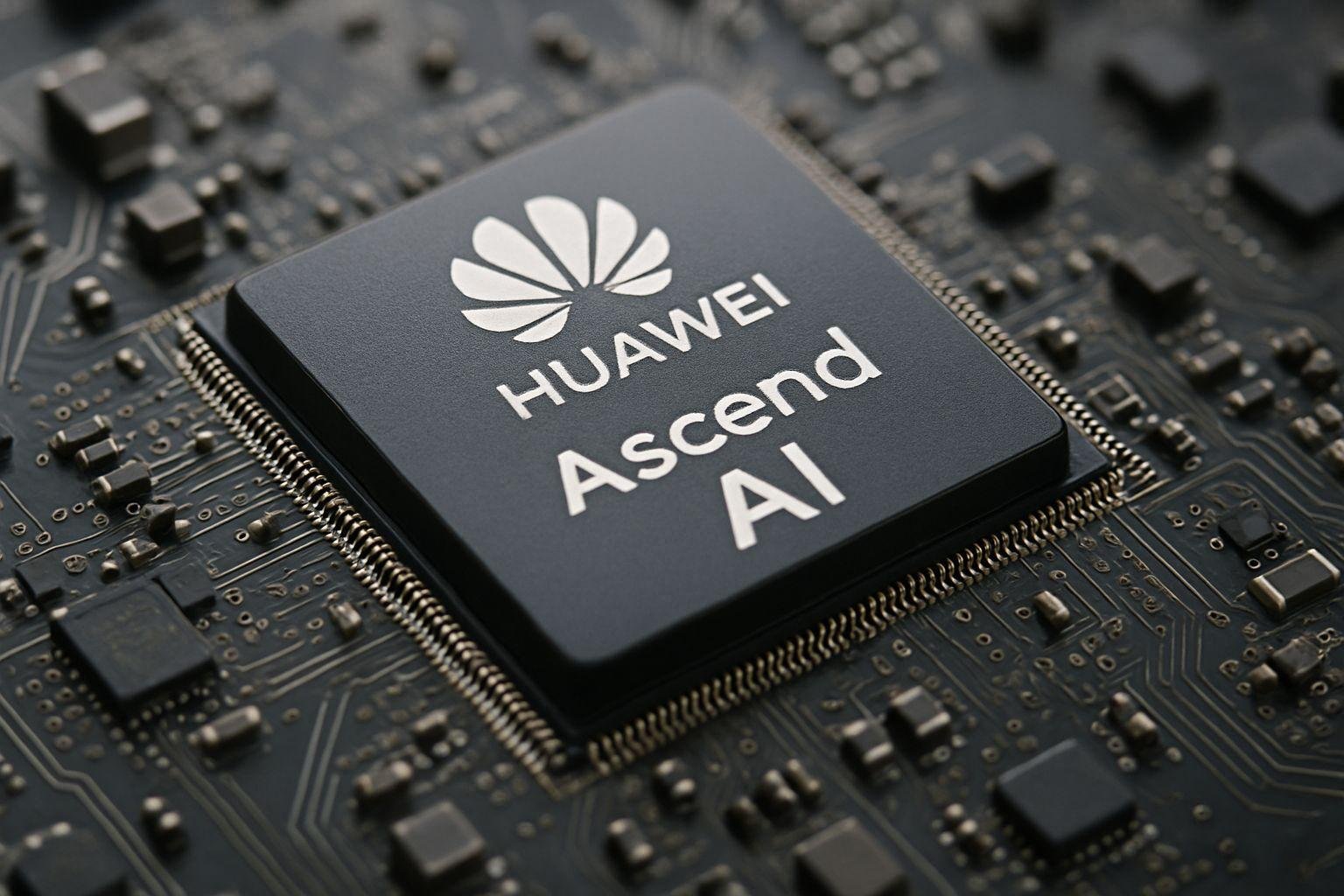

Shanghai: Huawei is accelerating its artificial intelligence chip programme as China continues efforts to build a stronger domestic alternative to Nvidia. At its Huawei Connect 2026 event in Shanghai, the company announced plans to launch two new Ascend AI processors in 2027 and said demand for its existing AI computing products in China is already higher than its current supply capacity.
Huawei plans to release the Ascend 960DT training chip in the first quarter of 2027 and the Ascend 960PR inference chip in the third quarter. The company has moved the 960DT launch forward by nine months, showing how quickly Huawei is trying to expand its AI hardware ecosystem.
The announcements are important for Nvidia because they come at a time when U.S. restrictions have limited China’s access to some of Nvidia’s most advanced AI processors.
Huawei Speeds Up Its AI Chip Roadmap
Huawei’s latest announcement represents a faster development cycle for its Ascend family.
The company says the Ascend 960DT will focus on AI model training and offer roughly twice the performance of its current generation. The 960PR, expected later in 2027, is designed for inference, the stage where trained AI models generate responses and perform tasks. Huawei plans to continue an annual upgrade cycle, with the Ascend 970 and Ascend 980 planned for 2028 and 2029 respectively.
This faster release schedule could help Huawei respond more quickly to demand from Chinese AI developers and data-centre operators.
Huawei’s existing Ascend 950 family is already being deployed in China, although the company says demand is greater than its ability to supply the market. Reuters reported that Huawei has deployed more than 1,000 AI systems using earlier-generation chips.
Huawei Is Building More Than Individual Chips
One of the most important parts of Huawei’s strategy is that it is not relying only on faster individual processors.
The company is developing large computing systems that connect large numbers of AI chips so they can operate as a single system. Huawei has introduced technologies such as UnifiedBus and optical connectivity to help processors communicate more efficiently.
At Huawei Connect 2026, the company said its technology could allow a SuperPoD to connect as many as 4,000 processors. Reuters also reported that Huawei is developing a new architecture called Peerium, designed to link as many as 1 million processors for large-scale AI training.
This approach matters because advanced AI models require enormous amounts of computing power. A company can compensate for limitations in individual chips by connecting many processors and improving the speed at which they communicate.
Why Nvidia Remains Important
Huawei’s progress does not mean Nvidia’s position has suddenly disappeared.
Nvidia has built a major advantage around not only its GPUs but also its software ecosystem. Its CUDA platform is widely used by AI developers, researchers and cloud companies, and Reuters reported that Nvidia continues to hold an important software advantage over Huawei.
This is one of the biggest challenges Huawei faces.
Building a competitive processor is only part of the AI hardware business. Developers also need software tools, libraries, frameworks and compatible infrastructure. Nvidia’s long-established ecosystem makes it easier for many developers to build and deploy AI workloads without redesigning their software stack.
Huawei is therefore trying to create a broader ecosystem around its Ascend chips rather than competing only on raw processor performance.
U.S. Restrictions Are Changing the Market
The competition between Huawei and Nvidia is also closely connected to U.S. technology-export controls.
American restrictions have limited China’s access to certain advanced chips and semiconductor technologies. Reuters reported that Huawei’s inability to fully satisfy domestic demand is itself partly connected to restrictions affecting access to advanced chip technology and components.
These restrictions have created a strong incentive for Chinese technology companies to develop local alternatives.
For Huawei, this has turned the Ascend programme into more than a commercial project. It is also part of China’s larger push to reduce dependence on foreign semiconductor technology.
Supply Is Another Major Challenge
Huawei’s growing demand is encouraging, but producing advanced AI chips at scale remains difficult.
A shortage of high-bandwidth memory (HBM) has already affected Chinese AI chipmakers. Reuters reported earlier this month that Huawei raised the price of its upcoming Ascend 950DT accelerator card by about 20% to 50%, with prices exceeding 250,000 yuan, partly because of tight HBM supplies and higher procurement costs.
HBM is particularly important for AI processors because modern AI workloads require extremely fast movement of large amounts of data.
For Huawei, securing memory and other advanced semiconductor components will therefore be just as important as designing the next-generation processor.
Could Huawei Become a Bigger Nvidia Alternative?
Huawei’s 2027 plans could strengthen its position in China’s AI market, particularly if domestic companies continue to face limited access to advanced Nvidia hardware.
The company is already working with Chinese developers and expanding its computing systems. Reuters reported that Huawei expects growing adoption of its Ascend products among Chinese AI developers.
However, the impact on Nvidia will depend on several factors, including chip performance, supply capacity, software compatibility, energy efficiency, pricing and the ability of Huawei’s systems to handle large AI workloads reliably.
The competitive picture is therefore more complicated than a simple comparison between two processors.
The Global AI Chip Race Is Expanding
Huawei’s announcements also show how the AI chip competition is becoming increasingly global.
Nvidia remains a major supplier of advanced AI computing technology, while companies in China are investing heavily in domestic alternatives. Other technology companies are also developing specialised processors and new ways to connect computing systems.
Nvidia itself is expanding beyond traditional GPU sales. Its NVLink Fusion technology is being used by other chip companies to connect their processors with Nvidia’s data-centre infrastructure, illustrating how system-level connectivity is becoming an increasingly important part of the AI hardware market.
What Huawei’s 2027 Plans Mean for Nvidia
Huawei’s accelerated Ascend roadmap does not immediately replace Nvidia’s global position, but it could change the competitive landscape in China.
The biggest development is Huawei’s move toward large-scale AI systems, where thousands or potentially millions of processors can work together. If the company can improve hardware supply, software compatibility and system performance, Chinese AI companies could have a stronger domestic alternative to Nvidia.
For Nvidia, the development highlights the importance of maintaining its advantage in hardware, software and networking while responding to a rapidly changing global market.
For China, Huawei’s progress offers a path toward greater technological self-reliance.
The next major test will come in 2027, when the Ascend 960DT and 960PR are scheduled to enter the market. Their actual performance, availability and adoption will provide a clearer picture of how far Huawei has progressed in the global AI chip race.
Also Read | The Rise of Agentic AI: How Autonomous AI Agents Are Changing Work in 2026














Leave a comment