

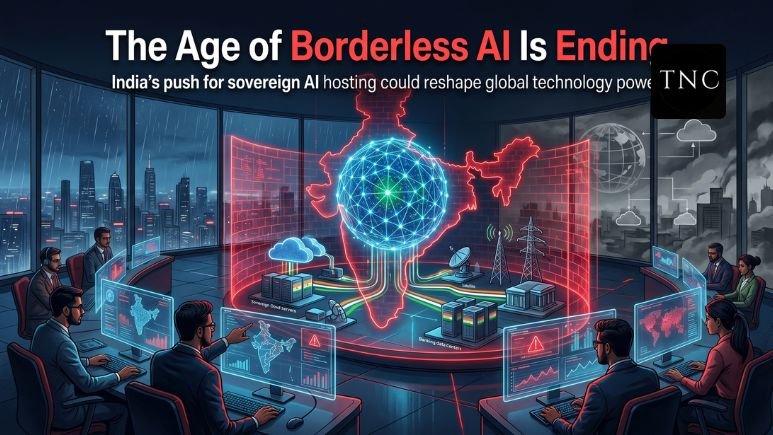

At 2:13 a.m., the screens inside a Mumbai cybersecurity command center flashed red.
An engineer at a large Indian financial institution watched as an automated system simulated a coordinated attack against the bank’s internal servers. The software probing the weaknesses was not written by a criminal syndicate in Eastern Europe or a ransomware gang operating from the dark web. According to officials familiar with the exercise, the threat model came from a new generation of artificial intelligence systems capable of identifying vulnerabilities faster than most human security teams can patch them.
Inside government circles in New Delhi, the incident sharpened an uncomfortable question already spreading through India’s banking, telecom, and infrastructure sectors: What happens when the world’s most powerful AI systems operate beyond the reach of Indian law?
That question now sits at the center of a growing geopolitical and technological battle over “sovereign AI” the idea that nations must control where advanced AI systems are hosted, how they process sensitive data, and who ultimately governs their access.
India’s latest push focuses on Anthropic and its Claude family of AI models, particularly the controversial cybersecurity-focused system known as Claude Mythos. Indian officials are reportedly pressing for these models to be hosted within India or on government-approved sovereign cloud infrastructure, citing risks tied to banking systems, telecom networks, payment rails, and power grids.
Why This Fight Matters
For years, countries treated cloud infrastructure as a commercial convenience. Data traveled globally. Servers sat wherever computing was cheapest. Silicon Valley built the tools; governments adapted later.
Artificial intelligence is changing that equation.
Advanced AI systems are no longer just chatbots generating marketing copy or answering customer support questions. Models like Claude Mythos are increasingly viewed by regulators as dual-use technologies tools that can strengthen cybersecurity defenses while also exposing weaknesses at unprecedented speed. Reuters reported that India’s central bank and financial regulators have already begun consultations with global agencies to understand the risks posed by such systems.
The concern is straightforward: if a foreign-hosted AI model analyzes Indian banking infrastructure, telecom architecture, or strategic networks, who controls the data? Which country’s laws apply? And what happens during a geopolitical crisis?
These are no longer theoretical debates.
Indian officials have reportedly warned that sensitive sectors cannot rely entirely on foreign-hosted AI infrastructure because of jurisdictional and national security concerns.
The language sounds technical. The implications are deeply political.
The New Digital Nationalism
India is not alone.
Around the world, governments are beginning to treat AI infrastructure the same way they once treated oil reserves, ports, and military communications. Strategic. Sensitive. Too important to outsource completely.
The European Union has accelerated conversations around “digital sovereignty.” China already operates behind a tightly controlled domestic AI ecosystem. The United States has pushed restrictions on advanced semiconductor exports while tightening oversight of frontier AI systems.
India’s approach is emerging somewhere in the middle: open to foreign AI companies, but increasingly unwilling to allow unrestricted dependence on them.
The Claude Mythos debate reveals how quickly that shift is happening.
Anthropic reportedly held discussions with Indian officials from the Finance Ministry, MeitY, and CERT-In regarding cybersecurity risks and access controls surrounding the model. Meanwhile, India’s banking sector has begun increasing cybersecurity spending in anticipation of more sophisticated AI-driven threats.
Punjab National Bank alone has raised cybersecurity allocations by more than 50 percent this year, according to Reuters.
That spending surge reflects a broader fear inside institutions worldwide: AI systems are beginning to compress the timeline between discovering vulnerabilities and exploiting them.
The AI Arms Race Has Entered Infrastructure
Much of the public conversation around AI still revolves around productivity tools, AI assistants, and creative applications. But inside governments, the conversation sounds very different.
Officials worry about AI systems that can:
- map vulnerabilities in telecom networks,
- detect weaknesses in payment systems,
- automate cyber intrusion strategies,
- or accelerate attacks on critical infrastructure.
Reports surrounding Claude Mythos suggest the model demonstrated unusually advanced cybersecurity capabilities during restricted testing. That has triggered intense scrutiny among regulators globally, including India’s Reserve Bank and financial ministries.
The irony is hard to miss. The same AI tools that may help defend infrastructure could also become the most effective tools ever built to attack it.
That duality is driving governments toward sovereign hosting demands.
Hosting AI locally gives regulators tighter oversight, faster legal jurisdiction, and greater leverage during emergencies. It also reduces dependence on foreign cloud providers during diplomatic disputes or sanctions battles.
For India, which is aggressively positioning itself as a global AI power under the IndiaAI Mission, sovereign hosting is becoming part of a larger national strategy.
Silicon Valley Meets the Nation-State
For AI companies, however, sovereign hosting creates a difficult dilemma.
Training and deploying frontier AI models requires enormous computing infrastructure, centralized updates, and strict security controls. Fragmenting these systems country-by-country increases costs and operational complexity. It also risks exposing proprietary technology to local regulations and political pressure.
Yet governments are making clear that unrestricted access to strategic AI systems may no longer be acceptable.
The conflict increasingly resembles earlier fights over semiconductor supply chains, telecom equipment, and internet governance. The difference is speed. AI capabilities are evolving far faster than governments can legislate around them.
India’s stance signals something larger than one negotiation with Anthropic. It reflects the arrival of a new era where countries no longer see advanced AI merely as software.
They see it as infrastructure.
The battle over where AI lives may become as important as the battle over what AI can do.
India’s push for sovereign hosting shows that governments are beginning to treat advanced AI systems not as consumer technology, but as strategic national assets tied directly to cybersecurity, financial stability, and geopolitical power.
The age of borderless AI is colliding with the realities of national sovereignty and neither side looks ready to back down.
Also Read / Anthropic CEO Rejects Pentagon Demands, Says AI Company Cannot “In Good Conscience” Comply.














Leave a comment