


AI and Technology Investment in India Continues to Grow
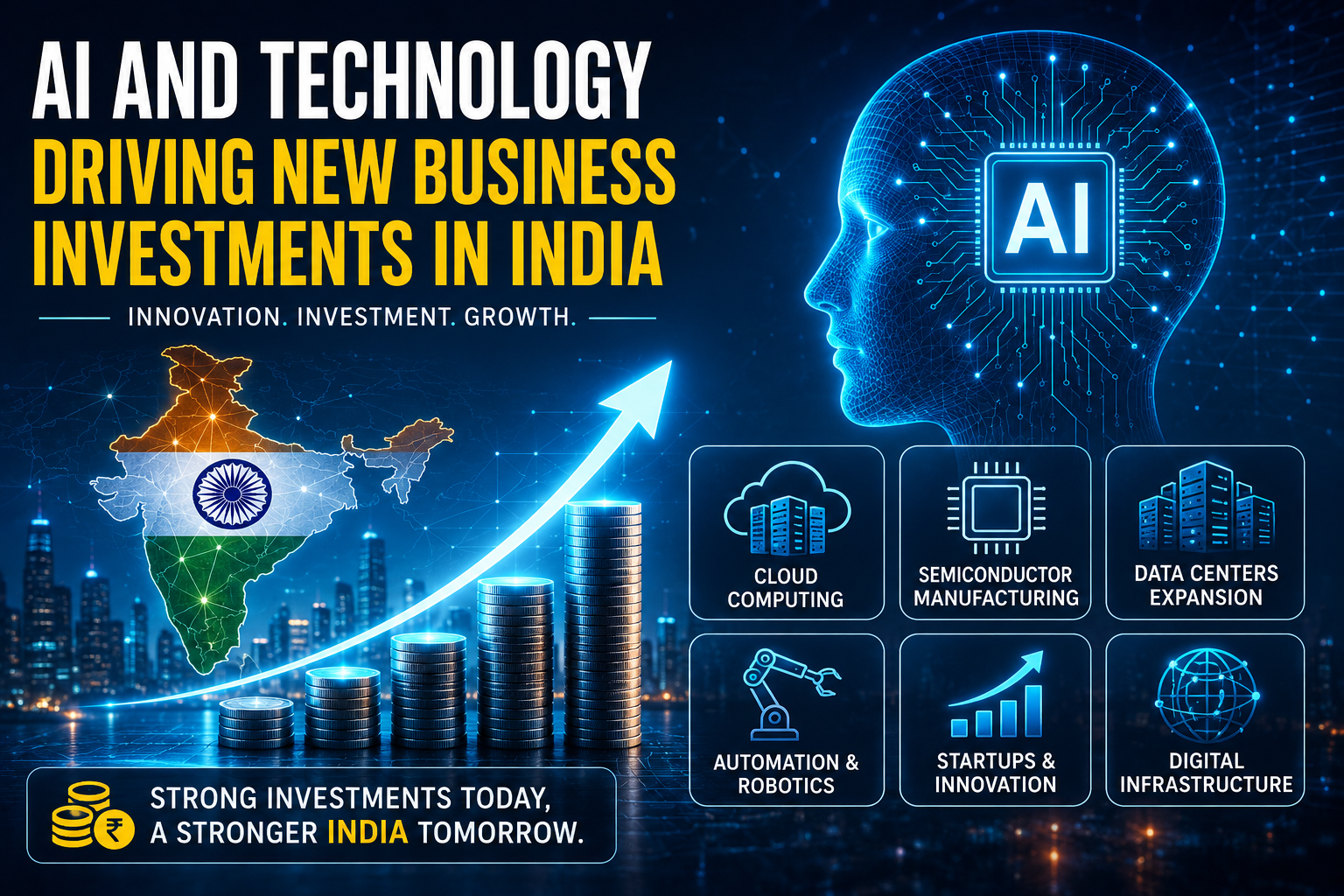
Artificial intelligence and technology are becoming major drivers of new business investment in India. Companies across sectors are increasing spending on AI, cloud computing, data centres, semiconductors and digital infrastructure as businesses look for new ways to improve productivity and compete in global markets.
The trend is also supported by stronger private-sector capital spending. India’s economy grew 7.8% in the April-June 2026 quarter, while private-sector capital investment increased 11.9% from a year earlier. Gross fixed capital formation also rose to 34.3%, showing that businesses are investing more heavily in new productive capacity.
Technology is playing an important role in this investment cycle. Large companies, startups and global technology firms are expanding their presence in areas that depend on advanced computing and digital infrastructure.
AI Is Moving From Experiments to Business Operations
Indian companies are increasingly moving beyond AI trials and using the technology in real business operations. AI tools are being adopted for customer support, software development, data analysis, automation, cybersecurity and decision-making.
The shift is important because businesses are looking for measurable returns from their technology spending. Rather than investing only in experimental projects, companies are focusing on AI applications that can reduce costs, improve services and create new products.
India’s strong technology workforce is another advantage. The country has a large pool of software engineers, data specialists and AI developers. The Economic Survey has highlighted India’s technical talent and argued for an application-focused approach to AI development rather than relying only on expensive frontier models.
Data Centres Receive Major Investment
The rapid growth of AI is creating strong demand for data-centre capacity. AI applications require large amounts of computing power, storage and electricity, which is encouraging companies to invest in physical infrastructure.
Amazon announced an additional $13 billion investment in India to expand its AI and cloud infrastructure through 2030. The planned investment is expected to increase Amazon Web Services’ data-centre capacity in Mumbai and Hyderabad. Amazon’s total investment commitments in India have reached $48 billion, according to the company.
Google and other global technology companies are also investing heavily in Indian data-centre infrastructure. This trend is helping create demand for power, networking equipment, cloud services and specialised technology workers.
Indian AI Infrastructure Is Attracting Capital
Investment is not limited to global technology giants. Indian AI infrastructure companies are also attracting significant funding.
Yotta Data Services is preparing for a possible initial public offering between January and March 2027. The company plans to raise as much as $1.5 billion, with the money expected to be used for debt repayment, purchasing graphics processing units and expanding sovereign cloud infrastructure.
The company’s plans highlight the growing importance of AI computing infrastructure in India. Demand for GPUs and high-performance computing is rising as businesses deploy more AI applications.
India’s AI sector also attracted more capital in the first half of 2026 than during the whole of 2025, according to a CRISIL analysis. Much of that funding was directed toward AI infrastructure and major deals involving companies such as Neysa Networks and Sarvam AI.
Government Support Strengthens Technology Investment
Government programmes are also supporting the expansion of India’s technology ecosystem.
The IndiaAI Mission, approved with an outlay of ₹10,372 crore, is designed to strengthen computing capacity, AI startups, foundation models, skills and responsible AI development. More than 38,000 GPUs have been onboarded for a common compute facility, with access intended for Indian startups and academic institutions at affordable rates.
The government is also working to strengthen India’s semiconductor capabilities. New investments in chip manufacturing, assembly, testing and design are being encouraged through semiconductor programmes.
These measures are designed to reduce dependence on overseas technology infrastructure and build stronger domestic capabilities.
Semiconductors Become a New Investment Priority
Semiconductors have emerged as another major area of business investment.
India is building an ecosystem that covers chip fabrication, packaging, testing, electronics manufacturing and research. Companies such as CG Power, Kaynes Technology and Dixon Technologies are expanding their positions in the semiconductor and electronics value chain.
The growth of semiconductor investment could have a wide economic impact. More local production can create jobs, attract suppliers and strengthen India’s electronics manufacturing capabilities.
The sector is also closely linked to AI because advanced computing systems require increasingly powerful chips.
Startups Are Benefiting From the AI Boom
Indian startups are another important part of the investment story. Venture funding is increasingly flowing into companies developing AI software, infrastructure and industry-specific applications.
The current investment environment is encouraging startups to build solutions for healthcare, financial services, education, agriculture, logistics and enterprise technology. India’s large domestic market gives these companies an opportunity to test products at scale.
However, investors are becoming more selective. Funding is increasingly focused on companies that can demonstrate commercial demand, sustainable revenue and strong technology foundations.
Private Investment Could Support India’s Next Growth Phase
The rise in private capital spending suggests that India’s economic growth is becoming broader. Public infrastructure investment played a major role in earlier growth cycles, but private companies are now increasing spending on factories, technology and infrastructure.
Recent investment plans cover areas such as railways, AI, semiconductors, renewable energy and manufacturing. Private-sector capital investment increased by more than ₹5 trillion compared with a year earlier during the April-June quarter, according to Reuters.
This trend could support employment, productivity and long-term economic growth.
Challenges Remain for Technology Investors
Despite the strong momentum, technology investment also faces challenges.
AI infrastructure requires significant amounts of capital, electricity and computing equipment. Companies must also deal with cybersecurity risks, data protection requirements and a shortage of specialised talent in some areas.
Global economic uncertainty and geopolitical tensions could also affect investment decisions. Higher energy costs and currency movements may increase operating expenses for technology businesses.
For startups, the biggest challenge may be turning AI innovation into sustainable commercial businesses.
India’s Technology Investment Story Enters a New Phase
The growth of AI and technology investment in India reflects a broader shift in the country’s economy. Businesses are no longer treating technology only as a support function. Increasingly, AI, cloud computing, semiconductors and digital infrastructure are being viewed as core business investments.
With government support, rising private-sector spending and strong demand from global technology companies, India is building a larger technology investment ecosystem.
The next phase will depend on execution. Companies that can convert technological innovation into useful products, stronger productivity and sustainable revenue are likely to attract the most investment.
For India, the growing flow of technology capital could become an important part of the country’s long-term growth story.
Also Read | Vivo T5 5G Launched in India With 7,050mAh Battery and 144Hz AMOLED Display














Leave a comment