

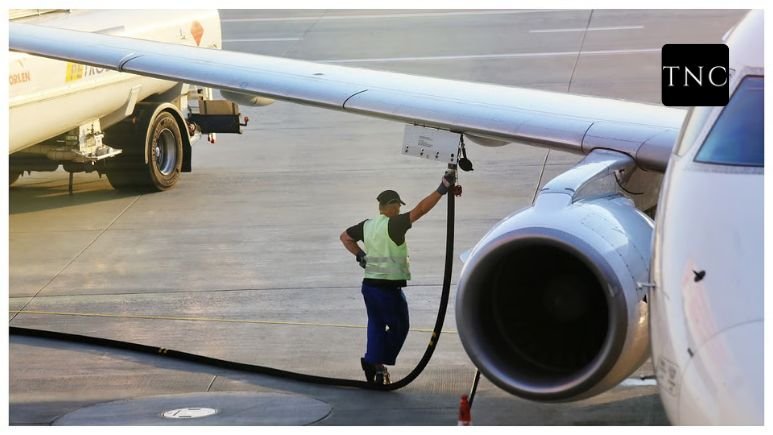

India stepped into financial year 2026-27 facing a sharp and immediate cost-of-living jolt on Wednesday, as state-owned oil companies revised aviation fuel and commercial cooking gas prices upward a vivid domestic reminder that the war raging 2,000 kilometres away in West Asia is not a distant crisis but one that reaches directly into Indian kitchens, airports, and restaurants.
A Record That Nobody Wanted
Aviation Turbine Fuel, the lifeblood of India’s airline industry, crossed the Rs 2 lakh per kilolitre threshold for the first time in the country’s history on April 1, 2026, with initial prices published by state-owned retailers showing a staggering 114.5% surge to Rs 2,07,341 per kilolitre in Delhi. The scale of that initial announcement triggered an immediate market reaction, sending aviation stocks and airline operators into a tailspin before authorities stepped in with a partial correction.
State-owned Indian Oil Corporation, which leads the monthly pricing revisions, had initially doubled the ATF price in New Delhi to Rs 2,07,341 per kilolitre. Within hours, however, the company revised it downward to Rs 1,04,927 per kilolitre a figure that, while still a significant increase, was more in line with what domestic carriers could absorb without immediate catastrophic fare increases.
The government clarified that domestic airlines would face a more manageable 8.5% increase in jet fuel prices, with the full unrevised price applying to international and charter operations. The episode illustrated both the volatility of energy pricing in the current environment and the government’s awareness of the social and economic consequences of passing the full cost through to Indian travellers.
Commercial LPG: The Heat Reaches Restaurants and Hotels
Simultaneously, the price of a 19-kilogram commercial LPG cylinder was hiked by Rs 195.50, bringing the cost in Delhi to Rs 2,078.50. Domestic 14.2-kilogram cylinders were left unchanged at Rs 913, offering households some temporary relief. The distinction matters enormously. Commercial cylinders are the primary cooking fuel for India’s vast hospitality sector, the dhabas, hotel kitchens, caterers, and street food vendors that feed hundreds of millions of people daily. A hike of nearly Rs 200 on a cylinder used dozens of times a week by a single establishment translates rapidly into higher menu prices.
This is the second consecutive monthly hike in commercial LPG, following a Rs 114.5 increase in March, indicating sustained upward pressure directly linked to global crude prices and the West Asia conflict. Opposition politicians were quick to react. Shiv Sena (UBT) MP Priyanka Chaturvedi slammed the Centre over the commercial LPG hike, questioning why lower oil prices in previous months had not been passed on to consumers, while hikes were now being transmitted in full.
India’s LPG Vulnerability: Structural and Acute
To understand why India is so exposed to this particular crisis, it helps to look at the underlying supply geography. India is the world’s second-largest buyer of LPG and burns approximately 31 million tonnes a year, with roughly 60% imported most of it via the Strait of Hormuz, the narrow waterway that is now effectively closed to normal shipping traffic.
The government has moved with some urgency to address the supply gap. India has stepped up domestic LPG production by 40% to 50,000 metric tonnes per day, though this still falls short of the 80,000 tonnes needed. Indian companies have also secured 800,000 tonnes of LPG cargo from the United States, Russia, Australia, and other countries to reduce dependence on Gulf supplies. The government has also cut industrial supply to prioritise households, a measure that limits economic damage for ordinary families in the short run but raises longer-term questions about industrial competitiveness.
The Global Backdrop Driving Every Number
According to the International Energy Agency’s March 2026 report, the war in the Middle East is creating the largest supply disruption in the history of the global oil market, with crude and oil product flows through the Strait of Hormuz falling from around 20 million barrels per day before the war to a trickle. Gulf states have cut total oil production by at least 1 million barrels per day since the conflict began.
ATF prices at major metro airports have risen sharply across the board. Delhi is priced at Rs 1,04,927 per kilolitre, Kolkata at Rs 1,09,450, Mumbai at Rs 98,247, and Chennai at Rs 1,09,873 all reflecting the same underlying global crude price surge driven by geopolitical uncertainty in West Asia and widening refining crack spreads.
More to Come: OMC Sources Signal Further Hikes
The April 1 revision is unlikely to be the last. Sources at oil marketing companies told BusinessToday that phased price hikes in ATF and premium petrol and diesel are “imminent,” adding that “the evolving West Asia crisis means phased price hikes are imminent” as the situation on the ground continues to shift.
The government has already taken some countermeasures to cushion the blow. The Centre cut excise duty on petrol to Rs 3 per litre and brought it down to zero for diesel, moves that have held retail pump prices stable for now. Civil Aviation Minister Ram Mohan Naidu has also asked state governments to consider lowering Value Added Tax on aviation fuel, noting that VAT on ATF ranges between 18% and 29% in major aviation hubs like Delhi and Maharashtra a state-level lever that could meaningfully ease pressure on airlines without requiring further central intervention.
A New Financial Year, an Old Problem
What stands out about April 2026 is not just the individual price increases, but their combined impact. The cost pressures now affecting jet fuel, commercial LPG, premium petrol, and a wide range of manufactured goods are being driven by global and structural factors, making them difficult to avoid in the short term.
For most Indians, the immediate consequence will be felt not at the fuel pump but in the rising cost of a meal, a flight ticket, or a delivery order. As the West Asia conflict enters its second month with no ceasefire in view, the Indian economy faces a test of resilience that will be measured, in part, in the very ordinary arithmetic of what things cost and how many more hikes are yet to come.
Also Read / India Signs First Major LPG Deal With United States Suppliers.











Leave a comment