

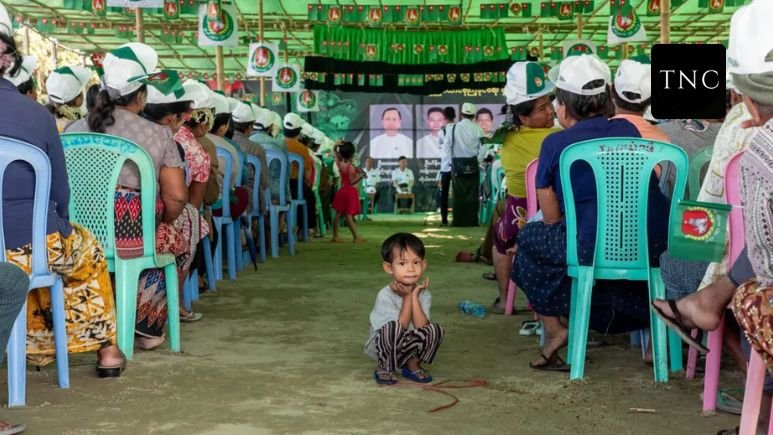

The rain began before dawn, drumming against the tin roofs of a village outside Mandalay. By sunrise, the roads had turned to sludge. A schoolteacher named Ko Min folded a few clothes into a plastic bag, grabbed his daughter’s hand, and stepped onto a truck already packed with families fleeing artillery fire. Nobody on the truck spoke much. The adults stared ahead. The children slept sitting upright. Somewhere in the distance, fighter jets circled above the mountains.
Five years after Myanmar’s military seized power in a coup that shattered a fragile democratic experiment, scenes like this have become routine. The country is no longer simply enduring political turmoil. It is living through the collapse of a state.
Yet inside the capital, Naypyidaw, the generals are trying to project a different image. Parliament has reconvened. Elections widely condemned as manipulated have been staged. Junta chief Min Aung Hlaing has now moved into the presidency under what the military describes as a transition toward civilian governance. On paper, Myanmar appears to be inching toward political normalcy. On the ground, the country remains fractured by civil war, economic ruin, and deep public distrust.
That contradiction defines Myanmar today: a government attempting to manufacture legitimacy while losing control of large parts of the nation it claims to govern.
The military’s strategy is not new. Myanmar’s generals have long used controlled political openings as pressure valves. A similar experiment began in 2010, when the junta loosened its grip just enough to attract investment, reduce sanctions, and ease international isolation. That transition eventually produced something the military did not fully anticipate a stronger democratic movement led by Aung San Suu Kyi and the National League for Democracy.
This time, the generals are trying to avoid repeating that mistake.
The current “transition” is tightly engineered. Opposition leaders remain jailed or exiled. Entire regions consumed by conflict were excluded from voting. Independent media has been crushed. The military-backed Union Solidarity and Development Party swept elections that critics across the international community dismissed as neither free nor fair.
But the deeper problem for the junta is not international criticism. It is the battlefield.
Since the 2021 coup, resistance movements have transformed from scattered protests into a nationwide armed rebellion. Ethnic militias, pro-democracy fighters, and local defense groups now control significant territory across the country. In some areas, the military governs only by airstrikes. Entire townships have slipped beyond state authority. Even where the junta has regained ground, it has done so through forced conscription, emergency laws, and escalating violence.
The result is a country trapped in permanent instability.
Myanmar’s economy tells the same story. Inflation has battered household budgets. Electricity shortages have crippled businesses. Foreign investment has evaporated. The kyat has suffered repeated shocks. While recent World Bank assessments point to modest signs of stabilization in some sectors, the broader outlook remains bleak because conflict continues to choke transport, trade, and reconstruction.
For ordinary people, survival has replaced ambition.
Farmers abandon fields because roads are unsafe. Young professionals leave for Thailand, Singapore, or Malaysia. Students study online when internet blackouts permit it. Aid agencies warn of worsening hunger in conflict zones, while entire communities live with the constant possibility of displacement.
Even the military’s apparent political restructuring reveals weakness more than confidence. Analysts increasingly argue that the junta’s new civilian façade is not evidence of stability but a tactic to buy time to reduce diplomatic pressure, reopen regional engagement, and fracture opposition forces.
ASEAN, long criticized for its ineffective response, now faces renewed pressure to engage with Myanmar’s nominal civilian government despite continuing violence. Regional powers are balancing competing fears: state collapse, refugee flows, Chinese influence, and the risk of a conflict that spills across borders.
China, meanwhile, remains focused on protecting strategic infrastructure and trade routes. India watches anxiously from its northeastern frontier, wary of instability spreading across porous borders. Neither side appears convinced that Myanmar is moving toward genuine reconciliation.
And that may be the most important reality of all.
Myanmar is not undergoing a democratic transition. It is undergoing a struggle over what kind of state will survive the war.
The military still commands aircraft, heavy weapons, and institutional power. But resistance groups hold territory, public sympathy, and momentum in many regions. Neither side appears capable of outright victory. That leaves Myanmar suspended between conflict and collapse governed by overlapping authorities, competing armies, and exhausted civilians caught in between.
The Bottom Line: Myanmar’s generals may have changed uniforms for suits and reopened parliament halls, but the country beneath them remains deeply broken. Elections cannot stabilize a nation where bullets still decide power, the economy continues to unravel, and millions no longer believe the state represents them. Until those realities change, Myanmar’s “transition” will look less like a path to peace and more like war wearing civilian clothes.









Leave a comment