

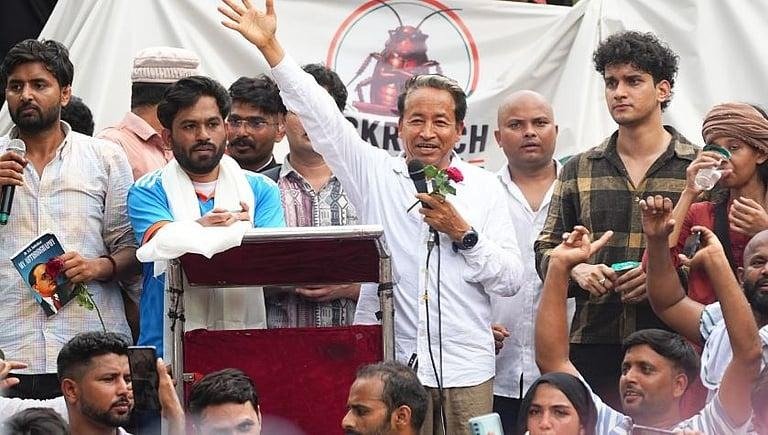

New Delhi: Environmentalist and education reform activist Sonam Wangchuk has ended his 26-day hunger strike, bringing an important chapter of the nationwide student-led protest movement to a close. Wangchuk announced his decision after receiving written assurances from the Central Government and after extensive discussions with Union ministers and Members of Parliament.
The 59-year-old activist had begun his indefinite fast on June 28, expressing solidarity with students protesting against alleged irregularities in competitive examinations, including the NEET paper leak controversy. His hunger strike became a major symbol of demands for greater accountability, transparency, and reforms in India’s examination system.
Hunger Strike Ended After Government Assurances
Wangchuk broke his fast late Thursday night at Medanta Hospital in Gurugram in the presence of Union Health Minister JP Nadda, Union Minister Jitendra Singh, his wife Gitanjali Angmo, and leaders of the Apex Body of Leh-Ladakh.
In a message shared after ending the fast, Wangchuk described the moment as the “end of hunger and the beginning of accountability.” He explained that the decision followed prolonged negotiations and written commitments from the government to address key concerns raised by protesting students.
According to Wangchuk, more than 65 Members of Parliament from different political parties had either visited him personally or appealed to him to end the hunger strike after promising to raise the issue in Parliament.
What Did the Government Promise?
The Centre assured Wangchuk that several important issues would receive attention in Parliament.
Among the major assurances were:
- No legal action against peaceful protesters.
- Discussion on accountability in India’s examination system.
- Greater focus on preventing examination paper leaks.
- Continued dialogue on education reforms.
- Consideration of compensation for families affected by the examination controversy.
These commitments convinced Wangchuk that meaningful discussions could now continue through democratic and parliamentary processes instead of an indefinite fast.
Student Movement Continues
Although Wangchuk has ended his fast, organisers of the youth-led protest movement made it clear that their campaign is far from over.
Leaders associated with the movement said demonstrations will continue until broader demands are addressed, including stronger action against those responsible for examination irregularities and greater accountability within the education system. Some protesters are also continuing to demand the resignation of Union Education Minister Dharmendra Pradhan.
Organisers stressed that Wangchuk’s decision should not be viewed as the end of the protest but as a new phase focused on dialogue and parliamentary action.
Prime Minister Responds
Prime Minister Narendra Modi welcomed Wangchuk’s decision to end the hunger strike and wished him a speedy recovery.
The Prime Minister urged the activist to follow doctors’ advice, regain his strength, and return to normal life after nearly four weeks without regular food.
Earlier, the Prime Minister had also announced that the government would strengthen laws against examination paper leaks and speed up legal proceedings in such cases, signalling the government’s intention to restore confidence in India’s examination system.
Health Remains a Priority
Doctors had closely monitored Wangchuk’s health throughout the fast, particularly after he was shifted to Medanta Hospital in Gurugram.
Medical experts advised that ending the hunger strike carefully was essential to avoid complications after 26 days of fasting. His recovery will now include gradual nutritional support and continued medical observation.
Supporters expressed relief after seeing Wangchuk safely end the fast and thanked medical staff for their care during the difficult period.
Why the Protest Drew National Attention
The protest initially focused on alleged irregularities in competitive entrance examinations but soon developed into a wider discussion about education reforms, youth employment, governance, and public accountability.
Thousands of students, parents, teachers, and civil society groups joined demonstrations across several cities, making it one of the country’s most closely watched public movements in recent years.
Many participants argued that examination integrity is essential for maintaining public trust in India’s education system.
What Happens Next?
With the hunger strike now over, attention will shift toward Parliament and the government’s next steps.
Student organisations say they will closely monitor whether the promised discussions lead to concrete policy changes and legal reforms. Protest leaders have also said they will continue peaceful demonstrations if they believe progress is too slow.
For Sonam Wangchuk, ending the fast marks not the end of his campaign but the beginning of a new effort to ensure that commitments made during negotiations are translated into action.
The coming weeks are expected to be crucial as lawmakers debate examination reforms and measures aimed at strengthening transparency, accountability, and fairness in India’s education system.










Leave a comment