

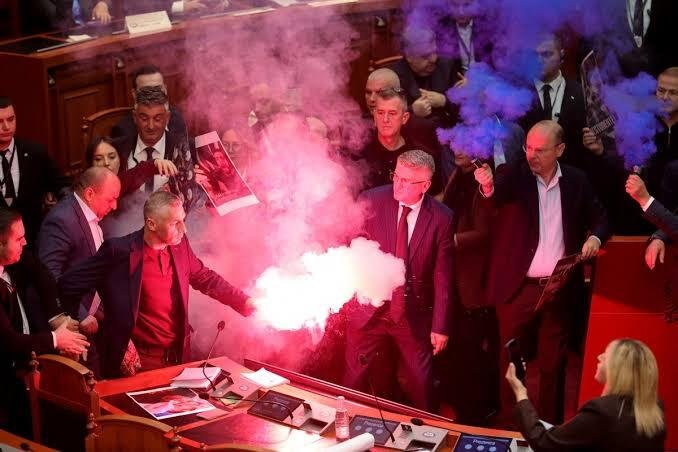

Albania’s parliament witnessed dramatic scenes on Thursday, October 29, after opposition lawmakers set off smoke bombs and flares during a heated parliamentary session.
The incident occurred in the capital, Tirana, as tensions continued to rise over student-led anti-government demonstrations.
Opposition leader Sali Berisha accused ruling party lawmakers of being criminals and strongly criticised the government’s response to protesters.
Members of his Democratic Party blocked the parliamentary podium, displayed photographs of injured demonstrators and disrupted proceedings.
The Albania parliament smoke bomb protest has drawn international attention and raised fresh questions about the country’s growing political unrest.
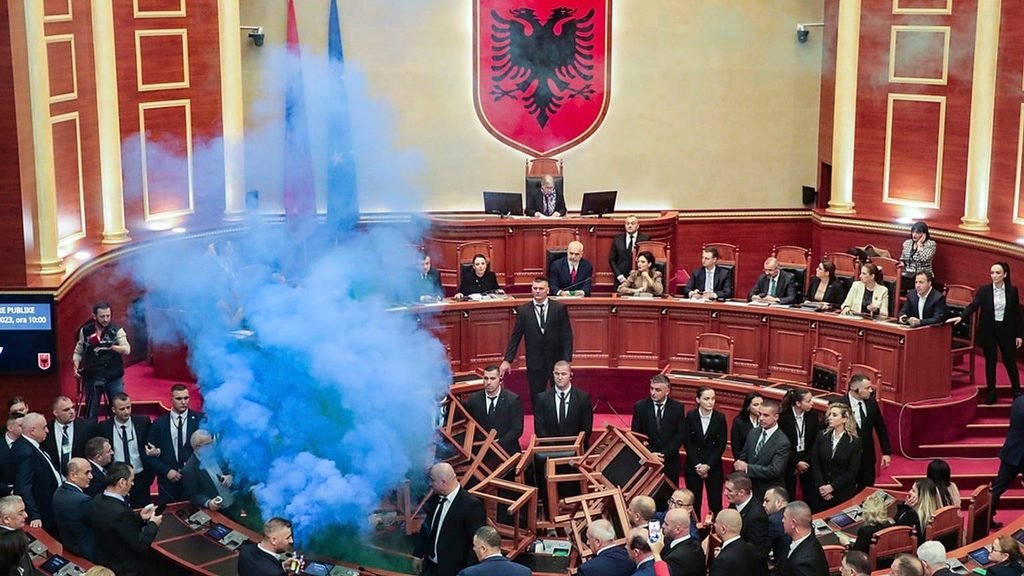
The disruption took place during a parliamentary session involving legislation concerning Albania’s central bank.
Opposition MPs attempted to stop proceedings by surrounding the podium and preventing lawmakers from continuing the session normally.
Several politicians lit blue flares, filling parts of the chamber with coloured smoke.
Others displayed photographs of protesters allegedly injured during confrontations with police.
Some opposition members shouted slogans demanding Prime Minister Edi Rama’s resignation.
Despite the disruption, ruling Socialist Party lawmakers continued with the parliamentary agenda.
The dramatic confrontation followed similar disturbances inside parliament earlier in October.
Why Did Sali Berisha Call Government Officials Criminals?
Sali Berisha, leader of Albania’s main opposition Democratic Party, delivered a strongly worded speech criticising the government’s handling of street demonstrations.
He accused ruling lawmakers of being criminals and argued that young protesters had faced unacceptable treatment from security forces.
His comments referred to allegations that police had used rubber bullets and other force against demonstrators.
Parliament Speaker Niko Peleshi interrupted Berisha’s speech and later prevented him from speaking for the remainder of the session.
The speaker considered his remarks an encouragement of violence.
Berisha’s accusations reflect the opposition’s position and should not be treated as established criminal findings against government lawmakers.
Four Opposition MPs Expelled From Parliament
The confrontation resulted in disciplinary action against several lawmakers.
Parliament Speaker Niko Peleshi expelled four opposition MPs from Thursday’s sitting.
They were Xhelal Mziu, Bledi Himçi, Ivi Kaso and Bledion Nallbati.
The decision followed the use of flares, obstruction of parliamentary proceedings and continuing disorder.
The expulsions highlighted the growing confrontation between Albania’s government and opposition.
They also raised questions about how political disagreements should be handled within democratic institutions.
Why Are Students Protesting in Albania?
The parliamentary chaos is connected to wider demonstrations across Albania.
Student-led protests intensified in October, with demonstrators demanding changes to education policies and government leadership.
Major concerns include high education costs, limited employment opportunities and dissatisfaction with public services.
Protesters have also raised allegations of government corruption and economic mismanagement.
Some demonstrations have expanded beyond Tirana into other cities.
The movement has attracted wider political attention as opposition parties increasingly support calls for Prime Minister Edi Rama’s resignation.
However, protesters do not necessarily share identical political views or demands.
Have the Protests Turned Violent?
Although many demonstrations have remained peaceful, others have involved serious clashes.
Some protesters have attacked government buildings, banks and private property.
Police have responded to unrest using crowd-control measures.
According to reports, hundreds of people, including police officers, have been injured during the wider demonstrations.
Opposition politicians accuse the authorities of using excessive force against students and other protesters.
Those allegations require independent examination.
The violence has increased pressure on the government to restore public order while protecting the right to peaceful protest.
What Has Prime Minister Edi Rama Said?
Prime Minister Edi Rama has rejected demands for his resignation.
Rama has led Albania’s government since 2013 and secured a fourth term following the 2025 election.
His administration has introduced measures intended to discourage violent demonstrations.
These include proposed financial penalties for people attending protests that become violent.
The government has also announced economic support measures, including assistance for lower-income households and students.
Rama has encouraged student representatives to participate in dialogue.
However, opposition leaders argue that the government’s response does not adequately address public frustration.
What Does This Mean for Albania’s Political Future?
The parliamentary confrontation demonstrates how deeply divided Albania’s political environment has become.
The ruling Socialist Party maintains control of the government, while the Democratic Party continues to challenge its leadership.
The protests have created pressure over economic conditions, education and allegations of corruption.
Repeated disruptions inside parliament may make cooperation between political parties more difficult.
At the same time, public demonstrations are an important part of democratic participation when conducted peacefully.
The challenge for Albania’s leaders is to address legitimate concerns while preventing further violence.
Why Is the International Community Watching?
Albania is a member of NATO and a candidate for membership in the European Union.
Its political stability, democratic institutions and rule-of-law standards are therefore important beyond its borders.
The European Union closely monitors governance, judicial reform and anti-corruption efforts in countries seeking membership.
Continuing political unrest could attract additional scrutiny of Albania’s institutional stability.
However, the parliamentary incident alone does not determine the country’s future relationship with the European Union.
What Happens Next?
Further anti-government demonstrations are expected, with another protest planned for Saturday, October 31.
Authorities will likely continue monitoring gatherings and preparing security arrangements.
The opposition is expected to maintain pressure on Prime Minister Edi Rama.
Meanwhile, the government faces demands to address student concerns and allegations of excessive police force.
Whether negotiations can reduce tensions remains uncertain.
Conclusion
The Albania parliament smoke bomb protest has become another dramatic moment in the country’s ongoing political crisis.
Opposition MPs used flares, smoke bombs and parliamentary disruption to express anger over the treatment of demonstrators.
Sali Berisha’s accusations against government lawmakers further intensified the confrontation.
As Albania prepares for additional protests, attention remains focused on public safety, political accountability and the government’s response.
Also Read | Israel Election 2026: Netanyahu’s Coalition Future Uncertain as Political Deadlock Deepens



Leave a comment