

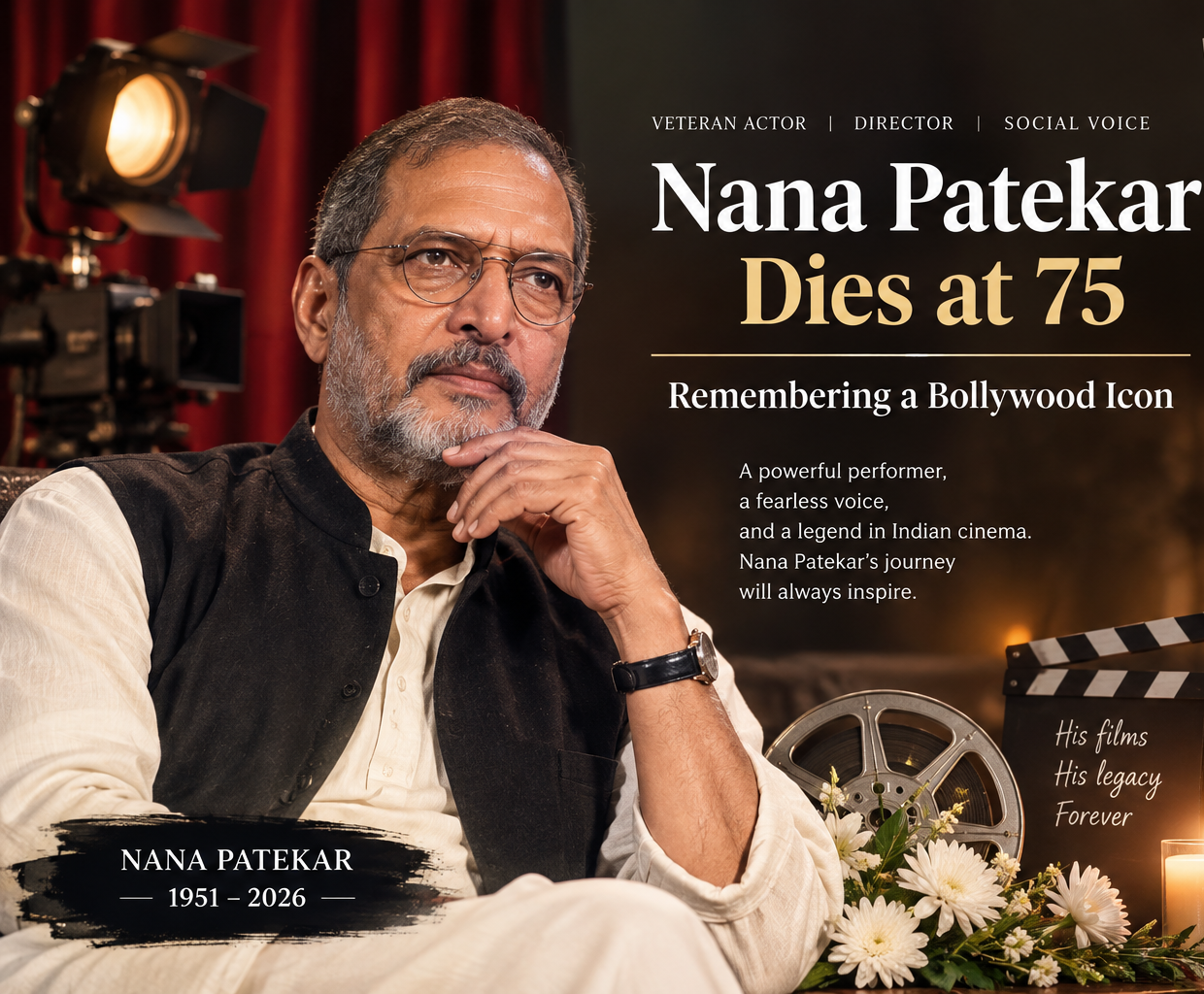

Nana Patekar Dies at 75
Veteran Indian actor Nana Patekar died at the age of 75 on October 8, 2026, after suffering a cardiac arrest at his residence in Goa. According to doctors, he was found unconscious and was taken to hospital, where efforts to revive him continued for around 45 minutes. He was later declared dead.
His death has left a deep sense of loss across the Hindi and Marathi film industries. Known for his powerful performances, distinctive voice and intense screen presence, Patekar built a career that lasted for more than four decades. He was equally comfortable in serious dramas, political stories, crime films and popular comedies.
The Maharashtra government has also announced that the actor will be given full state honours at his cremation, recognising his contribution to cinema and his social work through the Naam Foundation.
From Theatre to Indian Cinema
Born Vishwanath Patekar in Maharashtra on January 1, 1951, Nana Patekar began his creative journey in theatre before moving into films. His film career started with Gaman in 1978. Over time, he developed a reputation for playing complex and emotionally demanding characters.
Unlike many conventional stars, Patekar often allowed the character to take priority over glamour. His dialogue delivery, body language and ability to convey anger, pain and vulnerability made him a memorable performer.
His early work helped establish him as an actor of substance, and he soon became associated with some of the most respected films of Hindi cinema.
The Breakthrough With Parinda
One of the defining points in Nana Patekar’s career came with Vidhu Vinod Chopra’s Parinda.
The 1989 crime drama showcased his ability to play a dark and complicated character with great intensity. The performance won him the National Film Award for Best Supporting Actor, further establishing him as one of India’s leading performers.
Parinda became an important film in Indian cinema and remains one of the titles most closely linked to Patekar’s legacy.
His work with actors such as Jackie Shroff also contributed to the film’s memorable impact.
Krantiveer and National Recognition
Patekar’s career reached another major milestone with Krantiveer.
His performance as Pratap Narayan Tilak became one of his most celebrated roles. The character’s emotional intensity and social anger connected strongly with audiences and critics.
For the performance, Patekar won the National Film Award for Best Actor. His work in Agni Sakshi also brought him another National Film Award, showing the extraordinary range he displayed across different roles.
These performances helped establish him not simply as a popular actor but as one of the country’s most respected acting talents.
A Different Side of Nana Patekar in Welcome
While Patekar was celebrated for serious performances, he also proved that he could dominate comedy.
His portrayal of Uday Shetty in Welcome introduced him to a new generation of viewers. The 2007 comedy became a major popular success, and Patekar’s performance, alongside Anil Kapoor’s Majnu Bhai, became one of the most remembered comedy pairings in mainstream Hindi cinema.
The role showed that Patekar did not depend on a single acting style. He could move from intense dramatic roles to comic characters without losing his distinctive screen identity.
That versatility became one of the most important features of his career.
Natsamrat and Marathi Cinema
Nana Patekar also remained deeply connected to Marathi cinema and theatre.
His performance as Ganpatrao “Appa” Belwalkar in Natsamrat was widely acclaimed. The film gave him the opportunity to explore an aging theatre artist dealing with family, memory, identity and loss.
The performance demonstrated his ability to communicate powerful emotions without relying on spectacle.
For many Marathi cinema audiences, Natsamrat became another example of why Patekar was regarded as an extraordinary performer across languages and formats.
Actor, Director and Theatre Artist
Patekar’s contribution was not limited to acting.
He also worked as a director and writer, including directing Prahaar: The Final Attack, a film centred on soldiers and discipline. His long association with theatre remained another important part of his artistic identity.
His career therefore extended beyond the conventional role of a Bollywood star. He was an actor, filmmaker and theatre artist who regularly chose subjects with emotional or social weight.
Awards and Padma Shri
Over the course of his career, Nana Patekar received several major honours.
Reports note that he won three National Film Awards, four Filmfare Awards and two Filmfare Marathi Awards. In 2013, the Government of India awarded him the Padma Shri, one of the country’s major civilian honours.
The awards reflected the breadth of his work in both mainstream and serious cinema.
Yet his reputation among audiences often went beyond trophies. Viewers remembered his voice, expressions, dialogue delivery and ability to make even difficult characters feel real.
His Contribution Beyond Cinema
Patekar was also known for his social work.
He was associated with the Naam Foundation, which worked on issues affecting rural communities and farmers in Maharashtra. His social efforts added another dimension to his public life and helped explain why tributes after his death have extended beyond the film industry.
The Maharashtra government’s decision to honour him with a state funeral reflects both his artistic contribution and his wider public impact.
Tributes From the Film Industry
News of Patekar’s death prompted tributes from actors, politicians and colleagues.
Akshay Kumar described the actor’s death as the loss of an extraordinary talent, while other public figures remembered his strong personality and influence on Indian cinema.
The tributes reflect the unusual place Patekar occupied in Indian cinema. He was respected by serious filmmakers, admired by fellow actors and loved by audiences who followed both his dramatic and comic work.
A Lasting Legacy
Nana Patekar’s legacy rests on the variety and strength of his performances.
From Parinda and Krantiveer to Agni Sakshi, Welcome and Natsamrat, he repeatedly reinvented himself while maintaining a recognizable acting style.
He showed that an actor does not need conventional glamour to become a major star. Strong writing, emotional depth, character work and a distinctive personality can create a lasting connection with audiences.
His influence can also be seen in the way younger actors discuss character-driven performances and the importance of theatre training.
Conclusion
Nana Patekar’s death at 75 marks the end of a remarkable chapter in Hindi and Marathi cinema.
From his theatre roots and 1978 film debut to acclaimed performances in Parinda, Krantiveer and Natsamrat, and his unforgettable comic role in Welcome, he built a body of work that crossed genres and generations.












Leave a comment