

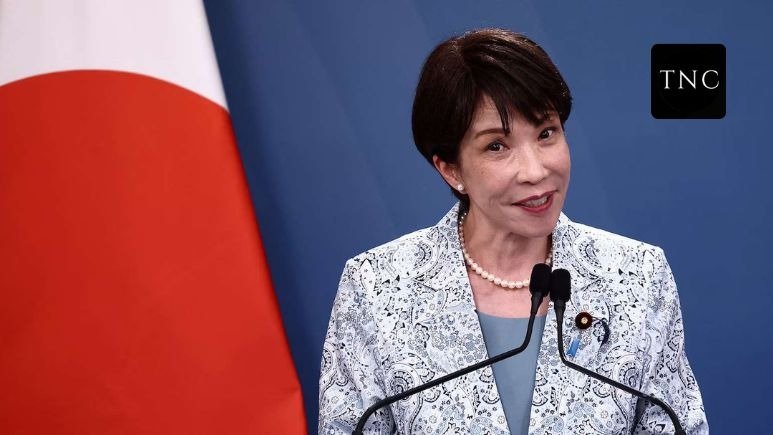

New Delhi, July 1: Japanese Prime Minister Sanae Takaichi arrived in India on Tuesday for her first official visit since taking office, marking another significant milestone in the growing strategic partnership between India and Japan. The three-day visit, scheduled from July 1 to July 3, will include the 16th India-Japan Annual Summit with Prime Minister Narendra Modi, where both leaders are expected to discuss a broad range of bilateral, regional, and global issues. The visit was officially announced by India’s Ministry of External Affairs (MEA) and Japan’s Ministry of Foreign Affairs.
The summit comes at a time when India and Japan are seeking to deepen cooperation in economic security, defence, technology, infrastructure, and supply-chain resilience amid an evolving Indo-Pacific security environment.
First Official Visit to India
Prime Minister Takaichi’s visit is her first official trip to India since assuming office and reflects the strong diplomatic ties between the two countries. The visit follows Prime Minister Narendra Modi’s trip to Tokyo in August 2025 for the 15th India-Japan Annual Summit, where both leaders reaffirmed their commitment to strengthening the India-Japan Special Strategic and Global Partnership
Officials from both governments have described the visit as an opportunity to review progress on existing agreements while exploring new areas of cooperation in emerging technologies, clean energy, defence manufacturing, and digital innovation.
Annual Summit to Focus on Strategic Cooperation
The centrepiece of the visit will be the 16th India-Japan Annual Summit, during which Prime Minister Modi and Prime Minister Takaichi are expected to hold detailed discussions on expanding bilateral cooperation.
According to the MEA, the summit will enable both leaders to review the “full spectrum” of India-Japan relations and exchange views on important regional and international developments
Key issues expected to feature prominently include:
- Trade and investment
- Defence and maritime security
- Semiconductor manufacturing
- Artificial intelligence and emerging technologies
- Supply-chain resilience
- Clean energy and green transition
- High-speed rail and infrastructure projects
- Indo-Pacific cooperation
Business Delegation to Boost Economic Ties
Prime Minister Takaichi is accompanied by a large delegation of Japanese business leaders, highlighting the economic importance of the visit. Japanese companies continue to play a major role in India’s manufacturing, automobile, infrastructure, electronics, and logistics sectors.
Officials expect discussions to focus on encouraging fresh Japanese investment in India, particularly under initiatives such as “Make in India” and partnerships in advanced manufacturing.
Japan has remained one of India’s largest foreign investors, supporting projects ranging from metro rail systems to industrial corridors and the Mumbai-Ahmedabad High-Speed Rail project.
Defence and Indo-Pacific Security
Security cooperation is expected to be another major agenda item.
India and Japan have significantly strengthened defence relations over the past decade through military exercises, defence technology collaboration, intelligence sharing, and maritime cooperation.
Both countries are key partners in promoting a free, open, and inclusive Indo-Pacific. As geopolitical competition continues to reshape the region, New Delhi and Tokyo are expected to discuss ways to enhance cooperation in maritime security, regional stability, and disaster response.
Officials believe stronger India-Japan coordination will contribute to peace, stability, and rules-based international cooperation across the Indo-Pacific.
Technology and Innovation
Emerging technologies are also likely to feature prominently during the summit.
The two countries are expected to explore partnerships in:
- Artificial intelligence
- Semiconductor manufacturing
- Quantum technologies
- Digital infrastructure
- Cybersecurity
- Innovation ecosystems
These sectors have become increasingly important as governments worldwide seek to strengthen technological competitiveness and secure resilient supply chains.
Strong People-to-People Relations
Beyond government cooperation, India and Japan continue to expand educational, cultural, and tourism exchanges.
Student mobility, language education, skill development, and workforce collaboration have grown steadily in recent years, strengthening mutual understanding between the two nations.
Officials believe these people-to-people connections provide an important foundation for long-term bilateral cooperation.
Global and Regional Issues
Apart from bilateral matters, Prime Minister Modi and Prime Minister Takaichi are expected to exchange views on regional and global developments, including the Indo-Pacific, economic security, international trade, climate action, and multilateral cooperation.
The leaders are also likely to reaffirm their commitment to working together in international forums while promoting sustainable development and regional prosperity.
Looking Ahead
The outcomes of the summit are expected to shape the next phase of India-Japan relations. Analysts anticipate announcements related to investment, infrastructure, technology partnerships, defence cooperation, and economic collaboration.
As both countries seek to navigate an increasingly complex geopolitical landscape, the visit underscores their shared commitment to strengthening strategic ties and expanding cooperation across multiple sectors.
Prime Minister Takaichi’s first official visit to India is expected to further reinforce one of Asia’s most important bilateral partnerships and open new opportunities for collaboration in the years ahead.












Leave a comment