

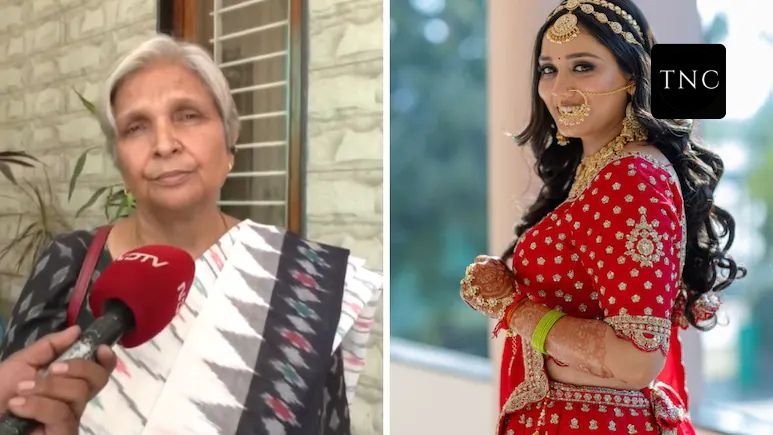

The ceiling fan in the Katara Hills apartment was still spinning when police officers arrived. A steel plate sat untouched on the dining table. Neighbours whispered in the corridor. Inside the house, 33-year-old model and actress Twisha Sharma was found hanging, barely five months after her wedding.
By evening, grief had hardened into accusation.
Twisha’s family alleged that the marriage had become a battleground over dowry demands. They accused her husband and in-laws of harassment and murder claims that quickly ignited outrage across Bhopal and on social media. But as the investigation deepened this week, the case took another contentious turn.
Twisha’s mother-in-law, retired judge Giribala Singh, stepped before reporters carrying a stack of bank transaction slips. The transfers, she said, ranged from ₹5,000 to ₹50,000 and proved the family had financially supported Twisha regularly, not exploited her.
The documents are now part of an increasingly bitter public and legal battle that has exposed the fragile line between allegation and evidence in India’s dowry death investigations.
Twisha had married advocate Samarth Singh in December 2025. On May 12, she was found dead at her marital residence in Bhopal’s Katara Hills area. Her family alleges sustained dowry harassment pushed her to death or worse, that she was murdered. Police have since intensified the probe, while a court rejected Samarth Singh’s anticipatory bail plea.
But the Singh family has responded aggressively.
Giribala Singh has denied all allegations and argued that Twisha struggled with mental health issues and depression. She claimed the actress faced emotional pressure from the entertainment industry and alleged that her own family had distanced themselves from her in recent months.
The retired judge’s remarks have sparked fierce criticism, particularly after comments suggesting that men are often treated like criminals in dowry cases.
Meanwhile, the controversy has spiraled far beyond the courtroom. Twisha’s brother has alleged intimidation and threats, while competing narratives involving CCTV footage, claims about substance use, and disputes over family conduct have flooded television debates and social media feeds.
At the center of it all is a question India continues to wrestle with: when a young married woman dies under suspicious circumstances, what counts as truth?
Dowry-related deaths remain one of the country’s most politically and emotionally charged crimes. For women’s rights groups, the allegations in Twisha’s case fit a familiar pattern emotional abuse hidden behind closed doors until tragedy forces it into public view. For the accused families, however, such cases can become instant convictions in the court of public opinion long before evidence is tested.
The transaction slips submitted by Giribala Singh may ultimately become crucial evidence or little more than legal theatre. Investigators will now examine phone records, forensic reports, financial trails, witness statements, and the timeline leading up to Twisha’s death.
For now, the apartment in Katara Hills remains sealed. One family demands justice. The other insists it is being destroyed by accusation.
And somewhere between those two stories lies the truth investigators are still trying to uncover.
Also Read / Not Sympathy. Accountability: How the RG Kar Case Turned a Grieving Mother Into a Political Force.












Leave a comment