

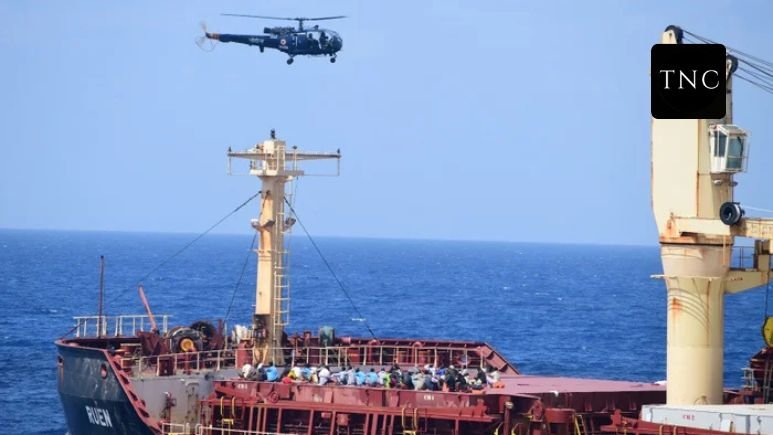

Somali pirates have seized a cargo vessel off the northeastern coast of Somalia, with two Indian nationals and 13 Syrian crew members taken hostage in the second maritime hijacking in the region in less than a week. The attack on the Sward, a general cargo ship flagged by St Kitts and Nevis, marks a sharp and alarming resurgence of piracy in the Horn of Africa, with security analysts warning that the global disruption caused by the Strait of Hormuz blockage has created ideal conditions for opportunistic attacks on vessels rerouted through vulnerable sea lanes.
The United Kingdom Maritime Trade Operations (UKMTO), a Royal Navy-run agency that serves as the primary point of contact for commercial shipping in the region, confirmed on Monday that the Sward was hijacked 6 nautical miles northeast of the Somali coastal town of Garacad and was being steered toward the Somali coastline. The British maritime security firm Vanguard, which tracks vessels in the region, assessed that the ship was “under pirate control and proceeding toward the Somali coastline,” and confirmed that the Puntland Maritime Police Force had been notified. An operations officer from that force told the Associated Press that nine armed pirates had boarded the Sward and seized control.
The Sward had been sailing from Suez, Egypt, to the Kenyan port of Mombasa, carrying a cargo of cement, when it was intercepted.
The Sward attack follows the seizure on Wednesday of an oil tanker, the Honour 25, which had departed a Red Sea port in the self-declared republic of Somaliland and was heading to Mogadishu. That vessel carries 17 crew members whose nationalities include Indian, Pakistani, Indonesian, Sri Lankan and Myanmar nationals, according to BBC reporting. The Honour 25 was boarded by six armed individuals and subsequently anchored off the Somali coast between the fishing towns of Xaafun and Bander Beyla, with five more armed men boarding the ship after the initial seizure. The ship had previously circled waters near the entrance to the Strait of Hormuz before turning toward Mogadishu, according to maritime vessel-tracking service ShipAtlas.
The twin attacks have prompted alarm in New Delhi, with Indian government sources indicating that the Ministry of External Affairs is in contact with relevant authorities to establish the precise status and safety of the Indian nationals aboard both vessels. The Indian Navy’s MARCOS (Marine Commandos) have conducted anti-piracy operations in Somali waters in the past and successfully captured Somali pirates in several prior incidents, though no naval intervention has been confirmed in either current situation.
Maritime security analysts are linking the revival of Somali piracy directly to the cascading effects of the Strait of Hormuz blockade, which began when the United States and Israel launched strikes against Iran on February 28 of this year. The effective shutdown of the strait has blocked passage for a substantial portion of the petroleum that powers the global economy, forcing shipping companies to reroute cargo through alternative sea lanes. Some vessels have been diverted to the Suez Canal route, while others have taken the considerably longer route around the Cape of Good Hope in Southern Africa. Some Saudi oil shipments have been redirected through pipelines to the Red Sea, bypassing the strait entirely.
This surge in rerouted maritime traffic has coincided with a decline in the anti-piracy naval patrols that had kept Somali waters largely safe for over a decade. Anti-piracy patrols were quietly scaled back in recent years as international naval attention and funding were redirected toward countering Houthi rebel attacks on shipping around the Bab al-Mandeb strait, which connects the Gulf of Aden to the Red Sea and the Suez Canal. The combination of less surveillance and more vessels in Somali waters, including ships and crews less familiar with the area, has given pirate groups a window to operate that had not existed since the peak years of Somali piracy.
Somali pirates wreaked havoc on global shipping between roughly 2008 and 2018, hijacking hundreds of vessels and holding thousands of crew members for ransom, costing the maritime industry and insurers billions of dollars. A coordinated international naval response, involving forces from the European Union, NATO, India, China and other countries, combined with improved onboard security measures, effectively suppressed the threat during that decade. However, maritime security organisations tracked a renewed uptick in incidents beginning in late 2023, and Monday’s seizure of the Sward confirms that the resurgence is accelerating under the conditions created by the Hormuz crisis.
BBC reporting cited by the Maritime Executive noted that fuel prices in Mogadishu have tripled since the start of the US-Israeli conflict with Iran, making fuel-laden tankers particularly lucrative targets for pirate groups and providing a strong financial incentive for attacks that had previously carried too high a risk of interdiction. EUNAVFOR Atalanta, the EU’s anti-piracy naval mission, has been monitoring developments but has not yet formally acknowledged either of the current incidents.
The Sward and Honour 25 incidents are widely expected to sharpen diplomatic pressure on international naval powers to reinforce the anti-piracy presence in the waters off the Horn of Africa, and the Indian government in particular is under pressure to take action to secure the safety of its nationals at sea. With the Strait of Hormuz still blocked and no imminent resolution to the conflict that closed it, shipping analysts warn that the conditions driving the piracy resurgence are unlikely to ease in the near term.
Also Read / The Lights Went Out in Islamabad and the Strait of Hormuz Was to Blame .














Leave a comment