


The message came just after midnight.
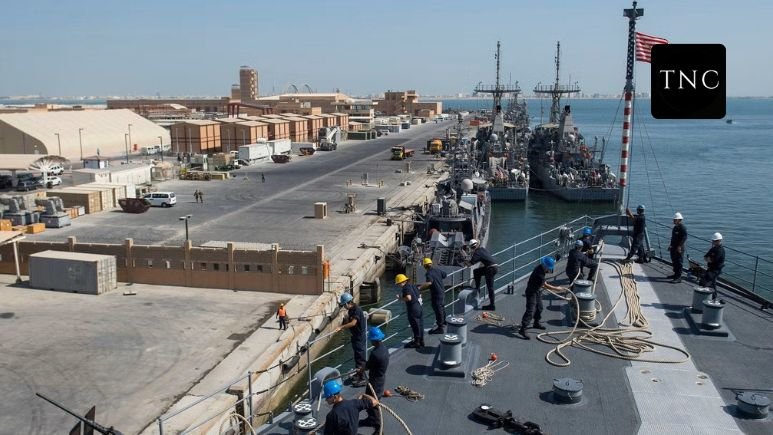
A petty officer stationed in the U.S. The Navy’s Fifth Fleet base in Bahrain grabbed what he could: two uniforms, a passport, a phone charger. Around him, doors slammed, duffel bags scraped across concrete floors, and families moved in hurried silence. There was no formal ceremony, no orderly departure. Just a blunt instruction: take what fits in a backpack and move.
By sunrise, entire housing blocks stood half-abandoned. Cars sat in parking lots, keys still inside. Furniture, photos, children’s toys left behind. Within days, roughly 1,500 American sailors and their families had been quietly evacuated out of Bahrain, many landing back in the United States with little more than what they could carry.
The Hidden Story Behind a Sudden Exit
This wasn’t just a logistical reshuffle. It was a signal.
The evacuation followed escalating tensions in the Middle East, particularly after reported missile and drone strikes linked to Iran targeted U.S. positions in the region. Bahrain home to the U.S. The Navy’s strategic Fifth Fleet sits at the heart of American naval operations in the Gulf. When personnel are pulled from such a critical hub, it reflects more than caution; it suggests vulnerability.
The story matters because it exposes a rarely seen side of military power: how quickly dominance can give way to retreat, and how global geopolitics translates into sudden, personal disruption for those on the ground.
What This Evacuation Really Means
The withdrawal reveals three uncomfortable truths.
First, modern warfare is no longer distant.
Drone and missile capabilities have compressed the battlefield. Bases once considered secure like the one in Bahrain are now within reach of precision strikes. The traditional idea of “safe zones” for stationed troops is eroding fast.
Second, deterrence is being tested in real time.
The U.S. maintains a vast military footprint in the Gulf to project stability. But when attacks force evacuations, even partial ones, adversaries read it as pressure working. It shifts the psychological balance, even if only temporarily.
Third, the human cost is immediate and chaotic.
Behind the strategy briefings and defense statements are families uprooted overnight. Reports indicate many sailors left behind homes and possessions, arriving in the U.S. with minimal belongings.
This is not the slow, planned withdrawal seen in official announcements. It’s abrupt, reactive, and deeply personal.
There’s also a broader regional ripple. Other U.S. bases across the Middle East have reportedly faced similar threats or adjustments, hinting at a wider recalibration of military posture in response to evolving risks.
Power isn’t just measured by how many forces a country deploys it’s revealed by how quickly those forces have to move.
The quiet evacuation of 1,500 U.S. sailors from Bahrain shows that even the world’s most advanced military can be forced into sudden retreat when the rules of conflict change. And for the people on the ground, geopolitics doesn’t unfold in policy papers it arrives as a midnight order and a backpack.











Leave a comment