

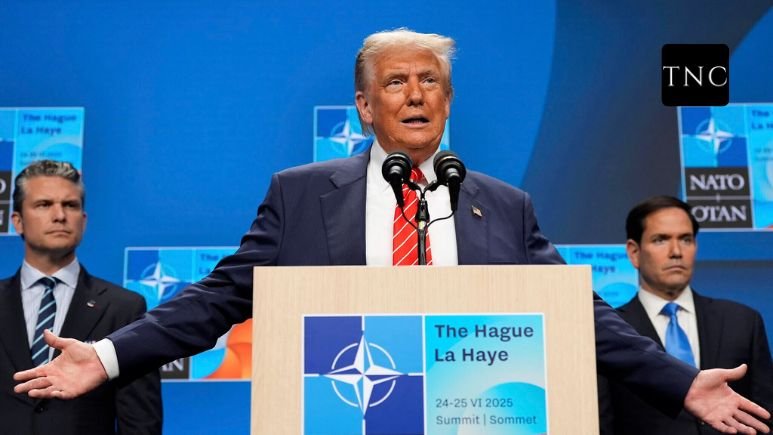

In the most seismic challenge to the Western security order since the end of the Cold War, U.S. President Donald Trump declared on Wednesday that he is strongly considering withdrawing the United States from NATO, describing the 77-year-old alliance as a “paper tiger” whose European members had betrayed America by refusing to join or support the military campaign against Iran.
The remarks, published in an interview with Britain’s Daily Telegraph, have sent shockwaves through chancelleries across Europe and prompted urgent questions about whether the post-World War II security architecture that has underpinned Western stability for nearly eight decades is now structurally broken.
The Words That Changed Everything
Asked by the Telegraph whether he would reconsider U.S. membership of NATO after the Iran war ended, Trump replied: “Oh yes, I would say it’s beyond reconsideration. I was never swayed by NATO. I always knew they were a paper tiger, and Putin knows that too, by the way.”
It was not a throwaway comment. It was a considered, on-the-record statement to a major newspaper and it was immediately reinforced by Trump’s own Secretary of State. Marco Rubio, historically one of the most pro-NATO voices in Republican foreign policy circles, told Fox News that the U.S. “will have to reexamine” its relationship with the alliance after the conflict ends, adding that much of NATO’s value had always been in providing military bases that allowed the U.S. to project power globally but “if now we have reached a point where the NATO alliance means that we can’t use those bases to defend America’s interests, then NATO” had fundamentally failed its purpose.
The Anatomy of the Rupture
To understand how the transatlantic alliance arrived at this precipice, it is necessary to trace the sequence of decisions European governments made and why they made them since the U.S. and Israel launched strikes on Iran on February 28.
European leaders were not consulted before the war began. They view it as a conflict of choice rather than necessity, and have been deeply reluctant to join what they fear could become another open-ended “forever war” in the Middle East, comparable to Iraq or Afghanistan. When Trump subsequently demanded that NATO members deploy warships to reopen the Strait of Hormuz through which roughly 20% of the world’s oil supply normally passes, the request was declined by every allied government.
Some went further. Spain closed its airspace to U.S. military aircraft carrying out missions against Iran. Britain’s Prime Minister Keir Starmer initially refused permission for the U.S. to use British bases for offensive operations, having assessed the campaign as illegal under international law. France blocked American military supply flights from crossing its territory. In Trump’s worldview, this was not a principled legal disagreement, it was betrayal.
Trump told the Telegraph he had expected allied support to be instinctive: “Beyond not being there, it was actually hard to believe. And I didn’t do a big sale. I just said, ‘Hey,’ you know, I didn’t insist too much. I just think it should be automatic. We’ve been there automatically, including Ukraine. Ukraine wasn’t our problem. It was a test, and we were there for them, and we would always have been there for them. They weren’t there for us.”
The UK Singled Out; Starmer Fights Back
Britain bore particular force from Trump’s anger, given the symbolic weight of the so-called “special relationship.” In the Telegraph interview, Trump mocked Britain’s naval capacity, saying: “You don’t even have a navy. You’re too old and had aircraft carriers that didn’t work.” He dismissed Starmer’s energy policy as an obsession with “costly windmills” and suggested advising the British Prime Minister was pointless.
Starmer’s response was measured but firm. The Prime Minister called NATO “the single most effective military alliance the world has ever seen,” insisted Britain was “fully committed” to it, and said he would “act in the British national interest in all the decisions I make, whatever the pressure, whatever the noise.” He also announced that Britain would host a meeting of approximately 35 countries this week to discuss multilateral options for restoring freedom of navigation through the Strait of Hormuz once the fighting ends, a deliberate signal that London is working to build an international framework rather than simply saying no to Trump.
What a NATO Exit Would Actually Mean
To grasp the full weight of Trump’s threat, it helps to understand what NATO is and what American withdrawal would mean in practice. NATO is a collective defence treaty under which an attack on one member is treated as an attack on all. It was the founding guarantee of Western Europe’s security after 1945, the framework through which U.S. troops have been permanently stationed in Germany, Poland, and across the continent, and the architecture that integrated the militaries of 32 nations into a single deterrent force against Russian aggression.
CNN analysts noted that European militaries have been exposed by the Iran war. It took several weeks for Britain’s Royal Navy to get a single anti-missile destroyer stationed off Cyprus. France was able to dispatch an aircraft carrier battle group, but without U.S. support, no combination of NATO powers could unilaterally open the Strait of Hormuz and keep it open, even the U.S. The Navy currently considers close-range operations in the strait too dangerous given Iran’s drone and missile capabilities.
U.S. withdrawal from NATO would indulge Trump’s America First principle and his anger at allies he regards as free riders on American security guarantees but America does not exist in a vacuum defined by presidential rhetoric. The economic and political reverberations of an unresolved Strait of Hormuz blockade, a fracturing alliance, and a resurgent Russia watching closely from the sidelines would be felt in American markets just as surely as in European capitals.
Putin Is Watching
Trump’s aside that “Putin knows” NATO is a paper tiger is not a rhetorical flourish, it is a strategic signal with real-world consequences. Russia has closely monitored every rift between Washington and its European allies since the Iran war began, and a formal or de facto U.S. exit from NATO would remove the alliance’s central deterrent against further Russian adventurism in Eastern Europe, the Baltic states, and beyond.
The irony is sharp: Trump invoked America’s support for Ukraine during Russia’s invasion as evidence of U.S. reliability to allies. Yet U.S. withdrawal from NATO on the grounds that Europeans did not join a war they were never consulted on would fundamentally undermine the security of the same European nations whose support for Kyiv Trump once championed.
NBC News reported earlier this month that the Pentagon was already considering relinquishing the U.S. role of Supreme Allied Commander in Europe, overseeing NATO forces and operations across the continent, a move that, if taken, would be a structural rather than merely rhetorical signal of disengagement.
Europe’s Dilemma: Impossible Choices
Trump put European leaders in an impossible position. His year of berating allies demanding Denmark hand over Greenland, launching tariff assaults, and expressing disdain for allied sacrifices in post-9/11 wars had left them with little room to both help him and preserve their own political credibility at home. But staying out of the war will not spare them from paying its costs. High energy prices and rising inflation threaten to crush fragile economies and cause political blowback among electorates already hostile to weak centrist governments across Europe.
Wednesday’s interview may ultimately prove to be one more piece of Trumpian pressure tactics designed to coerce rather than announce. But even as a negotiating tool, it has crossed a threshold. When a sitting U.S. president tells the world’s press that NATO is a paper tiger and that withdrawal is “beyond reconsideration,” the alliance’s credibility as a deterrent is damaged regardless of whether the membership card is eventually torn up. The question now facing every European capital is not simply whether America will leave NATO, it is whether the NATO that remains, with or without America, can be rebuilt into something capable of keeping the continent safe in a world that has changed irrevocably in 32 days of war.








Leave a comment