

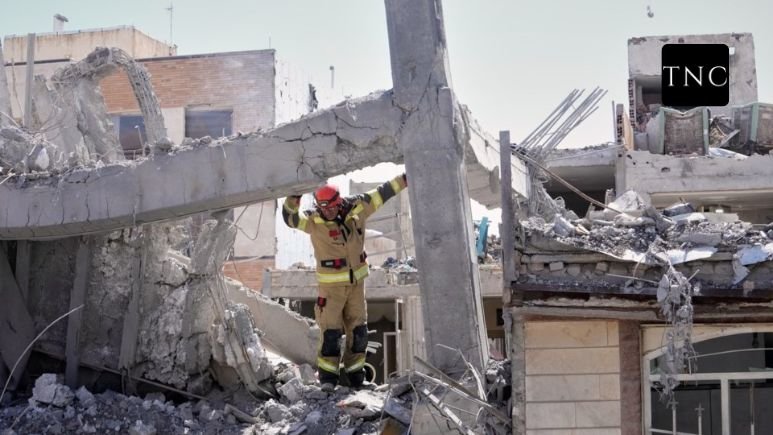

Tehran endured two large-scale waves of Israeli airstrikes on Sunday, damaging parts of the capital’s power transmission infrastructure and triggering blackouts across multiple districts the latest and most severe episode in a conflict that is deepening by the day with no ceasefire in sight.
A Capital Under Siege
According to a China Media Group correspondent in Tehran, residents in northern Iran’s Mazandaran province reported hearing large formations of fighter jets heading toward the capital shortly before the first wave of strikes. A second wave followed in quick succession. Earlier that morning, the Caspian coastal city of Nowshahr previously considered relatively calm was also struck around 7 a.m. local time.
The Israeli military confirmed both operations. It said dozens of fighter jets had targeted infrastructure in Tehran, and that the second strike was aimed at degrading Iran’s weapons production capacity, with more than 120 munitions dropped on facilities linked to weapons research and manufacturing. Ballistic missile storage and launch sites, as well as multiple air defense systems, were also struck.
Iran Widens Its Retaliation
Tehran responded forcefully. Seyed Majid Mousavi, commander of the aerospace force of the Islamic Revolutionary Guard Corps (IRGC), said Iranian operations were continuing, targeting Israel’s Ramat Hovav industrial zone along with a refinery, two steel plants, and two major aluminum facilities.
The strikes caused documented industrial damage. Israeli pesticide maker ADAMA confirmed that its Makhteshim plant in southern Israel had been hit, either by an Iranian missile or falling debris, with footage showing thick smoke rising over the facility a key hub for chemical production and hazardous waste treatment.
Iran also claimed strikes on U.S. assets across the region. The IRGC announced it had destroyed a U.S. E-3 Sentry airborne warning and control system aircraft in a missile and drone strike on Prince Sultan Air Base in Saudi Arabia, adding that nearby aircraft were seriously damaged. Tehran also released satellite imagery purportedly showing damage to U.S.-related facilities in Bahrain, including logistics centers, fuel storage sites, and hangars.
In a further sign of escalation, Iranian officials stated that Iran would begin targeting the residences of U.S. and Israeli military and political personnel in retaliation for strikes on Iranian residential areas.
Diplomacy Adrift
Even as the fighting intensified, fitful diplomatic activity continued in parallel with little to show for it. Iranian Foreign Ministry spokesperson Esmail Baghaei rejected claims of direct negotiations with Washington, confirming that only indirect exchanges had taken place through intermediaries. He described a U.S. 15-point proposal as “extreme and unreasonable” and accused Washington of lacking goodwill.
On the multilateral front, Pakistan, Türkiye, Egypt, and Saudi Arabia held talks on Sunday and agreed to form a joint committee to explore pathways toward resolving the conflict. Pakistan’s Deputy Prime Minister and Foreign Minister Mohammad Ishaq Dar said both Washington and Tehran had expressed confidence in Pakistan’s role as a facilitator.
Analysts See Little Room for Compromise
Chinese foreign policy analysts offered a sober assessment of the diplomatic outlook. Qin Tian, a Middle East researcher at the China Institutes of Contemporary International Relations, said Washington appears to be pursuing a dual-track approach keeping military pressure high while simultaneously exploring negotiation options. He noted, however, that prolonged confrontation does not serve U.S. strategic interests.
The deeper obstacle, analysts argue, is the incompatibility of each side’s stated demands. Niu Xinchun, dean of the China-Arab States Research Institute at Ningxia University, said U.S. demands including a complete halt to Iran’s nuclear activities, limits on its missile program, and an end to support for regional proxies remain fundamentally unacceptable to Tehran. Conversely, Iran’s demands, such as war reparations and guarantees against future U.S. attacks, are equally unlikely to be accepted by Washington.
“Without substantive adjustments, not only is an agreement unlikely even sitting down for talks will be difficult,” Niu said. He nevertheless raised one scenario that he described as plausible: that President Trump could announce a short-term ceasefire of roughly one month, during which both sides would negotiate their respective terms a fragile pause rather than a durable resolution.
The Wider Stakes
With Tehran’s skies lit by strikes, an Iranian missile striking Israeli industry, and U.S. military assets targeted from Saudi Arabia to Bahrain, the conflict has long since outgrown its origins. The coming days will test whether the Pakistani-led diplomatic channel can create even minimal breathing room or whether the logic of escalation continues to override every off-ramp on offer.
Also Read / The ‘Narrow Window’: Diplomacy Races Against the Armada as Tehran Signals Readiness for Talks.











Leave a comment