

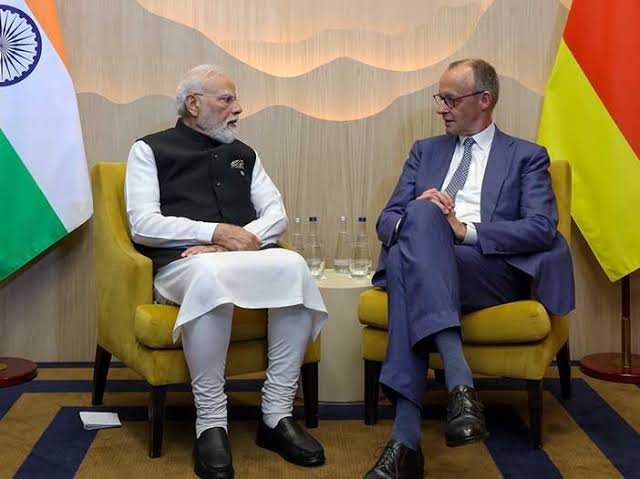

India-Germany ties were back in focus after Prime Minister Narendra Modi spoke with German Chancellor Friedrich Merz on November 24, 2026. The leaders discussed strengthening cooperation in defence, advanced technologies, trade and investment during a telephone conversation.
According to the Prime Minister’s Office, both leaders welcomed the continued momentum in their strategic partnership. Their discussion came during a significant anniversary year, as India and Germany marked 75 years of diplomatic relations.
What Did Modi and Merz Discuss?
The official readout highlighted the leaders’ commitment to expanding cooperation across key sectors. They also discussed regional and global developments and agreed to work closely for peace, stability and an international order based on agreed rules.
Trade featured prominently, with both leaders noting the opportunities that the India-European Union Free Trade Agreement would offer businesses and investors.
The conversation provided political support for an established partnership. The official announcement summarised shared priorities, while specific projects and commercial arrangements will need their own detailed updates.
Defence Cooperation Has an Existing Foundation
Defence was already a major part of the relationship before the latest call. During Merz’s January 2026 visit to India, the two sides welcomed a declaration aimed at developing a defence industrial cooperation roadmap.
The January joint statement described plans for technology partnerships, joint development and joint production of defence equipment. It also highlighted military training, joint exercises and exchanges between senior officials.
Existing areas of cooperation included submarines, systems that help helicopters avoid obstacles and technology to counter unmanned aircraft.
This background shows why the latest discussion matters. Defence cooperation can involve years of research, testing, approvals and industrial preparation. Regular political engagement can help maintain attention on that work, while practical progress depends on the organisations delivering each project.
Technology Partnerships Could Support Modern Industry
Advanced technology is another important pillar of India-Germany ties. The official outcomes of January’s visit included declarations on semiconductor ecosystems, critical minerals and telecommunications.
The list also included an agreement between India’s National Institute of Electronics and Information Technology and German semiconductor company Infineon Technologies.
These areas connect directly with the needs of modern industry. Semiconductors support electronic devices, while reliable communications and access to essential materials help businesses build and maintain production networks.
The potential gains extend to research, training and cooperation between companies. However, converting an agreement into useful technology requires sustained funding, skilled teams and clear responsibilities.
For businesses, the meaningful developments will be working partnerships, research outcomes and manufacturing capabilities that can be used in practice.
Trade Links Give the Partnership Economic Weight
Germany is India’s leading trading partner within the European Union, according to Germany’s Federal Foreign Office. Its anniversary overview reported that more than 2,000 German companies operate in India.
Those companies are active in sectors including vehicle manufacturing, mechanical engineering, chemicals and renewable energy. Indian firms also invest in Germany, particularly in information technology, pharmaceuticals and engineering.
The relationship therefore includes businesses operating in both directions. Stronger ties could help companies find partners, explore markets and organise more dependable supply networks.
For smaller firms, access to clear information will matter. Product standards, regulations, shipping arrangements and the ability to identify reliable customers often determine whether an export opportunity becomes a sustainable business.
Diplomatic encouragement can support this process, but individual companies must still assess costs, demand and commercial risks.
Education and Skills Connect People With Industry
The partnership also reaches beyond government and large companies. January’s official outcomes included a higher education roadmap, a healthcare skills partnership and plans for a renewable energy training centre in Hyderabad.
These initiatives can connect education with the needs of employers. Industrial cooperation may create demand for technicians, engineers and researchers, while university partnerships can support the exchange of knowledge.
Scientific links already provide another connection. Germany’s Foreign Office describes cooperation between universities, research institutes and innovation centres in areas such as artificial intelligence, health and climate research. Such links give the wider partnership a practical base: people can share expertise, test ideas and develop solutions through institutions with established research experience.
The benefits will depend on programme design and implementation. Students and professionals will need clear information about eligibility, training standards and recognised qualifications.
For employers, the challenge is to match training with real vacancies and the skills required on the job.
What Happens After the Discussion?
The next stage is implementation. Useful signals will include funded research, progress on industrial projects, business partnerships and public updates on existing commitments.
The November conversation reinforces the importance both governments attach to India-Germany ties. Its practical value will become clearer as their organisations turn shared goals into completed work.
For readers, the strongest measure of progress is simple: whether cooperation produces useful technology, stronger business links and opportunities that people can access.
Also read | India Condemns Riyadh Tower Attack After Two Indians Are Injured










Leave a comment