

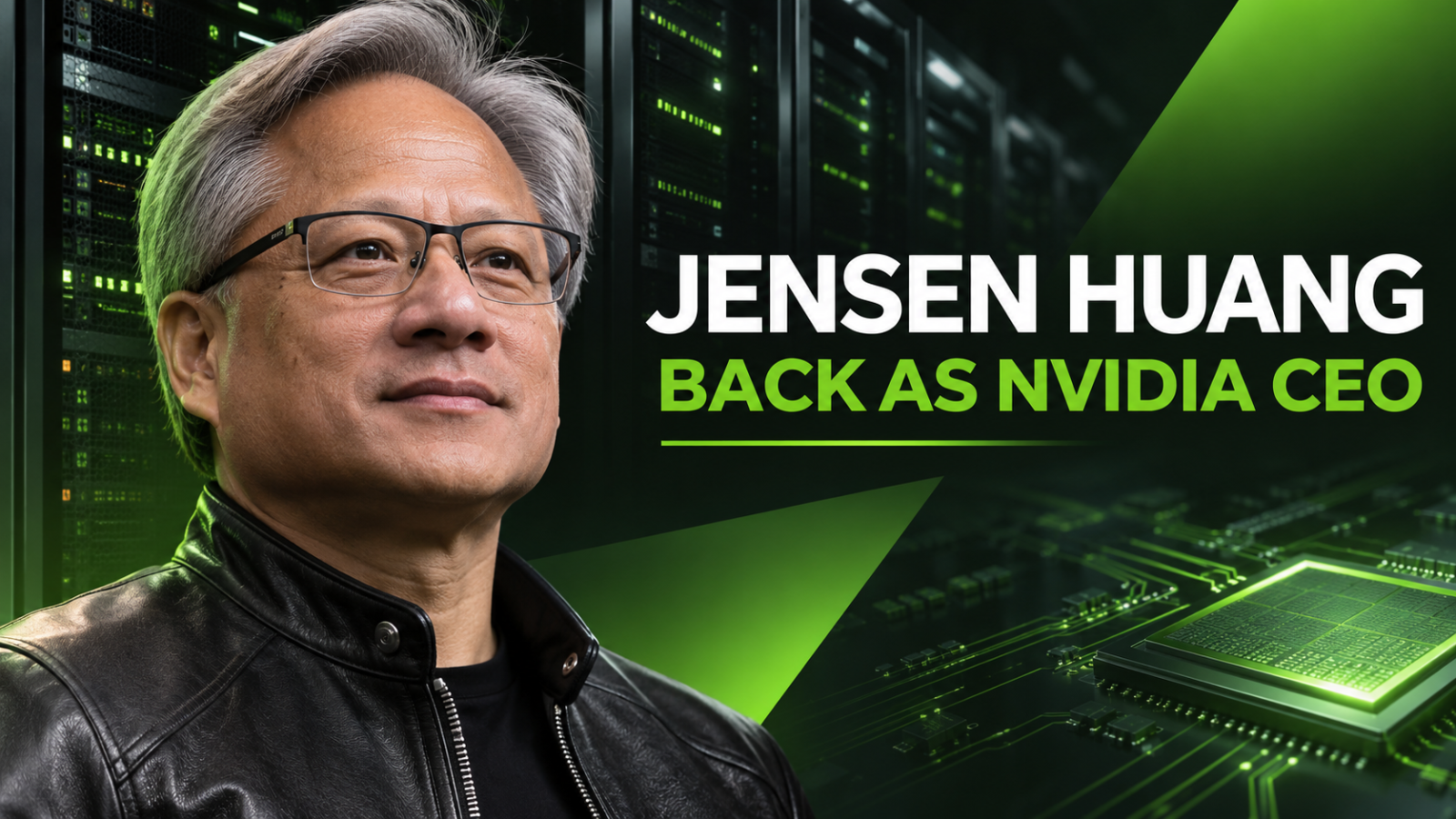

Jensen Huang is back as Nvidia’s chief executive, following a leadership crisis at the artificial intelligence chipmaker. The company announced his reinstatement on November 23, 2026, restoring him as president, CEO and a board director. His return brings Nvidia’s co-founder back to the centre of a business whose technology supports the global AI industry.
The company’s regulatory filing provides a precise timeline. Nvidia told the US Securities and Exchange Commission that its board reinstated Huang on November 22, effective immediately. The public announcement followed on November 23. His resignation had been announced on November 12, when Nvidia began searching for a permanent replacement.
At that point, Nvidia appointed finance chief Colette Kress as interim CEO while she continued her responsibilities. Harvey Jones became board chair. Following Huang’s reinstatement, Kress remains executive vice president and chief financial officer, and Jones continues as chair. Those appointments show how the leadership structure has developed during the episode.
Huang’s departure followed controversy over personal conduct and reports that he had been targeted by a foreign intelligence effort. Reuters reported that the allegations contributed to his resignation. The company’s own statements have focused on an independent investigation, leadership decisions and safeguards around national security and trade compliance.
Explaining the reversal, Nvidia said its directors unanimously supported Huang’s return after discussions with him. The board said it was satisfied with his openness and ability to lead. It also said input from senior US government officials gave it confidence that reinstating him presented no national security risk.
The investigation will continue, according to Nvidia. A committee made up entirely of independent directors has retained outside lawyers to examine the reports of foreign intelligence targeting. The company said Huang supports the review and will cooperate. The board had first announced that investigation on November 8, before his resignation.
Huang’s response emphasised his intention to resume work. In Nvidia’s announcement, he thanked the board, Kress, employees, shareholders and business partners for their support. He described his return as a responsibility he accepted with humility and renewed commitment. His statement focused on the company’s future.
Investors reacted strongly to the announcement. Reuters reported that Nvidia shares closed 31.5% higher on November 23, adding nearly $1 trillion in market value. The agency said the rise still left the stock below its level before Huang’s resignation. The movement reflected the scale of uncertainty surrounding the leadership change.
Political pressure also featured in the coverage. Reuters reported that President Donald Trump supported Huang’s reinstatement and said his intervention had been important. Industry figures and investors also pushed for his return. Their involvement shows how a decision inside one company became a matter of wider economic and political interest.
Huang’s influence is closely tied to Nvidia’s history. He co-founded the company in 1993 with Chris Malachowsky and Curtis Priem, initially targeting gaming and multimedia graphics. Nvidia later expanded the role of graphics processors into scientific computing and artificial intelligence. That transition helped make Huang one of technology’s most prominent executives.
The company’s software ecosystem is part of that story. Nvidia introduced CUDA in 2006, opening GPU processing to a wider range of computing applications. Its corporate history describes the subsequent growth of a large developer community. Customers’ use of both hardware and software helps explain why Nvidia’s direction matters beyond individual chip launches.
The business also continues to operate at an enormous scale. In results published on November 17, Nvidia reported quarterly revenue of $115.8 billion, including $107.6 billion from its Data Center business. Those figures underline how strongly its finances depend on infrastructure used for AI and other demanding computing workloads.
The results announcement described efforts to expand manufacturing capabilities with supply chain partners. For Huang, running the company means coordinating product development, production and relationships with customers deploying large computing systems. Leadership stability could support that work, while the company still needs to execute the commitments described in its business updates.
Questions about oversight remain part of the story. The Associated Press described Huang’s return as a test of whether restoring an influential founder can coexist with addressing unresolved conduct and security concerns. The response from employees and investors is one measure of confidence. The investigations will provide a different kind of assessment.
Nvidia has already created a National Security and Export Control Oversight Committee. Announced on November 17, it is chaired by director Suzanne Nora Johnson and includes Stephen Neal and John Dabiri. The committee oversees national security policies, export compliance and global trade risks, with support from independent outside experts.
The company also announced plans to recruit a chief compliance officer. That executive will oversee compliance across Nvidia and report to its Nominating and Corporate Governance Committee. Alongside Huang’s return, these changes place attention on how the company organises leadership, independent oversight and responsibility for managing risks across its operations.
Also Read | Sheikh Hasina’s December 16 Return Plan to Bangladesh












Leave a comment