


New Delhi: Prime Minister Narendra Modi turns 76 on September 17, 2026, marking another milestone in a political career that has taken him from a small town in Gujarat to the country’s highest elected executive office. Born in Vadnagar, Gujarat, on September 17, 1950, Modi has spent decades in public life, first as an organiser associated with the Rashtriya Swayamsevak Sangh (RSS), later as a Bharatiya Janata Party (BJP) leader, Gujarat chief minister and, since 2014, Prime Minister of India.
His birthday this year also comes as he completes more than 25 years in elected or executive public leadership. Current reports and birthday programmes across India are focusing on his long political career and his path from Vadnagar to New Delhi.
Early Years in Vadnagar
Modi was born into a family of modest means in Vadnagar, a town in north Gujarat. According to the Prime Minister’s official biography, his early years included helping at the family’s tea stall while continuing his studies. The biography also records his interest in reading, debates and public activities during his school years.
His early life became an important part of the public story surrounding his later political career. The official biography says that at the age of 17, he left home and travelled across different parts of India. He later moved to Ahmedabad, where he joined the RSS and began a long association with the organisation.
From RSS Organiser to BJP Leader
Modi became an RSS pracharak and worked in organisational roles for several years. During the Emergency period of the 1970s, he was involved in activities linked to the movement opposing the suspension of democratic institutions, according to his official biography.
A major change came in the 1980s when Modi moved into BJP organisational work. In 1987, he began working as a general secretary of the BJP in Gujarat. His organisational responsibilities expanded during the following years, and he later worked at the national level for the party.
The Election Commission’s historical data shows that the BJP subsequently expanded its national presence, winning 282 Lok Sabha seats in 2014 and 303 in 2019. Those results formed the electoral backdrop to Modi’s continued leadership of the party and government during his first two terms.
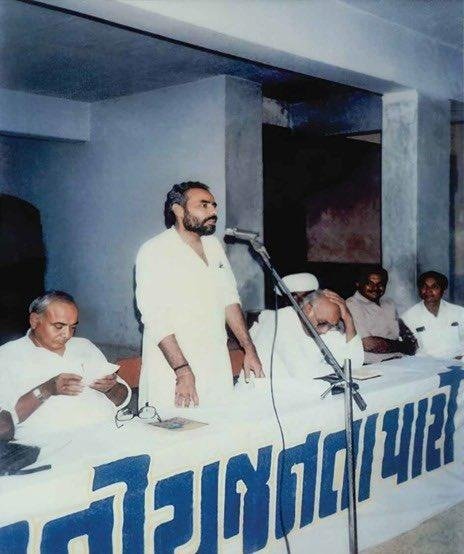
Gujarat Chief Minister: 2001 to 2014
In October 2001, Modi became chief minister of Gujarat, beginning a tenure that lasted more than 12 years. The Prime Minister’s official biography describes his Gujarat period as a 13-year stint in which he worked across administration, infrastructure and development programmes.
His years in Gujarat also became an important and contested part of his political record. The 2002 Gujarat violence, in particular, drew national and international scrutiny, and debates about the state’s administration during and after the violence continued for years.
At the same time, Modi built a strong political base in Gujarat and won repeated state elections as BJP leader. His administration promoted infrastructure, investment and industrial development, while the politics of the state increasingly became linked to his national profile.
The 2014 Turning Point
Modi’s biggest political transition came with the 2014 Lok Sabha election. The BJP won 282 seats, according to Election Commission data, allowing Modi to lead the first BJP government at the Centre with a clear single-party majority since 1984.
On May 26, 2014, Modi took oath as Prime Minister at Rashtrapati Bhavan. He then became the country’s head of government after more than a decade in Gujarat politics.
His first government placed major focus on areas including financial inclusion, infrastructure, digital services, sanitation and manufacturing, along with changes in taxation and economic policy.
Second Term and Major Policy Changes
The 2019 Lok Sabha election brought another BJP majority, with the party winning 303 seats. Modi took oath for a second term later that year.
During the second term, his government made several major policy and constitutional decisions. These included the abrogation of the special constitutional status of Jammu and Kashmir in 2019, the introduction of the Citizenship Amendment Act, major changes in labour and agricultural laws, and the launch of large infrastructure and welfare programmes.
The COVID-19 pandemic also became one of the defining events of his second term, bringing nationwide restrictions, public-health measures and a large vaccination campaign.
Third Term Begins in 2024
In the 2024 general election, the BJP won 240 Lok Sabha seats and formed the government with support from its National Democratic Alliance partners. Modi was sworn in as Prime Minister for a third consecutive term on June 9, 2024.
His third government has continued to focus on infrastructure, manufacturing, digital technology, welfare delivery and India’s role in international affairs. His administration has also continued work on programmes connected to roads, railways, housing, renewable energy and digital public infrastructure.
A Career Defined by Different Political Phases
Modi’s political journey can broadly be divided into several phases: his early years in Vadnagar, his work with the RSS, his rise as a BJP organiser, more than a decade as Gujarat chief minister and his three-term tenure as Prime Minister.
Each phase brought a different role. In the RSS, he worked largely as an organiser. In Gujarat, he was responsible for state administration. At the national level, his role expanded to include economic policy, national security, foreign affairs and the leadership of a coalition government in his third term.
Modi at 76
As Narendra Modi celebrates his 76th birthday, his political career spans more than four decades of active organisational and electoral politics, with over a quarter-century in senior public leadership.
From Vadnagar to Gandhinagar and then New Delhi, his career has included electoral victories, major policy decisions and intense political debate. Supporters point to his long record in government and organisational politics, while critics continue to challenge aspects of his policies and administration.
At 76, Modi remains India’s serving Prime Minister and one of the country’s most prominent political figures. His journey from a small Gujarat town to three consecutive terms in the Prime Minister’s Office remains a significant chapter in contemporary Indian political history.
Also Read | China Calls for Iran-US Diplomacy as Strait of Hormuz Crisis Deepens






Leave a comment