


The radar screens inside South Korea’s shipyards glow late into the night. Engineers in hard hats move between half-built destroyers, missile launch systems and air-defence platforms that are no longer meant only for Seoul’s military. Increasingly, they are being designed for export to countries anxious about China’s rise, Russia’s unpredictability and the fragility of old alliances.
Thousands of kilometres away in New Delhi, Indian defence planners are watching closely.
For years, India’s military imports followed a familiar map: fighter jets from Russia, surveillance systems from Israel, aircraft from the United States and artillery from Europe. But the geopolitical ground has shifted. Russia’s war in Ukraine exposed supply-chain vulnerabilities. Western systems often come with political strings and high costs. China’s naval expansion in the Indo-Pacific has intensified pressure on India to modernise faster.
That is where South Korea enters the picture.
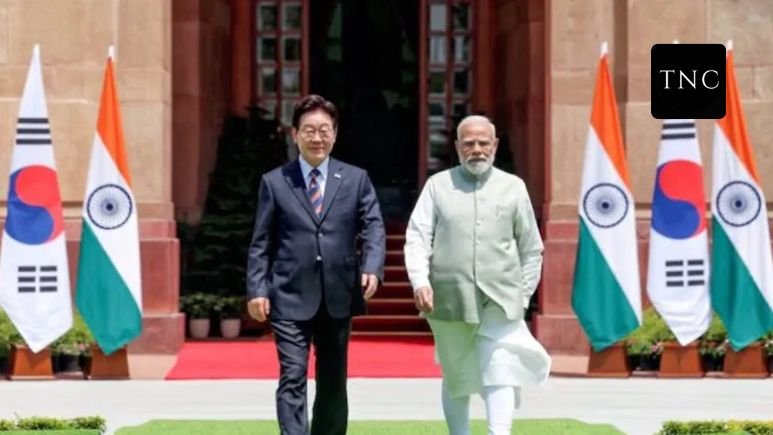
What began as a limited partnership around the K9 Vajra artillery gun is now evolving into something much larger, a strategic defence relationship that could reshape India’s missile, naval and air-defence capabilities over the next decade.
South Korea’s transformation into a global arms exporter has been swift and deliberate. A decade ago, its exports were heavily concentrated in shipbuilding and conventional artillery. Today, the country sells a far broader mix: missile systems, armoured vehicles, naval platforms and increasingly sophisticated air-defence technologies. Poland, the Philippines and the UAE have already emerged as major buyers, while India is positioning itself as both a customer and potential manufacturing partner.
The attraction for India is obvious.
South Korean systems are generally cheaper than Western alternatives, technologically mature and available faster than many European platforms. More importantly, Seoul has shown greater willingness to discuss technology transfer and joint production, a critical demand for New Delhi’s “Make in India” defence ambitions.
The K9 Vajra programme became the template. Manufactured in partnership with India’s private sector, the self-propelled artillery system demonstrated that Korean defence technology could be adapted for Indian conditions while also building local industrial capacity. Now, officials from both countries are exploring cooperation in anti-aircraft systems, missile development and advanced naval technologies.
The naval dimension may prove especially important.
China’s expanding maritime footprint in the Indian Ocean has forced India to rethink its sea-denial and coastal defence strategy. South Korea, one of the world’s leading shipbuilders, has decades of expertise in destroyers, submarines and integrated naval combat systems. Indian strategists see an opportunity to combine Korean manufacturing precision with India’s growing indigenous missile ecosystem, including systems like BrahMos.
Missile cooperation could become the centrepiece of the partnership.
South Korea has invested heavily in layered missile defence and precision-strike technologies as a response to North Korea’s arsenal. India faces a different threat environment, but the operational lessons are relevant. From ship-based missile interceptors to mobile air-defence batteries, Seoul’s experience aligns with India’s push to modernise its multi-domain warfare capabilities.
The timing also matters.
India’s defence exports recently touched record highs, crossing ₹38,000 crore in FY26, a sign that New Delhi increasingly wants to become not just a buyer but a global supplier of military hardware. Partnerships with countries like South Korea allow India to accelerate domestic production without depending entirely on legacy suppliers.
Yet the relationship is not without complications.
South Korea remains deeply tied to the United States security architecture, which could limit the transfer of some sensitive technologies. India, meanwhile, continues balancing relations with Russia, the US, Israel and Europe, a diplomatic juggling act that complicates long-term defence integration with any single partner.
There is also the question of strategic trust. Defence partnerships are rarely only about weapons. They depend on political alignment during crises. India will want assurance that South Korea can remain a reliable supplier during regional conflict. Seoul, in turn, will weigh how closely it wants to align with India amid rising tensions involving China.
Still, the broader trajectory is unmistakable.
Across Asia, middle powers are building new defence networks outside the traditional Cold War blocs. India and South Korea are discovering that they share overlapping concerns: maritime security, supply-chain resilience, advanced manufacturing and the need to reduce dependence on larger powers.
That convergence is slowly turning an arms relationship into something more strategic.
The Bottom Line: India is no longer just shopping for weapons. It is searching for long-term defence partners who can help it build military capability at scale. South Korea, with its rapidly expanding defence industry and willingness to collaborate, may become one of the most important pieces in that strategy.
Also Read / India’s Gold Tax Gamble: Will a 15% Duty Stop Imports or Restart Smuggling?











Leave a comment