

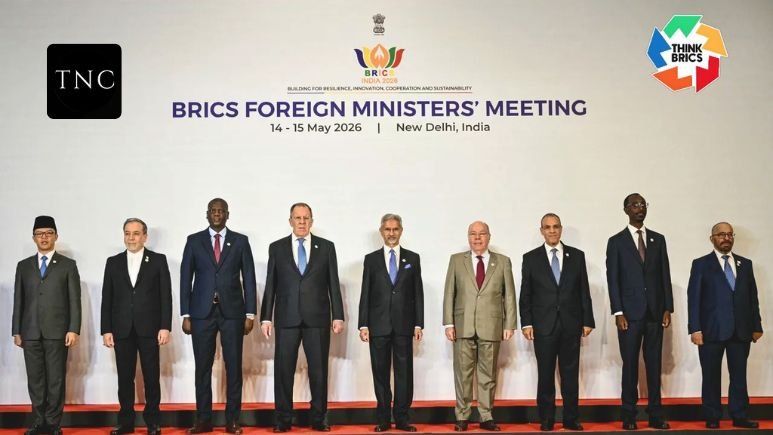

The room at Bharat Mandapam had gone quiet by the time the diplomats stopped pretending there was still a deal to salvage.
Indian officials shuffled papers. Translators removed their headsets. Delegates who had spent two days talking about “Global South solidarity” walked out separate doors into the humid New Delhi evening. There would be no joint communiqué, only a softer chair’s statement drafted by India after negotiations over the Iran war collapsed behind closed doors.
Iran wanted condemnation of the US-Israel military campaign. The United Arab Emirates, itself now entangled in the widening regional conflict, resisted language that could implicate Gulf partners. China sent a lower-level representative instead of Foreign Minister Wang Yi. Russia pushed for strategic unity. India, the host nation, tried to hold the room together without alienating any side.
It failed.
That breakdown matters far beyond diplomatic protocol. For years, BRICS the coalition of Brazil, Russia, India, China, South Africa and its newly expanded members marketed itself as the political voice of a rising non-Western world. But the Iran war exposed a harder truth: it is far easier to unite countries against Western dominance than to unite them around each other’s wars.
India now sits at the center of that contradiction.
New Delhi wants BRICS to become a serious geopolitical counterweight. It also wants strong relations with Washington, energy stability in the Gulf, defense cooperation with Israel, and continued influence among Arab states. Those ambitions increasingly collide as the Middle East crisis deepens.
For Prime Minister Narendra Modi and External Affairs Minister Subrahmanyam Jaishankar, the summit was supposed to showcase India’s diplomatic maturity before the larger BRICS leaders’ summit later this year. Instead, it highlighted the limits of “multi-alignment,” India’s strategy of maintaining close ties with rival global powers simultaneously.
The numbers explain why India is cautious.
Nearly half of India’s crude oil imports flow from the Middle East. A prolonged disruption around the Strait of Hormuz threatens fuel prices, inflation, fertilizer supply chains, shipping costs, and domestic political stability. Indian officials repeatedly emphasized maritime security and uninterrupted trade routes during the summit discussions.
But economics is only one layer of the crisis.
The expanded BRICS bloc now includes countries that are openly competing for regional influence. Iran and the UAE are both members. Egypt and Ethiopia carry their own disputes. China and India remain strategic rivals despite public diplomacy. The organization grew larger before it developed mechanisms to manage internal conflict.
That weakness surfaced in New Delhi.
Iranian Foreign Minister Abbas Araghchi reportedly pushed BRICS nations to explicitly condemn what Tehran called “aggression” by the US and Israel. Indian negotiators instead steered discussions toward softer language sovereignty, dialogue, international law, regional stability. Diplomatically safe words. Politically empty ones.
The result was symbolic but significant: BRICS could not speak with one voice during one of the biggest geopolitical crises of the year.
And symbolism is the currency BRICS depends on.
Unlike NATO or the European Union, BRICS has no military structure, no treaty obligations, and no binding policy framework. Its power comes from perception the idea that emerging economies can collectively shape a new world order. Every visible fracture weakens that narrative.
India understands this better than most members.
For two decades, Indian diplomacy has carefully balanced competing blocs. It buys Russian oil while strengthening ties with the US. It works with Israel on defense while maintaining relations with Iran and Gulf monarchies. It participates in both the Quad and BRICS. That flexibility once looked like strategic genius.
Now it looks increasingly like strategic overload.
The Iran war is forcing countries to choose clearer positions. Neutrality becomes harder when shipping lanes close, energy markets spike, and allies demand public support. India’s carefully calibrated ambiguity may no longer satisfy everyone simultaneously.
There is another risk here, one Indian policymakers rarely say aloud: if BRICS cannot manage disagreements among its own members, China could emerge as the bloc’s only decisive power center by default. India has long hoped the organization would evolve into a multipolar platform. But unresolved divisions tend to benefit the strongest actor in the room.
And Beijing is almost always the strongest actor in the room.
The failed communiqué in New Delhi was not merely a diplomatic embarrassment. It was a preview of the future BRICS may be heading toward bigger, louder, more influential economically, yet internally fragmented whenever hard security questions arise.
The BRICS summit did not collapse because of one war. It stumbled because the bloc is trying to become a geopolitical alliance without agreeing on geopolitics first.
India walked into the summit hoping to prove it could lead the Global South. It walked out confronting a more difficult reality: leadership is hardest when your partners are fighting each other.
Also Read / Global South Ascendant: India Unveils Lotus-Inspired Logo for BRICS 2026.








Leave a comment