

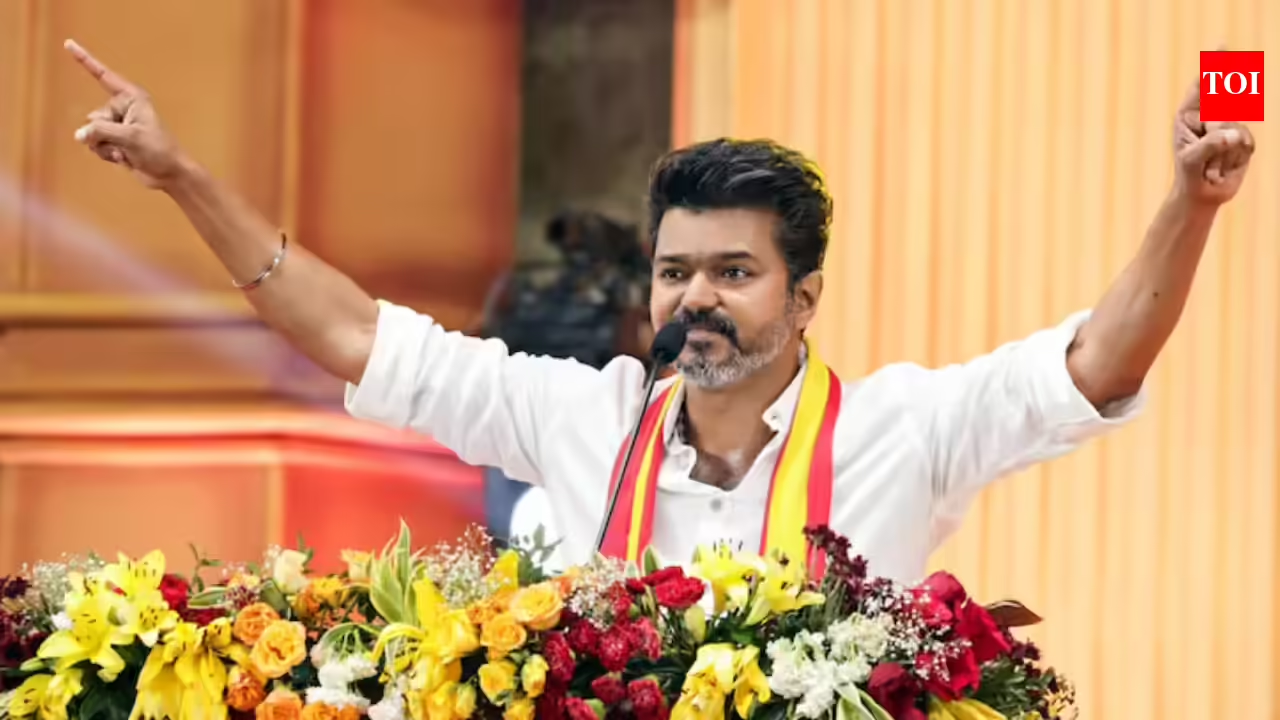

The queue outside a polling booth in Chennai barely moved. A first-time voter, ink still fresh on his finger, leaned toward his friend and asked a question echoing across Tamil Nadu this election: “Will Vijay actually change anything?” A few feet away, an elderly man shook his head. “Politics isn’t cinema,” he muttered, before stepping forward to cast his vote.
Inside that moment hope, skepticism, and a state in transition the real story of Tamil Nadu’s 2026 election begins.
As ballots were cast across all 234 constituencies, a parallel contest unfolded not just between major alliances, but between political experience and celebrity disruption. BJP chief Nitin Nabin publicly ruled out any post-poll alliance with actor Vijay’s newly launched Tamilaga Vettri Kazhagam (TVK), signaling confidence in the AIADMK-led NDA and dismissing the need for new political entrants in government formation.
This stance matters because it defines the election’s central tension: whether Tamil Nadu’s deeply entrenched alliance politics can absorb or resist the arrival of a high-profile outsider.
Nabin’s statement is not just political rhetoric, it’s strategic positioning.
First, it reinforces the NDA’s dependence on the AIADMK as its anchor in Tamil Nadu. By projecting unity and self-sufficiency, the alliance is attempting to counter the perception that it lacks grassroots depth in a state historically dominated by Dravidian parties.
Second, it directly challenges Vijay’s political narrative. The actor-turned-politician has entered the race contesting across constituencies, banking on popularity and public discontent. But Nabin’s dismissal that “no new entrant can create a massive impact” is a calculated attempt to frame TVK as electorally insignificant before results even arrive.
This is a familiar pattern in Indian politics: established parties often minimize emerging forces to prevent momentum. Yet history shows that underestimating new entrants can be risky especially in a state where cinema and politics have long shared a powerful, if unpredictable, relationship.
Third, the refusal of a post-poll alliance signals ideological rigidity or discipline, depending on perspective. In many Indian states, post-election alliances are tools of convenience. By ruling it out early, the BJP is trying to project decisiveness and avoid the optics of opportunistic coalition-building.
But there’s a trade-off. If the numbers fall short, such declarations can limit flexibility in a fractured mandate.
Finally, the broader electoral landscape remains complex. The DMK continues to be a dominant force, while the AIADMK-led NDA seeks to consolidate anti-incumbency sentiment. Into this equation steps TVK neither fully established nor easily dismissed, complicating vote shares and constituency-level outcomes.
The real impact of Vijay’s entry may not be outright victory, but disruption: splitting votes, reshaping margins, and forcing traditional players to rethink strategy.
Tamil Nadu’s election isn’t just about who wins it’s about who gets taken seriously.
Nitin Nabin’s rejection of an alliance with Vijay draws a clear line: experience over experimentation. But elections have a way of humbling certainty. If TVK manages even a modest dent in vote share, the question won’t be whether Vijay needed an alliance it will be whether the political establishment misread the moment.
Also Read / Tamil Nadu vs Centre: The Delimitation Debate That Could Redraw India’s Political Map.











Leave a comment