

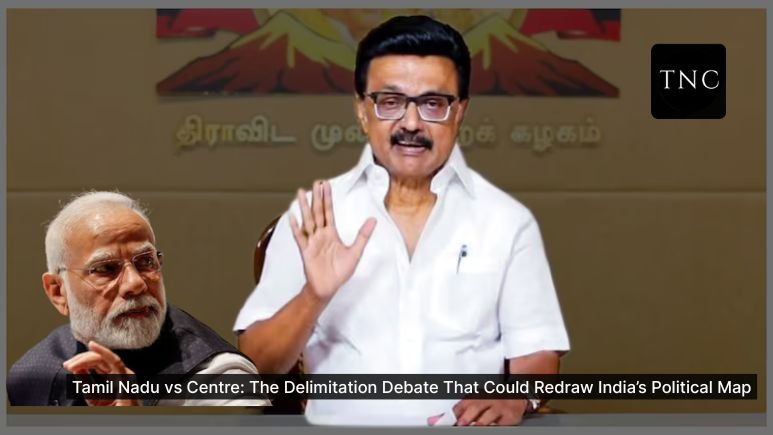

By mid-morning, the tea stall outside Chennai’s Secretariat had stopped serving tea. Not because the milk had run out but because the men gathered there were no longer interested in drinking. They were arguing. Loudly.
“Population control should be rewarded,” one man insisted, slamming his steel tumbler down. Another shot back: “Then why should our seats be reduced?” A third, scrolling through his phone, read aloud a clip of M. K. Stalin warned that the state could come to a standstill.
The kettle hissed in the background. No one moved to turn it off.
This wasn’t just another political speech. It felt, in that moment, like something bigger was shifting something that could redraw not just electoral maps, but the balance of power across India.
At the center of the storm is the delimitation process of redrawing parliamentary constituencies based on population. The controversy erupted after Stalin warned of “massive agitation” if Tamil Nadu’s political representation is reduced or if northern states gain disproportionate power.
His accusation is blunt: the Centre is moving forward without adequate consultation, potentially reshaping India’s political structure in a way that penalizes southern states for successfully controlling population growth.
This is no longer a technical exercise in governance. It is a political fault line, one that pits federal balance against demographic arithmetic, and raises a deeper question: Who gets to shape India’s democracy and on what basis?
Delimitation, on paper, is simple. More people should mean more representation. But India froze this process decades ago to encourage population control. Southern states like Tamil Nadu invested heavily in education, healthcare, and family planning and succeeded.
Now, that success may cost them.
If delimitation proceeds strictly on population data, states in the Hindi-speaking belt where population growth has been higher stand to gain more seats in Parliament. Southern leaders argue this creates a perverse incentive: those who controlled growth lose political weight, while those who didn’t gain influence.
Stalin’s warning isn’t just rhetoric. It taps into a long-standing anxiety in Tamil Nadu, one rooted in language, identity, and federal autonomy. From anti-Hindi agitations to fiscal disputes, the state has historically resisted what it sees as northern dominance.
Now, delimitation risks becoming the most consequential chapter in that story.
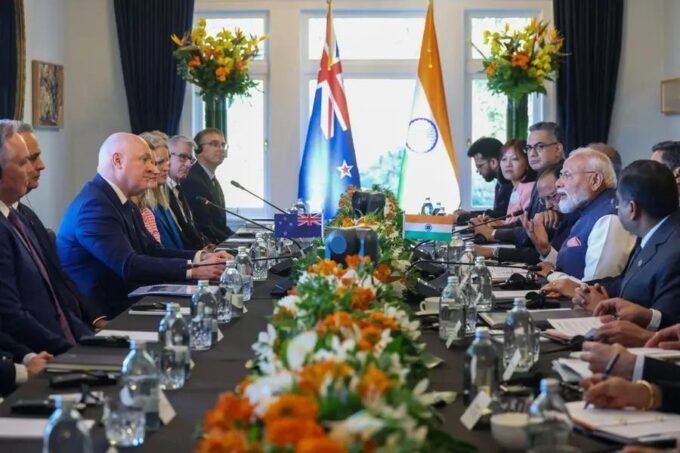
The Centre, for its part, has attempted to reassure. Prime Minister Narendra Modi has linked delimitation to broader reforms and emphasized fairness. But the trust deficit remains.
Political timing complicates everything. With the 2026 Tamil Nadu Legislative Assembly election approaching, the issue has quickly become campaign fuel. Opposition leaders accuse Stalin of fearmongering; Stalin accuses the Centre of secrecy.
And beneath the political noise lies a structural tension: India’s democracy is trying to reconcile two competing truths
- Representation should reflect population
- Governance should reward responsible policy
Right now, those principles are colliding.
The tea at the stall eventually boiled over.
No one noticed.
Because the real question wasn’t about seats or numbers anymore it was about fairness. If India redraws its political map, it won’t just shift constituencies. It will redefine what the country values more: population size, or policy success.
And whichever answer it chooses, someone somewhere will feel left out of the map.









Leave a comment