

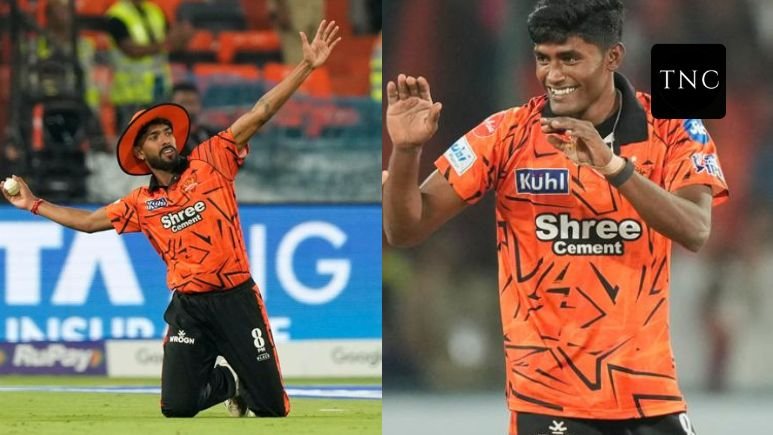

The first ball thudded into the gloves before the crowd had settled. A second later, the stumps lit up. Then another edge, another collapse. In the space of six deliveries, a young fast bowler no one outside domestic circuits truly knew had turned a packed stadium into a stunned silence. At the other end, another debutant lean, raw, and fearless watched, waited, and then joined the demolition. By the time the scoreboard steadied, the match was no longer a contest. It was an arrival.
That night in the Indian Premier League wasn’t just about a 57-run win. It was about two names Praful Hinge and Sakib Hussain announcing themselves in a league built on spectacle, pressure, and ruthless expectation. Their story matters because it captures what the IPL has quietly become: a high-stakes proving ground where unknown players don’t just participate, they redefine the narrative overnight.
The numbers tell part of the story. Hinge, a 24-year-old from Vidarbha, took three wickets in his very first over, something no bowler had ever done in the league’s history. He finished with 4 for 34. Hussain, younger and sharper in pace, matched the impact with 4 for 24. Together, they dismantled a strong batting lineup and shared eight wickets, turning a high-scoring chase into a collapse.
But statistics don’t capture the weight behind those deliveries.
Hinge’s journey had nearly ended before it began. A back injury threatened to derail his career, until mentorship from seasoned professionals helped rebuild both his body and belief. Hussain’s path was even more fragile growing up in Bihar, playing with limited resources, his family making financial sacrifices just to keep the dream alive. These weren’t academy-polished prodigies. They were products of persistence.
What makes their debut remarkable is not just the performance, it’s the timing. The IPL is a stage where reputations are pre-built, where million-dollar players dominate headlines. Yet here were two uncapped bowlers, picked at base prices, stepping into a vacuum and owning the moment. They didn’t ease into the game. They attacked it.
Hinge’s opening over wasn’t cautious; it was surgical. Three wickets, three statements. Hussain followed with pace and control, dismantling the middle order with a composure that belied his age. By the end, a team chasing 217 was bowled out for 159 a collapse triggered not by experience, but by fearless execution.
This is the IPL’s evolving truth: talent pipelines are deeper than ever, and the gap between “unknown” and “unstoppable” is shrinking. Teams are no longer just buying stars, they’re betting on raw potential, on players shaped in smaller towns, quieter grounds, and tougher circumstances. And increasingly, those bets are paying off.
There’s also a broader shift at play. Indian cricket, long dominated by a handful of power centers, is decentralizing. Players from regions like Vidarbha and Bihar are no longer exceptions; they’re becoming the new normal. The league’s scouting networks, domestic circuits, and exposure platforms are converging to create opportunities that didn’t exist a decade ago.
For fans, it’s thrilling. For established players, it’s a warning. The next breakout star may not come with hype; it may arrive with six balls that change everything.
In a league obsessed with big names and bigger price tags, Praful Hinge and Sakib Hussain proved something simpler and far more powerful: opportunity, when met with courage, doesn’t just create careers. It rewrites hierarchies overnight.












Leave a comment