

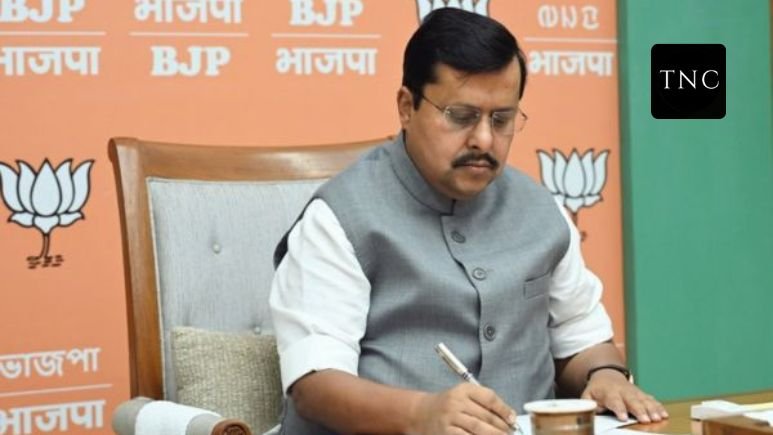

The chamber fell into a rhythmic thud desk after desk echoing approval as Nitin Nabin rose to take his oath. The words were familiar, ritualistic even, but the moment was not. A party president stepping into Parliament’s Upper House carries a different weight. Around him, seasoned leaders and first-time MPs waited their turn, some smiling, some stone-faced, each aware that this was less ceremony, more signal.
In the front rows, aides leaned in, whispering last-minute reminders. Cameras tracked every movement. And as the oath concluded, the applause wasn’t just for a man, it was for a shift already underway.
On April 16, 2026, sixteen newly elected and re-elected members, including BJP president Nitin Nabin, took oath as Rajya Sabha MPs, reflecting a broader recalibration of India’s political power structure.
The group included leaders from multiple parties BJP, Congress, and regional allies representing states from Bihar and Assam to Maharashtra and Telangana.
This wasn’t just a routine parliamentary formality. It marked a strategic consolidation of leadership within the Upper House, where legislation is debated, delayed, and sometimes decisively shaped. The entry of high-profile political figures into the Rajya Sabha underscores how parties are preparing for the next phase of governance and confrontation.
The elevation of Nitin Nabin to the Rajya Sabha is not accidental, it is tactical.
At 45, Nabin represents a generational pivot within the BJP. His appointment as party president earlier in 2026 already signaled a shift toward younger leadership. Now, his move into Parliament completes that transition from organizational command to legislative influence.
This dual positioning matters. Party presidents typically operate behind the scenes crafting strategy, managing alliances, and shaping narratives. But a seat in the Rajya Sabha gives Nabin a direct voice in national lawmaking, allowing him to align party machinery with parliamentary execution.
The composition of the oath-taking group reinforces another pattern: balance.
Eight MPs belong to the BJP, while others represent Congress and regional parties. This mix reflects the fragmented but competitive nature of Indian politics in 2026. No single party dominates uncontested; instead, influence is negotiated across chambers, committees, and coalitions.
There is also a geographic calculation at play. The newly sworn-in MPs come from a spread of politically critical states Bihar, Assam, Maharashtra, Telangana regions that are either electoral battlegrounds or strategic strongholds.
By placing key figures in the Rajya Sabha, parties ensure continuity of leadership even when electoral volatility affects the Lok Sabha or state assemblies. It is a hedge against uncertainty.
And then there is timing.
The Rajya Sabha elections in 2026 are part of a larger electoral cycle that includes multiple state polls and shifting alliances. The Upper House becomes not just a legislative body but a staging ground where policy, politics, and positioning intersect.
This oath-taking ceremony was less about protocol and more about power.
By moving leaders like Nitin Nabin into Parliament, political parties are tightening control over both narrative and legislation. The Rajya Sabha is no longer just a reviewing chamber, it’s becoming a frontline arena.
And the message from that echoing hall was clear: the next political battles in India won’t just be fought in elections; they’ll be shaped, line by line, inside Parliament.










Leave a comment