

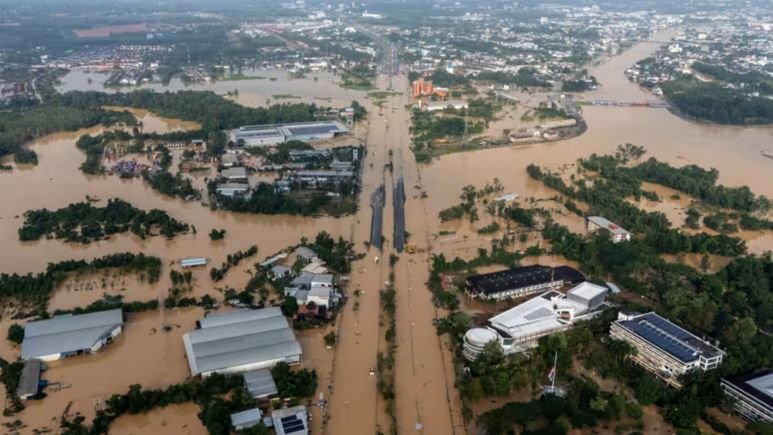

Rescue teams across Southeast Asia are racing to reach isolated communities after a rare tropical storm formed near the equator, combining with seasonal monsoons to trigger the region’s deadliest floods in decades.
Nearly 1,000 people are confirmed dead across Indonesia, Thailand, and Sri Lanka after a “turbocharged” weather system, driven by the rare Cyclone Senyar, unleashed catastrophic flooding and landslides. Indonesia has been hardest hit, with at least 442 confirmed deaths on Sumatra island, where flash floods have swept away entire villages and left hundreds more missing.
The devastation was caused by a “perfect storm” of three simultaneous weather systems: Cyclone Senyar in the Malacca Strait, Typhoon Koto in the Philippines, and Cyclone Ditwah off the coast of Sri Lanka.
In Indonesia, the formation of Cyclone Senyar an exceptionally rare event for the equatorial region brought torrential rainfall to Sumatra. Officials report that 402 people remain missing, with many feared buried under deep mud in the worst-hit Agam and Tanah Datar regencies.
Southern Thailand is also facing a crisis, with the death toll rising to 176. The flooding has affected more than 3 million people across 12 provinces, submerging homes in Songkhla and severing major transport links. Meanwhile, in Sri Lanka, Cyclone Ditwah has killed at least 334 people, making it the island nation’s worst natural disaster since the 2004 tsunami.
“The water just rose up into the house, and we were afraid, so we fled,” said Afrianti, a survivor in West Sumatra who lost her home to the rising waters.
“Tropical Cyclone Senyar serves as a clear reminder that the era of extreme weather has reached the equatorial zone,” stated officials from Indonesia’s meteorological agency, BMKG, warning that such storms were historically impossible in this region.
Meteorologists describe Cyclone Senyar as a meteorological anomaly. It formed at just 5.0° North latitude, a zone usually free from cyclones because the Coriolis effect (the force that spins storms) is too weak near the equator. The last time a storm of this nature formed in the Malacca Strait was Typhoon Vamei in 2001.
Experts say exceptionally warm sea temperatures created the energy needed to overcome the lack of rotation, a phenomenon consistent with climate change models predicting more erratic weather patterns in the tropics. Indonesian President Prabowo Subianto has deployed military helicopters and warships to deliver aid to cut-off areas, though he has stopped short of declaring a national emergency. Authorities in Thailand and Sri Lanka warn that the death toll will likely rise further as floodwaters recede and recovery teams gain access to remote districts.
Also Read / Sri Lanka death toll rises past 50 as cyclone brings historic flooding threat














Leave a comment