

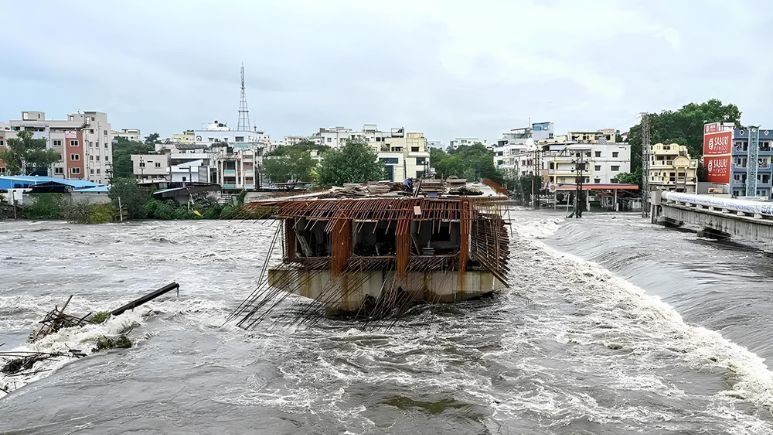

More than 50 people have died and 21 remain missing in Sri Lanka as Cyclone Ditwah unleashed torrential rains that triggered deadly landslides and the worst flooding in years.
The Disaster Management Centre reported Thursday that 56 people have been killed since heavy rains began last weekend. Most victims died in landslides that buried homes in the tea-growing central highlands, with Badulla district alone accounting for 21 deaths.
Prime Minister Harini Amarasuriya said Thursday the toll continues climbing as rescue teams reach isolated areas cut off by collapsed roads and overflowing rivers.
The cyclone formed Wednesday morning off Sri Lanka’s eastern coast after developing from a depression in the Bay of Bengal. It’s now tracking north-northwest toward India’s Tamil Nadu coast while continuing to dump heavy rain across the island.
‘Not experienced in recent history’
The Irrigation Department issued an extraordinary warning Thursday describing conditions as unprecedented.
“A High-Risk Flood Situation, of a level not experienced in recent history, may occur in the low-lying areas of the Kelani River Valley” within the next 24 hours, the department said.
The Kelani River, which flows through heavily populated western Sri Lanka including areas near capital Colombo, has been rising rapidly. Authorities issued red-level flood warnings for multiple river basins across the island.
The warning urged residents in flood-prone areas to “act with extreme caution in order to safeguard their lives, and to proceed as quickly as possible to the safest locations.”
Several neighborhoods in greater Colombo have already experienced flooding. The Kaduwela exit of the Southern Expressway was submerged Thursday, with motorists advised to use alternative routes.
India sends help
Sri Lanka’s Defence Secretary Air Vice Marshal Sampath Thuyacontha revealed Thursday that authorities have requested assistance from an Indian warship currently docked in Colombo.
“A formal request was made to the Indian High Commission in Colombo,” Thuyacontha said during a media briefing. The request includes use of the ship’s aircraft for rescue and relief operations.
However, he noted that adverse weather is also affecting Indian aircraft and flight operations may be limited by current conditions.
India separately announced “Operation Sagar Bandhu” to dispatch relief materials to Sri Lanka. Prime Minister Narendra Modi expressed condolences Thursday for the loss of lives.
“My heartfelt condolences to the people of Sri Lanka who have lost their loved ones due to Cyclone Ditwah,” Modi posted on social media. “I pray for the safety, comfort and swift recovery of all affected families.”
The worst-hit areas
Badulla district in the central highlands suffered the heaviest casualties. Twenty-one people died there when slopes collapsed onto homes overnight Tuesday, burying entire families.
The district of Nuwara Eliya, another mountainous tea-growing region, also reported multiple landslide deaths. Both areas sit on steep slopes already saturated from days of continuous rain.
When the soil can absorb no more water, even moderate additional rainfall can trigger catastrophic slope failures. Many deaths occurred at night when residents had no warning to escape.
Eastern coastal districts including Batticaloa and Ampara have experienced severe flooding as rivers burst their banks. Low-lying agricultural areas have been completely submerged.
The Disaster Management Centre said at least 17 districts across the island have been affected. More than 43,000 people from 12,300 families have been impacted.
Thousands in emergency shelters
Authorities have converted schools, temples, and public buildings into emergency camps housing thousands of displaced families.
The DMC reported that over 400 homes have been completely destroyed or severely damaged, with many more partially affected. Power cuts and contaminated wells have compounded difficulties for residents.
In hill districts, rescue operations face enormous challenges. Collapsed roads and blocked mountain passes prevent relief convoys from reaching some communities. Helicopter evacuations remain limited by poor weather.
President Anura Kumara Dissanayake instructed lawmakers to return to their constituencies to coordinate relief efforts. Parliament temporarily suspended budget debates so ministries can focus resources on the humanitarian response.
The government announced compensation of Rs. 1 million (approximately $3,400) for families of each deceased person.
Infrastructure paralyzed
Major road and rail links across central and eastern Sri Lanka have been disrupted. Washed-out bridges, submerged tracks, and blocked passes have delayed both commuters and relief convoys.
Key routes including the Kandy-Mahiyangana Road and Badulla-Kandy Road were closed until further notice due to landslide risks.
Train services faced significant disruptions. Parts of Colombo reported prolonged traffic jams as storm drains failed to cope with the sheer volume of runoff.
The government postponed national Advanced Level examinations originally scheduled for Thursday and Friday. Several schools in high-risk areas remain closed, citing dangers from unstable slopes and flooded access routes.
Multiple national parks closed Thursday due to dangerous conditions.
The cyclone’s path
Cyclone Ditwah intensified from a deep depression into a cyclonic storm at 6 AM Wednesday when centered about 120 kilometers southeast of Batticaloa on Sri Lanka’s east coast.
As of Thursday evening, the storm was tracking north-northwest across the southwestern Bay of Bengal toward India’s Tamil Nadu coast. The India Meteorological Department predicted further strengthening before the system makes landfall near Chennai around November 30.
The cyclone won’t directly hit Sri Lanka but continues dragging bands of heavy rain across the island. Meteorologists recorded more than 200 millimeters of rain in several districts within 24 hours, overwhelming drainage systems.
Winds have reached 70 kilometers per hour with gusts up to 80 kilometers per hour. Seas off the east and south coasts remain rough with waves reaching 3-4 meters, keeping fishing boats in port.
The name “Ditwah” comes from Yemen, referring to the Detwah Lagoon on Socotra Island. The World Meteorological Organization maintains a pre-agreed list of cyclone names submitted by member nations.
The Friday forecast
Forecasters warned Thursday that Friday could bring worse conditions as outer rain bands from Ditwah continue sweeping across Sri Lanka.
The next 24 to 48 hours remain critical. Saturated soil dramatically increases the risk of further slope failures even with moderate additional rainfall.
The government declared Friday a public holiday except for those in essential services, urging people to stay home and avoid unnecessary travel.
Aviation authorities issued advisories about turbulence and poor visibility. The Airport and Aviation Services assured the public it’s taking necessary precautions to maintain safe operations.
Naval and fishing communities were told to remain in port until conditions improve. A cyclonic storm warning signal remained hoisted at multiple ports.
Climate vulnerability
Weather experts note that cyclones affecting Sri Lanka during the northeast monsoon aren’t unusual, but Ditwah’s intensity and associated rainfall have made this one of the country’s most severe flood events in recent years.
Years of unplanned construction on hillsides, deforestation, and clogged urban drainage have increased communities’ exposure to landslides and flooding when extreme weather strikes.
Humanitarian agencies warn that as climate change drives more frequent and intense rainfall in the Indian Ocean region, Sri Lanka needs stronger early-warning systems, better land-use planning, and resilient infrastructure.
The country’s mountainous terrain and tropical location make it particularly vulnerable. During monsoon seasons, even moderate storms can trigger deadly consequences when they stall over the island.
India braces for impact
As Ditwah tracks toward India, Tamil Nadu state has mobilized emergency response teams. Chief Minister M K Stalin conducted a review meeting with district collectors Thursday.
“We are fully prepared to face the cyclone,” Stalin said. “IMD has given a warning for heavy rain in Delta districts and southern areas on November 29-30.”
He deployed 16 State Disaster Response Force teams and 12 National Disaster Response Force teams to districts expecting heavy rainfall. Relief camps are being established in affected areas.
Cyclonic storm warning signals were hoisted at Chennai, Cuddalore, and Nagapattinam ports. Puducherry and Andhra Pradesh also issued alerts as the storm approaches.
The recovery ahead
For thousands of Sri Lankan families who’ve lost relatives, homes, and livelihoods, the immediate priority remains survival and shelter.
Relief officials are racing to pre-position supplies and reinforce embankments in known flood hotspots while urging the public to heed evacuation orders.
The government faces enormous challenges. Beyond immediate rescue and relief, authorities must address longer-term needs including rebuilding destroyed homes, restoring infrastructure, and supporting agricultural communities whose crops have been devastated.
Many tea plantations in the central highlands have suffered damage, threatening livelihoods in regions where tea cultivation dominates the economy.
Full recovery from this cyclone-driven disaster will likely take months. The final death toll may rise further as rescue teams reach the most isolated communities.
The coming days will test both Sri Lanka’s emergency response capacity and its resilience as a nation. With more rain forecast and rivers still rising, the crisis is far from over.
Also Read This :
Aftermath of Jamaica’s Floods: Hurricane Melissa Intensifies, Cuba Braces for Impact.












Leave a comment