

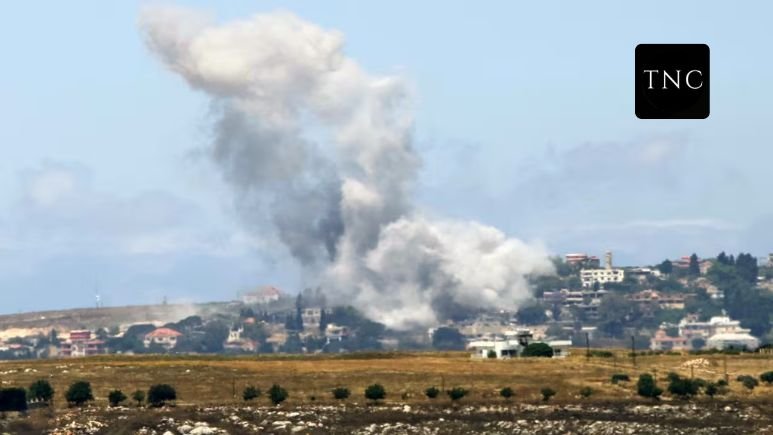

The missile alerts sounded before dawn. Across parts of Israel, civilians rushed toward shelters as air-defense systems lit up the night sky. Within hours, Iranian state media and military officials were celebrating what they called “Operation Nasr” , a name that carried far more weight than the missiles themselves.
For many outside the Middle East, the title may have sounded like just another military code name. Inside Iran, however, it echoed a chapter of national memory stretching back decades. The word “Nasr,” meaning “victory” in Arabic and Persian, has long been associated with resistance, sacrifice, and wartime endurance. By choosing that name, Iranian leaders were sending a message aimed as much at their own population as at their adversaries. Reports indicate that Iran described recent strikes on Israeli military targets as part of Operation Nasr, framing the action as retaliation for earlier Israeli attacks.
More Than a Military Operation
Military operations are often named for strategic reasons, but they also serve a political purpose. Names create narratives. They transform battlefield actions into stories that citizens can rally behind.
In Iran’s case, Operation Nasr appears designed to invoke memories of the country’s long struggle during the Iran-Iraq War of the 1980s, a conflict that remains central to the nation’s identity. For generations of Iranians, wartime victories are remembered not simply as military achievements but as symbols of national survival.
As tensions with Israel intensified, Tehran’s leadership faced a familiar challenge: how to demonstrate strength without appearing reckless. Reviving a historic wartime symbol offered an answer. The operation could be presented as part of a larger story of resilience rather than a single military exchange.
The Symbolism Behind the Name
The choice of “Nasr” comes at a moment when the regional conflict has entered a more dangerous phase. Missile exchanges between Iran and Israel have raised fears that years of shadow warfare could evolve into a broader direct confrontation. Recent strikes and counterstrikes have already pushed both countries closer to open conflict than at any time in recent memory.
In that environment, symbolism matters.
For Iran’s leadership, invoking a historical wartime reference serves three objectives:
First, it reinforces domestic unity. Wartime symbols often remind citizens of shared sacrifice and national purpose.
Second, it projects determination abroad. The message is that Iran views the conflict through a long-term historical lens rather than as an isolated military incident.
Third, it strengthens the narrative of deterrence. By framing military action as part of a legacy of resistance, Tehran seeks to signal that it remains prepared for prolonged confrontation if necessary.
A Region on Edge
The return of Operation Nasr comes amid growing instability across the Middle East. Diplomatic efforts have struggled to keep pace with military escalation. Airstrikes, missile launches, and proxy conflicts have increased uncertainty throughout the region, while global markets remain sensitive to any disruption involving major energy routes. Recent exchanges have reignited concerns that a wider regional conflict could emerge despite repeated calls for restraint.
For ordinary people, the consequences are immediate. Families monitor air-raid warnings. Businesses worry about economic disruption. Governments calculate the risks of escalation against the costs of appearing weak.
That is why the revival of a decades-old wartime symbol matters. It reflects a conflict increasingly shaped by history, identity, and political messaging not just military hardware
Operation Nasr is more than the name of a missile campaign. It is a reminder that modern conflicts are fought on two fronts: the battlefield and the battle for public memory. By resurrecting a symbol tied to past struggles, Iran is attempting to frame today’s confrontation with Israel as part of a larger narrative of endurance and resistance.
Whether that narrative strengthens deterrence or deepens the cycle of escalation remains one of the most important questions facing the Middle East today.
Also Read / Beyond the Artillery Gun: How India and South Korea Are Building a Defence Partnership for the Next Decade .









Leave a comment