

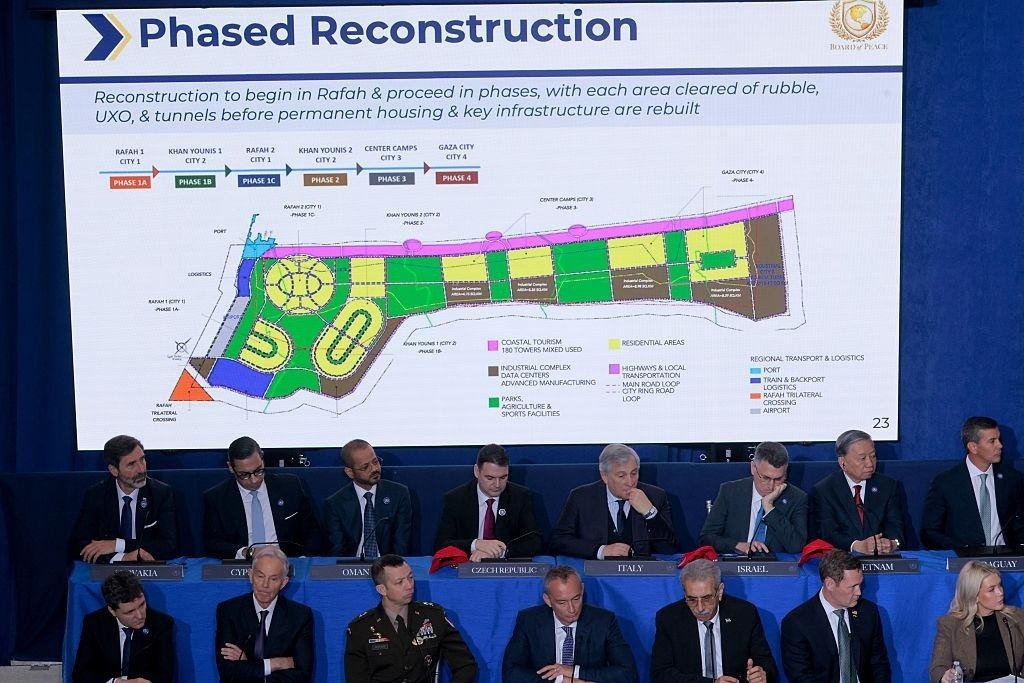

New York: A U.S.-backed $2.45 billion Gaza reconstruction plan has been unveiled to begin rebuilding damaged infrastructure, restoring essential services and supporting economic recovery in the Gaza Strip. The proposal, presented by President Donald Trump’s Board of Peace on September 23 during the United Nations General Assembly in New York, contains 66 projects to be carried out over six months.
The plan is designed as an initial recovery programme rather than a complete reconstruction package. According to the Board of Peace, physical damage in Gaza is estimated at around $35.2 billion, while full recovery and reconstruction could require approximately $71.4 billion over the next decade.
However, the implementation of the plan remains uncertain because Israel and Hamas have not agreed on several key conditions linked to the wider U.S.-backed ceasefire framework.
What Is the $2.45 Billion Plan?
The proposed recovery programme covers six broad areas: infrastructure development, human development, economic acceleration, digital transformation, legal affairs, and peace and security. The projects are intended to address urgent needs while also creating the foundations of longer-term governance and economic activity.
The Board of Peace says the projects are ready to begin when funding and access become available. But officials have acknowledged that the programme cannot proceed fully without political and security arrangements being settled.
Infrastructure Gets the Largest Share
Infrastructure is the biggest component of the six-month plan, accounting for roughly $1 billion.
About $400 million is earmarked for temporary shelters and insulated caravans for displaced Palestinians living in tents. Another $275 million would support rubble removal and clearing unexploded ordnance. Around $50 million is planned for hospital rehabilitation, while about $30 million would be used for damaged roads.
The infrastructure programme also includes repairs to border crossings, electricity and water systems and the distribution of 25,000 portable solar-power kits.
The plan additionally calls for permanently filling tunnels beneath locations selected for priority reconstruction projects. Officials say this is intended to make rebuilding possible in areas where underground structures create security or engineering concerns.
Temporary Housing Is an Immediate Priority
One of the most urgent issues is moving displaced families out of tents and unsafe buildings.
The plan allocates about $400 million for insulated caravans that can provide temporary accommodation. A separate project supported by the United Arab Emirates would establish an “Emirati Neighborhood” in Rafah intended to house up to 50,000 people, with its own utilities.
This part of the programme is aimed at addressing the housing crisis while longer-term construction gets underway.
The Board of Peace has acknowledged that the overall scale of Gaza’s housing damage is far greater than what the initial six-month programme can address. The larger reconstruction bill will therefore extend well beyond the $2.45 billion first-phase proposal.
Healthcare, Education and Welfare
Human development is another major component.
Around $300 million is allocated to health, education and welfare programmes. The goal is to restore basic services while helping schools, hospitals and social-support systems return to operation.
This is particularly important because the destruction of buildings and disruption of essential services have affected daily life across Gaza.
The proposal is therefore not limited to roads and housing. It also aims to rebuild institutions and services required for communities to function.
Security Takes Nearly $900 Million
Security is another major part of the package, with approximately $885 million allocated to related projects.
About $275 million would be used to build a hardened site in Rafah capable of supporting up to 5,000 personnel from the proposed International Stabilization Force. A further $140 million would support recruitment, training, equipment and deployment of a multinational security contingent.
The programme also includes about $120 million for mobilising Palestinian police. According to the plan, Palestinians selected for a new Gaza police force would undergo training before eventually taking on greater responsibility for local security.
Another $20 million weapons buy-back programme would provide incentives for Hamas and other armed groups to surrender weapons and ammunition for safe disposal.
Border Crossings and Governance
The plan also includes a political and administrative component.
Under the proposed arrangement, a Palestinian technocratic government would eventually take responsibility for managing Gaza’s crossings with Israel and Egypt for passengers and goods.
The proposal is therefore intended not only to rebuild physical structures but also to help establish functioning institutions.
Board officials and members of the Palestinian technocratic government say the recovery process should be Palestinian-led and based on Palestinian ownership.
Digital Services and Economic Recovery
Another notable part of the proposal is the effort to restart Gaza’s economy and digital systems.
Projects include a digital identification system, digital payments, 4G connectivity, electronic health and education platforms, grants for small businesses and a new Gaza investment fund.
The economic component is intended to move beyond emergency aid and help businesses reopen, workers return to productive activity and basic financial services resume.
The Board of Peace has described the programme as a starting point for creating the conditions of a functioning economy rather than a complete solution to Gaza’s long-term economic challenges.
Reconstruction Could Begin in Rafah
The proposal envisions reconstruction moving sector by sector, beginning in Rafah and then expanding northward, according to reporting on the plan. The timing would depend on security arrangements and the ability to gain access to damaged areas.
The approach is intended to allow projects to start in areas where conditions are considered workable rather than waiting for the entire territory to become accessible at once.
However, the wider process is closely linked to unresolved questions about Hamas disarmament and Israeli troop withdrawals.
Funding Remains a Major Challenge
One of the biggest unanswered questions is where the full $2.45 billion will come from.
Board of Peace officials acknowledged that the entire amount has not yet been secured. They said, however, that the money would not necessarily have to be available all at once and expressed confidence that donor countries could contribute once political conditions allow the programme to begin.
The funding challenge becomes even larger when the estimated $71.4 billion long-term reconstruction requirement is considered.
That means the six-month plan is only an initial step in a much larger rebuilding effort.
Political and Security Obstacles
The biggest challenge may not be the engineering work but the political environment.
Nearly a year after the ceasefire that halted the heaviest fighting, reconstruction has not begun on a large scale. Reuters and AP report that disagreements remain over Hamas disarmament, Israeli military withdrawal and the deployment of an international stabilization force.
The Board of Peace says cooperation between the relevant parties is necessary before the projects can move forward.
Officials have also acknowledged that the six-month timeline is not a realistic timeframe for rebuilding Gaza completely. U.S. Secretary of State Marco Rubio described the programme as a long-term project and said the six-month plan should be seen as an initial stage.
Why the Plan Matters
The Gaza reconstruction plan is significant because it combines emergency needs with longer-term institution building.
It addresses temporary housing, water, electricity, hospitals and roads while also proposing new digital systems, economic programmes and security structures.
Yet the proposal faces major practical questions about financing, access and political agreement. Until those conditions are resolved, the projects remain a blueprint rather than a fully operational reconstruction programme.
For Gaza’s more than two million residents, the most immediate priorities are housing, healthcare, clean water, electricity, food and safe access to essential services. The proposed plan seeks to address some of those needs while creating a pathway toward broader reconstruction.
What Happens Next?
The Board of Peace and its partners will need to secure funding and establish the political and security conditions required for work to begin.
The plan’s authors expect reconstruction to proceed gradually, with projects starting where access is possible and expanding as conditions allow. Meanwhile, international donors will be watching how the ceasefire and security arrangements develop before committing additional resources.
The $2.45 billion proposal is therefore best understood as a first-stage recovery programme rather than the full answer to Gaza’s reconstruction needs. Its success will depend on funding, access, security arrangements and political cooperation.
For now, the proposal provides a detailed list of early priorities, but turning those plans into real homes, hospitals, roads, utilities and jobs will require major financial and political commitments over many years.
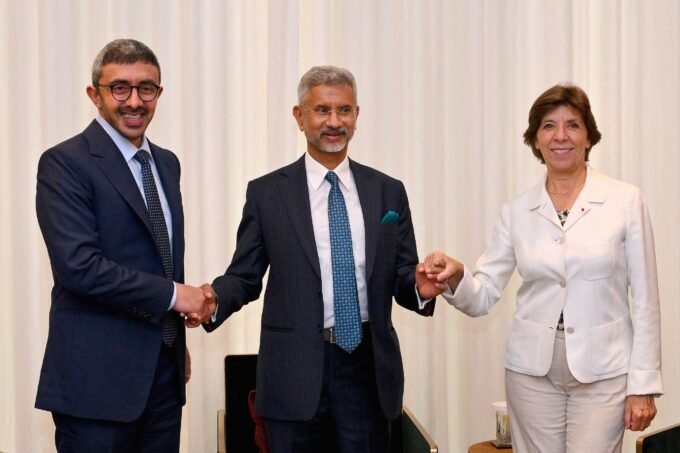
Also Read | India, France and UAE Discuss Space, AI and Energy Cooperation at UNGA






Leave a comment