

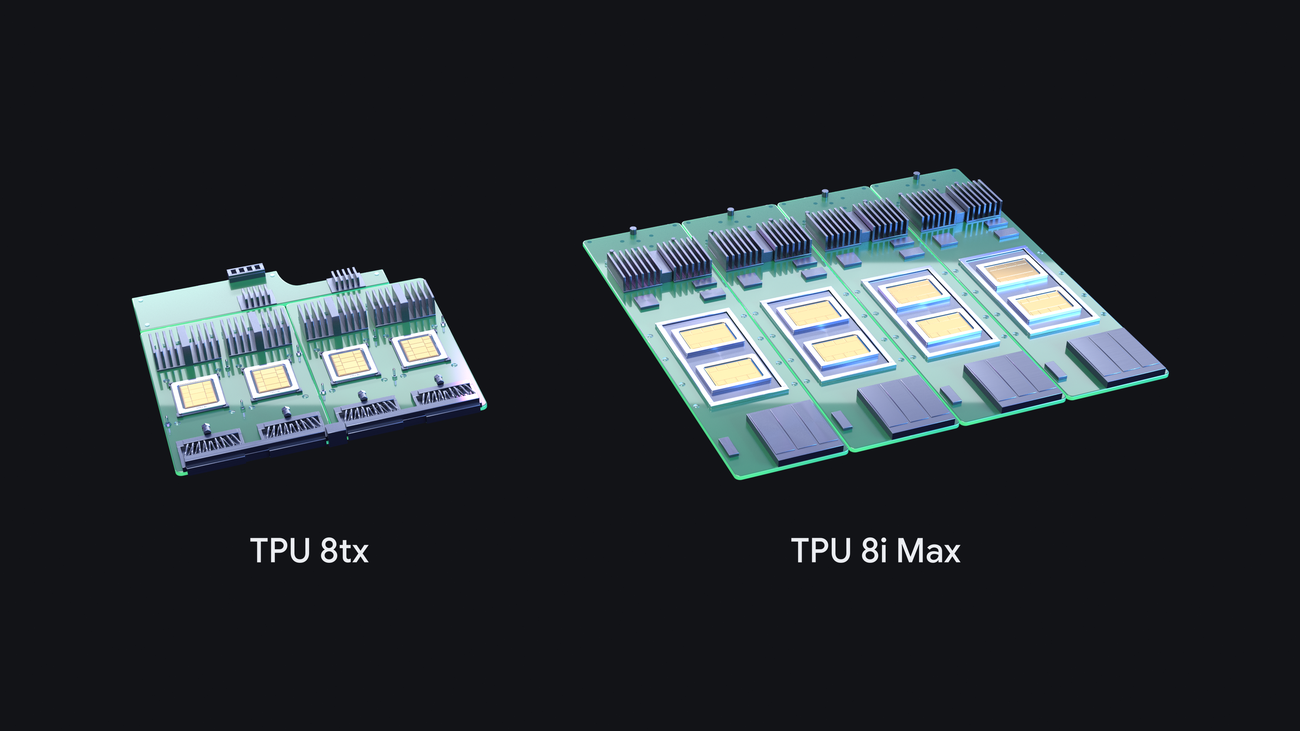

Google has announced two new artificial intelligence computing systems, TPU 8tx and TPU 8i Max, marking another major development in its AI infrastructure technology.
The announcement, made on November 9, 2026, expands Google’s eighth-generation Tensor Processing Unit (TPU) portfolio to four systems.
The Google new TPU systems are designed to address two growing challenges in artificial intelligence: protecting sensitive information and handling extremely large amounts of data.
As AI applications become more advanced, companies need powerful computing systems that can process information quickly, securely and efficiently.
Google believes its latest TPU technology can help meet these demands.
What Are Google’s New TPU Systems?
Tensor Processing Units are specialised processors developed by Google to accelerate artificial intelligence workloads.
Unlike traditional computer processors, TPUs are designed specifically for tasks such as training machine learning models and generating AI responses.
Google introduced its first TPU more than a decade ago.
Since then, the technology has become an important part of Google’s AI infrastructure, supporting products such as Gemini and services offered through Google Cloud.
The company has now expanded its eighth-generation TPU family with two additional systems:
- TPU 8tx: Designed for secure AI processing and confidential computing.
- TPU 8i Max: Designed for large AI workloads that require greater memory and computing capacity.
These systems join the previously announced TPU 8t and TPU 8i.
What Makes TPU 8tx Special?
Google’s TPU 8tx focuses on security.
Businesses increasingly use artificial intelligence to analyse confidential information, including financial records, customer data and internal documents.
Protecting this information during AI processing is essential.
TPU 8tx introduces hardware-level security features that help protect sensitive data and AI model information while computations are running.
This is especially important for industries such as banking, healthcare and government services.
The system is designed to support confidential AI inference, where trained models process information and generate results.
It can also support smaller training workloads and AI model customisation.
According to Google, TPU 8tx can deliver up to twice the latency performance improvement compared with TPU 8t for certain workloads.
TPU 8i Max: Built for Bigger AI Tasks
While TPU 8tx focuses on security, TPU 8i Max is designed for computing power and memory.
Modern AI systems increasingly process large documents, software projects, videos and complex instructions.
These workloads require significant memory capacity and fast data movement.
Google developed TPU 8i Max by combining two TPU 8i chips into a single package.
The company says the new configuration provides twice the computing power, SRAM capacity and high-bandwidth memory bandwidth of TPU 8i.
This allows the system to handle larger workloads without slowing down as easily.
It also increases computing density, helping data centres fit more processing power into existing infrastructure.
Why Is Google Expanding Its TPU Technology?
Artificial intelligence is moving beyond simple chatbots.
Businesses are developing AI agents capable of performing tasks, analysing information and working across different software systems.
These applications require specialised computing infrastructure.
For example, an AI assistant analysing an entire software project may need to remember thousands of instructions and files.
Another AI system handling confidential financial information must protect sensitive records throughout processing.
Google’s new TPU systems address these different requirements.
Instead of relying on one general-purpose configuration, Google is offering specialised systems for different AI workloads.
Four TPU Systems for Different AI Needs
Google’s eighth-generation TPU portfolio now includes four systems.
TPU 8t focuses on training large artificial intelligence models.
TPU 8i supports fast AI reasoning and real-time responses.
TPU 8tx provides additional security for confidential AI workloads.
TPU 8i Max handles large context windows and memory-intensive processing.
Together, these systems are designed to support different stages of AI development and deployment.
Google says this is the first time it has introduced four TPU systems within a single year.
Google Makes TPUs Easier for Developers
Alongside the hardware announcement, Google highlighted improvements to its software tools.
The company is expanding support for PyTorch, a popular framework used to develop machine learning models.
Its open-source TorchTPU project aims to make it easier for developers to run existing AI applications on Google TPUs.
Google has also introduced tools that help identify performance problems and optimise workloads.
These developments could reduce the technical barriers that previously made specialised AI hardware difficult to use.
For businesses, easier development tools may make adopting TPU-based infrastructure more practical.
What Does This Mean for the AI Industry?
The announcement reflects increasing competition in artificial intelligence hardware.
Companies developing advanced AI models need faster processors, greater memory capacity and improved security.
Google’s TPU systems offer another option alongside other AI computing technologies.
They may also help businesses choose infrastructure based on specific requirements rather than computing power alone.
However, actual performance and cost benefits will depend on the software, workload and deployment environment.
Google’s published performance figures should be understood as company-reported results.
How Could Businesses Benefit?
Businesses using AI could benefit from more specialised computing infrastructure.
Financial institutions may prioritise secure processing.
Software companies may need systems capable of analysing large codebases.
Research organisations may require powerful computing resources for complex experiments.
Cloud customers could also gain access to improved tools for developing and running AI applications.
These developments may support wider adoption of advanced AI systems across different industries.
Conclusion
The introduction of Google’s new TPU systems, TPU 8tx and TPU 8i Max, represents another step in the company’s artificial intelligence infrastructure strategy.
One system focuses on confidential computing, while the other is designed for larger workloads and improved memory performance.
Together with TPU 8t and TPU 8i, they complete a four-system eighth-generation portfolio.
As artificial intelligence becomes more powerful and widely used, specialised computing technology will play an increasingly important role.
Google’s latest announcement shows that the future of AI depends not only on smarter models but also on the infrastructure powering them.
Also Read | Nvidia Loses $430 Billion in Market Value! Jensen Huang Investigation Deepens













Leave a comment