

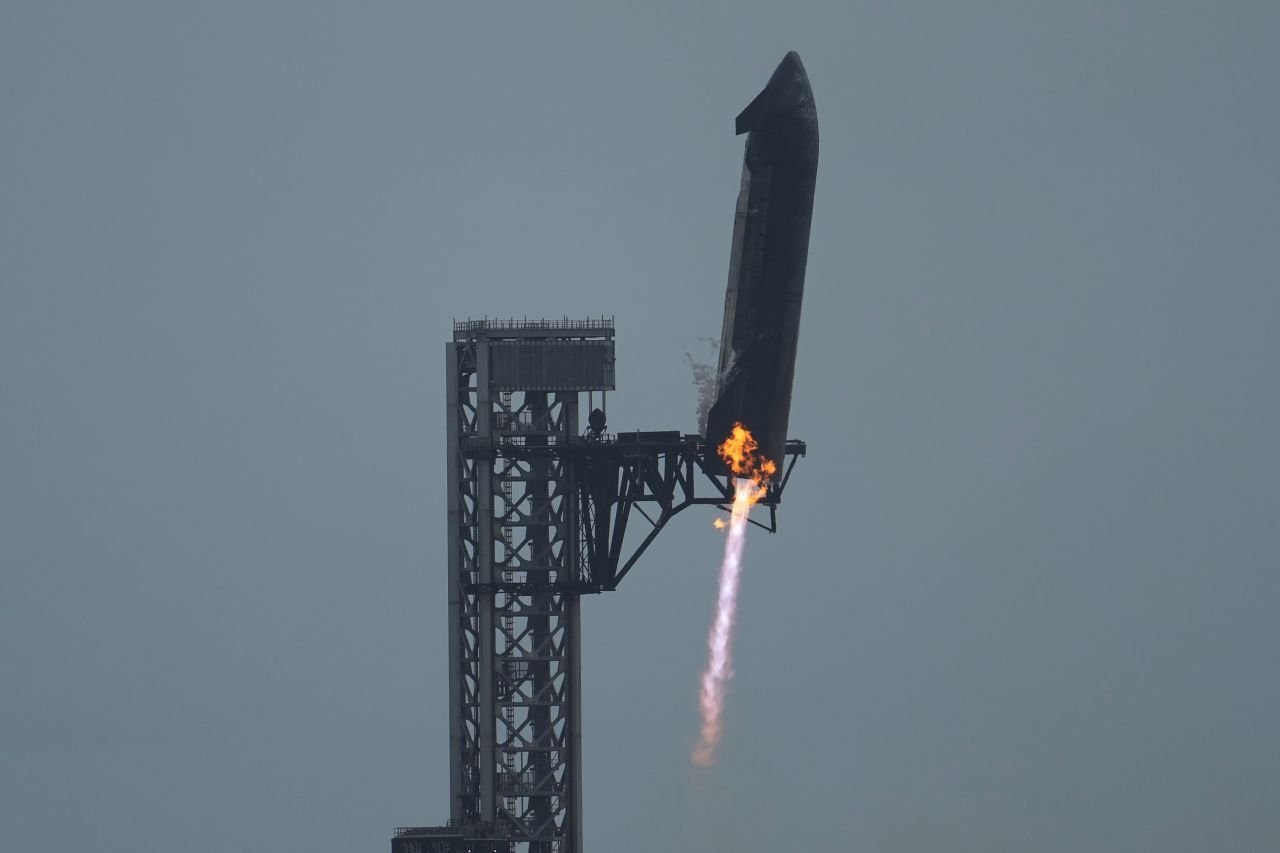

The SpaceX rocket catch in Texas marked a new milestone on November 14, 2026, when the company caught its Starship upper stage after a return from orbit. Giant mechanical arms on the launch tower supported the spacecraft as it completed Flight 15 at Starbase, near the Texas coast.
The vehicle, known as Ship 42, had launched on November 13 and spent roughly 22.5 hours in flight. It was the first time SpaceX had caught a Starship upper stage following an orbital mission.
What made this catch historic?
The Starship launch system has two main parts: the Super Heavy booster and the Starship spacecraft above it. The booster supplies the initial push from the launchpad. The upper stage continues the journey into space.
SpaceX first caught a returning Super Heavy booster on October 13, 2024, during its fifth flight test. On that earlier mission, the Starship upper stage completed a controlled splashdown in the Indian Ocean.
The November 2026 achievement went further by recovering the upper stage after an orbital flight. That distinction makes this a new chapter in the programme.
How did the tower catch work?
Starship returned through Earth’s atmosphere before approaching its launch tower, often called Mechazilla. During the final descent, it moved into an upright position and used its engines to slow down. The tower’s large arms then received the vehicle.
The arms are commonly nicknamed chopsticks because of their long, paired shape. They form part of SpaceX’s plan to recover its vehicles directly at the launch site.
Before Flight 15, SpaceX said a return would proceed only if critical systems for reentry, the landing burn, and the tower approach were healthy.
What happened to the Super Heavy booster?
SpaceX had planned to catch both stages on this flight. However, the Super Heavy booster did not complete its planned recovery and was lost after launch. The Associated Press reported that the booster exploded following Friday’s liftoff.
The successful upper-stage catch therefore came alongside a significant setback. Flight 15 demonstrated a new recovery capability, while the goal of catching both stages during the same mission remained unfinished.
Why the SpaceX rocket catch in Texas matters
Rocket hardware is expensive to build. Recovering major parts creates the possibility of flying them again instead of producing replacements for every mission.
SpaceX’s goal is a fully and rapidly reusable Starship system. Its Flight 15 plan described returning both stages to the launch site as an important step towards that goal.
The potential benefit is more frequent launches with lower hardware costs. However, the real savings will depend on inspections, repairs, preparation time, and how many flights each vehicle can complete. A successful catch is an important demonstration; dependable reuse requires repeated results.
Returning safely is another engineering challenge
An upper stage returning from orbit must survive intense heating and remain controllable throughout its descent. For Flight 15, SpaceX described improvements to Starship’s heat shield and plans to examine it before committing to the return.
Three of the planned Starlink satellites carried cameras intended to inspect the spacecraft’s protective tiles. The company said those images would be one of several sources used to assess readiness for the catch attempt.
This shows why recovery involves much more than placing a rocket between two steel arms. The whole return journey has to work.
More than a recovery test
The spacecraft also deployed 26 Starlink V3 broadband satellites into low Earth orbit during Flight 15.
Delivering satellites and recovering hardware are connected parts of the same ambition. A useful reusable system must carry cargo, return safely, and prepare for another launch. The catch demonstrated a major part of that sequence. Future missions will show how consistently SpaceX can complete it.
What could this mean for Moon missions?
NASA has contracted SpaceX to develop the Starship Human Landing System for Artemis missions. That lunar lander is a specialised version of Starship.
NASA’s published technical work also explains the importance of transferring very cold propellants between vehicles in Earth orbit. Tanker flights would help supply the fuel needed for lunar operations.
Reliable reuse could support the repeated launches such a system needs. The Texas catch supports that wider development effort, while orbital refuelling, lunar demonstrations, and other requirements remain separate milestones.
What happens after the historic catch?
The next important evidence will concern the recovered spacecraft’s condition, the work needed before another flight, and progress towards recovering both stages together.
For now, the SpaceX rocket catch in Texas offers a clear achievement: an upper stage returned from orbit and was caught at its launch site. Turning that achievement into routine operation will be the next test.
Also Read | Microsoft Global Service Outage Disrupts Outlook and Teams













Leave a comment