

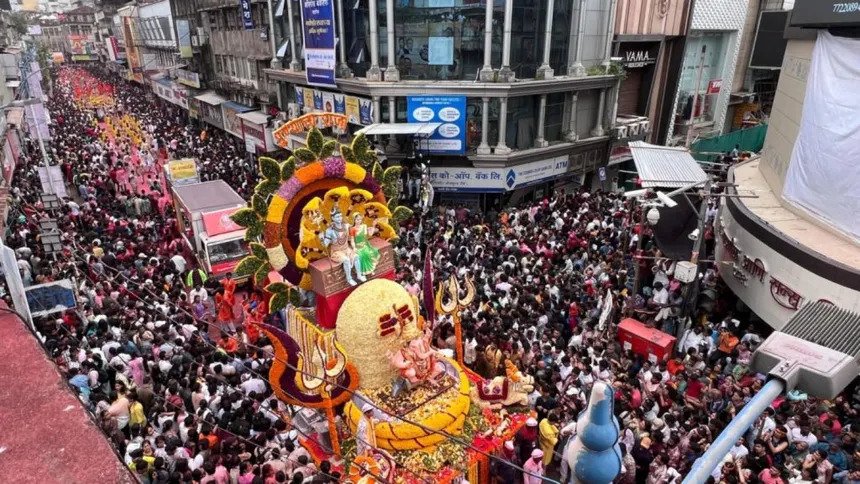

Mumbai: Mumbai is preparing for the final and busiest phase of Ganeshotsav 2026, with Anant Chaturdashi falling on September 25. As thousands of public and household idols are expected to be brought out for immersion, the Brihanmumbai Municipal Corporation (BMC), Mumbai Police, traffic authorities and railway agencies have put extensive arrangements in place to manage crowds, traffic and public safety.
The festival began on September 14, and immersions have already taken place on several designated days. By 6 am on September 21, the BMC said 18,818 Ganesh and Gauri idols had been immersed across Mumbai without any reported untoward incident in that update.
With the main immersion day approaching, authorities are preparing for much larger crowds.
Anant Chaturdashi on September 25
Anant Chaturdashi marks the conclusion of the city’s major Ganeshotsav celebrations. Mumbai traditionally sees large processions moving toward major immersion points such as Girgaon Chowpatty, Dadar, Juhu and other beaches, jetties and artificial ponds.
The BMC has prepared 383 artificial ponds and 67 natural immersion sites for this year’s festival. The natural sites include 44 beaches and jetties and 23 natural lakes.
The civic body has deployed more than 25,000 officials and employees at immersion locations. Equipment includes ambulances, motorboats, cranes, rafts and steel plates to support idol movement and water safety.
1,132 Lifeguards and Emergency Facilities
Water safety is one of the biggest priorities during visarjan because thousands of devotees gather near the sea and other water bodies.
The BMC has arranged 1,132 lifeguards, while natural immersion locations have been equipped with emergency facilities. Across the city, the civic body has also prepared 85 ambulances and 10 motorboats, according to its immersion plan.
At Swarajyabhoomi, Girgaon Chowpatty, one of Mumbai’s busiest immersion locations, the BMC has arranged 12 artificial ponds, 22 rafts, 90 toilets, a primary healthcare centre, observation towers and extensive lighting. Around 1,000 personnel are being deployed at the site.
Officials have also instructed trained lifeguards and emergency teams to remain available throughout the immersion period.
More Than 17,000 Police Personnel Deployed
Security arrangements have been expanded across Mumbai ahead of the festival’s final days.
Mumbai Police has deployed more than 17,000 personnel, including seven Additional Commissioners of Police, 37 Deputy Commissioners and 52 Assistant Commissioners. The deployment also includes police officers, SRPF platoons, Quick Response Teams, Riot Control Teams and Home Guards.
Police have asked citizens to cooperate with security personnel and immediately report unattended or suspicious objects. Special arrangements are being made for crowded immersion locations and major procession routes.
Mumbai’s mounted police unit is also being used during the festival. The horses are being deployed in rotation at beach immersion points, where they can provide mobility in areas that may be difficult for vehicles to access.

Traffic Restrictions on Key Routes
Traffic management is another major challenge because thousands of processions move through the city simultaneously.
One important restriction concerns the Jogeshwari-Vikhroli Link Road (JVLR). Heavy vehicles will be prohibited on both carriageways during the major immersion period on September 25, from 10 am until noon on September 26. The restriction is intended to reduce congestion and ensure that ambulances and fire tenders can move freely.
No-parking restrictions have also been imposed along parts of the JVLR, including the stretch between the L&T Flyover and IIT Market Gate, during specified immersion days.
Motorists are being advised to check traffic updates before travelling, particularly around areas used by major Ganpati processions.
Extra Local Trains for Devotees
Mumbai’s suburban rail network is preparing for the large crowds expected late on immersion day.
Central Railway will operate 22 special night suburban trains around the main visarjan period. Services will operate on selected nights, including September 23–24, September 24–25 and September 25–26. The services are intended to help devotees return home after processions that continue late into the night.
Western Railway has also revised the halting pattern of some trains at Charni Road station on September 25 to help manage crowds expected during Anant Chaturdashi.
Using suburban trains instead of private vehicles is expected to reduce pressure on roads during the busiest hours.
BMC Repairs Immersion Routes
The BMC has also focused on the condition of roads used by Ganesh mandals.
According to the civic body’s preparation report, 4,279 potholes at 506 locations and 171 drainage covers along arrival and immersion routes were repaired. Cables creating obstacles at 281 locations were removed, while tree pruning was carried out at 515 locations.
These measures are designed to help large idols move safely through narrow and crowded streets.
Eco-Friendly Immersion Arrangements
The civic administration is also promoting environmentally safer celebrations.
The BMC has distributed more than 940 metric tonnes of shadu clay free of cost to idol makers and provided 25,400 litres of eco-friendly colours for the 2026 festival. Artificial ponds are being used to reduce pressure on natural water bodies, while nirmalya collection arrangements have been expanded.
The BMC has arranged hundreds of nirmalya collection bins and dumpers so that flowers and other offerings can be collected separately instead of being left at immersion points.
Safety Remains a Key Concern
The extensive arrangements come amid a few safety incidents during this year’s festivities. On September 20, two people were killed and four injured in an electrocution incident near a Ganesh pandal in Kalachowki, prompting renewed calls for mandals to follow electrical-safety rules.
The incident has added attention to safety checks around temporary electrical installations, especially in areas where large crowds gather.
What Mumbaikars Should Expect
The final immersion day is expected to bring major crowds, prolonged traffic diversions and heavy pressure on public transport.
Residents travelling on September 25 should expect delays near major procession routes and immersion points. Checking traffic advisories, using local trains where practical, following police barricades and avoiding restricted roads can help reduce disruption.
With Anant Chaturdashi on September 25, Mumbai’s final Ganesh Visarjan day is expected to be one of the city’s largest public events of the year. Authorities have expanded police, medical, transport and civic arrangements, while the BMC has prepared hundreds of immersion facilities across the city.
For devotees, the focus will remain on a safe and peaceful farewell to Lord Ganesha. For the city’s agencies, the challenge will be managing enormous crowds while keeping roads, railways, beaches and emergency services functioning smoothly through the night.
Also Read | IIT Bombay Student Death: Crime Branch Takes Over Probe Amid Allegations and Campus Protests











Leave a comment