

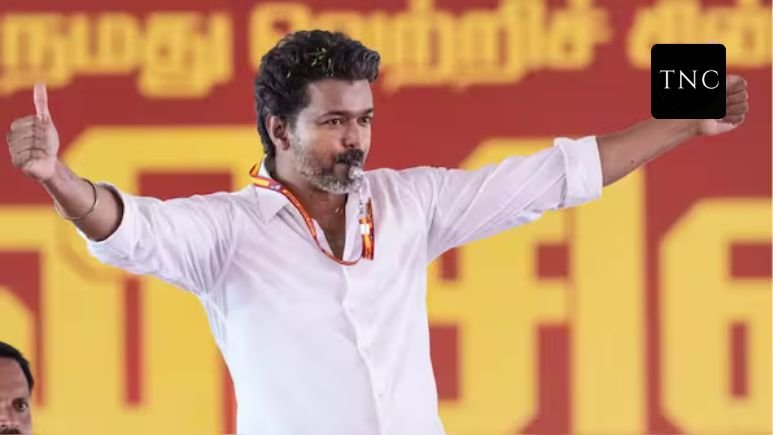

The convoy rolled through Chennai just after sunset. Outside Raj Bhavan, television vans clogged the road while party workers pressed against police barricades, shouting slogans into the humid evening air. Inside, actor-turned-politician Vijay carried a stack of support letters that could decide the future of Tamil Nadu politics.
Hours earlier, his party, Tamilaga Vettri Kazhagam (TVK), had stunned the political establishment by emerging as the single largest force in the state assembly elections. But victory on paper was not enough. The governor wanted proof. Numbers. Commitments. Stability.
By midnight, the political theatre had turned into a constitutional battle.
The Bharatiya Janata Party denied accusations that the governor was acting under pressure, insisting that constitutional procedure not political preference would determine who forms the government. Opposition leaders, meanwhile, accused the Centre of attempting to delay or influence the process behind closed doors.
This moment matters far beyond Tamil Nadu. It reflects a deeper shift unfolding across Indian politics: the collapse of traditional party equations, the rise of celebrity-led political movements, and the increasingly scrutinized role of governors in hung assemblies. The fight over Vijay’s numbers is not just about who becomes chief minister. It is about how power is negotiated when voters deliver fractured mandates and institutions are forced into the spotlight.
The election itself had already rewritten expectations. TVK, contesting its first major assembly battle under Vijay’s leadership, broke through the decades-long dominance of the DMK and AIADMK. Exit polls had hinted at a surge, but few anticipated the scale of the disruption.
The problem is arithmetic.
In a 234-member assembly, the majority mark remains firmly fixed. TVK emerged tantalizingly close but short of outright control. That transformed every smaller party and independent legislator into a potential kingmaker. Congress quickly signaled openness to supporting Vijay in order to prevent a BJP-backed formation from gaining ground in the state.
Governors in India occupy a peculiar constitutional position. Officially neutral, they are expected to ensure stable government formation when no party secures a clear majority. In practice, their decisions often trigger accusations of political bias especially when the governor is perceived to be aligned with the ruling party at the Centre. Critics argue that requests for repeated proof of majority or delays in inviting parties to form governments can become political tools. Supporters counter that governors are obligated to verify claims carefully in unstable situations.
That tension now sits at the heart of Tamil Nadu’s post-election drama.
For the BJP, the stakes are strategic. Tamil Nadu has long resisted the party’s expansion despite its dominance across large parts of northern and western India. A fractured mandate offers a rare opening to influence government formation indirectly. At the same time, the BJP cannot afford to appear openly interventionist in a state where regional identity politics remain powerful.
For Vijay, the challenge is even larger. Campaigning as an outsider is one thing. Converting electoral momentum into a functioning coalition government is another. His rise reflects public frustration with entrenched political structures, but charisma alone cannot survive a floor test in the assembly.
The Congress finds itself in an equally uncomfortable position. Supporting TVK may keep the BJP out, but it also risks weakening its already fragile relationship with long-time ally DMK. The party’s shrinking footprint across several states has forced it into increasingly tactical alliances designed more around survival than ideology.
And hovering above all of it is the governor’s office, a constitutional institution that repeatedly becomes controversial whenever election results produce uncertainty.
India has seen this movie before. From Maharashtra to Karnataka to Madhya Pradesh, government formation after hung mandates has increasingly moved from the ballot box into legal interpretation, late-night negotiations, and gubernatorial discretion. Each episode chips away at public trust while intensifying partisan suspicion.
The Tamil Nadu episode may ultimately end with a straightforward floor test. Vijay could prove his majority and form the government. Or alliances could shift again before the assembly even convenes. But the larger story is already clear: Indian politics is entering an era where personality-driven movements can rapidly disrupt old party systems, while institutions designed for constitutional balance face mounting pressure to prove their neutrality.
The bottom line: elections no longer end on counting day. In modern Indian politics, the real battle often begins after the numbers come in.
Also Read / “Politics Isn’t Cinema”: The Tamil Nadu Election Where Vijay’s Entry Changed Every Calculation .








Leave a comment