

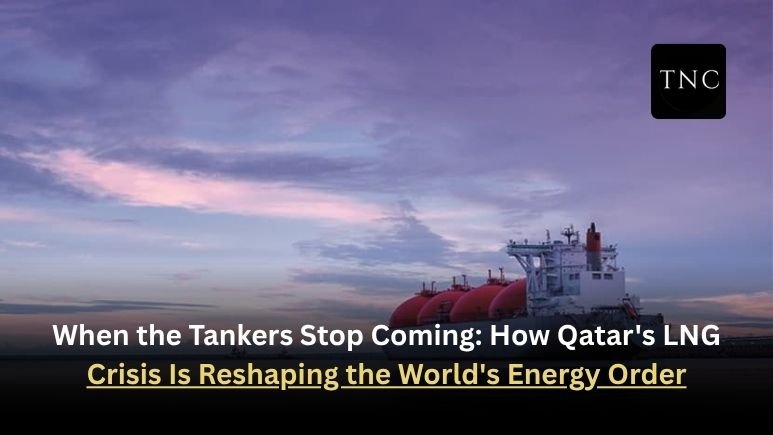

At Dahej port in Gujarat, a supervisor named Rakesh Patel stood on the jetty before sunrise, scanning the horizon where LNG tankers usually appear like slow-moving cities. The schedule on his clipboard showed a Qatari shipment due overnight. It never docked.
By mid-morning, calls began. First from the terminal operator. Then from a fertilizer plant inland. By noon, the message was clear: supplies were delayed, prices were rising, and nobody knew how long the disruption would last.
Rakesh folded the schedule and slipped it into his pocket. “We’ll manage today,” he said. “Tomorrow is the problem.”
What happened at Qatar’s Ras Laffan industrial hub isn’t just a regional disruption it’s a stress test for the entire global energy system.
Missile strikes tied to escalating Middle East conflict have knocked out roughly 17% of Qatar’s LNG export capacity, with repairs expected to take three to five years.
That matters because Qatar is not just another supplier. It accounts for about 20% of global LNG exports, feeding energy-hungry economies across Asia and Europe.
The question is no longer whether there will be disruption. It’s who absorbs the shock and how the world reshapes its energy future because of it.
1. Asia Will Feel the First Shock
The center of gravity is Asia. More than 80% of Qatar’s LNG flows into countries like India, China, Japan, and South Korea.
India is particularly exposed. Nearly 45% of its LNG imports come from Qatar, making it vulnerable to immediate supply and price shocks.
That dependency translates quickly into real-world consequences:
- Higher electricity costs
- Strain on fertilizer and industrial sectors
- A shift back to dirtier fuels like fuel oil or coal
South Korea, by contrast, has buffers stockpiles, diversified sourcing, and nuclear fallback. But even there, officials are preparing contingency plans.
Not all importers are equal. The crisis is exposing that hierarchy in real time.
2. Europe’s Energy Transition Faces a New Test
Europe had already pivoted toward LNG after reducing reliance on Russian gas. Qatar became a critical pillar of that strategy.
Now that pillar is cracked.
With supplies tightening, European gas prices have already shown sharp volatility, and storage strategies for upcoming winters are under pressure.
The implication is stark:
Europe may be forced to:
- Compete aggressively in spot markets
- Delay green energy transitions
- Reconsider long-term contracts with alternative suppliers
Energy security, once framed as a transition problem, is back to being a survival problem.
3. A Structural Shift in LNG Markets
This is not a temporary spike. It’s a structural shock.
With a chunk of global LNG offline for years:
- Prices gain a permanent geopolitical premium
- Buyers diversify away from single-source dependence
- Sellers like the U.S. and Australia gain leverage
The scramble for LNG cargoes has already begun, pushing prices sharply higher in Asia.
In effect, the market is fragmenting:
- Long-term contracts become more valuable
- Spot markets become more volatile
- Energy becomes more political
4. The Hidden Supply Chain Fallout
LNG isn’t just fuel it’s a backbone for modern industry.
The Ras Laffan disruption also affects:
- Helium supplies (critical for semiconductors)
- LPG used in households
- Petrochemical feedstocks
Countries like South Korea and China, deeply tied to global manufacturing, face second-order shocks that go far beyond power generation.
This is how an energy crisis quietly becomes a technology and inflation crisis.
5. The Geopolitical Risk Premium Is Back
For years, global energy markets operated on an assumption: supply chains, while complex, were ultimately stable.
That assumption is gone.
The Strait of Hormuz a narrow shipping lane now looms as a choke point again. Even temporary disruptions there can paralyze supply flows.
The message to markets is unmistakable:
Energy security is no longer about efficiency. It’s about resilience.
A single strike on a coastal industrial city has exposed a deeper truth: the global energy system is still fragile, still concentrated, and still vulnerable to geopolitics.
Countries that depend heavily on one supplier like India will feel the pain first. Others will adapt, but at a cost.
And for the next five years, every delayed tanker, every price spike, every policy shift will trace back to the same moment when the ships stopped arriving, and the world realized just how thin its energy cushion really was.
Also Read / The Night the Flames Reached the Gas Fields.












Leave a comment