


Inside a dim command center somewhere in the Middle East, a young intelligence officer stares at a wall of screens. Satellite feeds flicker. Drone footage streams in real time. Thousands of signals, heat signatures, vehicle movements, intercepted communications pulse across the dashboard.
A decade ago, analyzing this flood of information would have taken teams of analysts working for days, sometimes weeks.
Now the computer does it in minutes.
An AI system scans the data, flags suspicious activity near a suspected missile depot, and recommends a list of possible targets. Coordinates appear on the screen. Another algorithm simulates the strike and predicts collateral damage. Within moments, a commander reviews the options and approves the attack.
The missile launches.
From detection to decision, the entire process takes less time than it once took analysts just to organize the data.
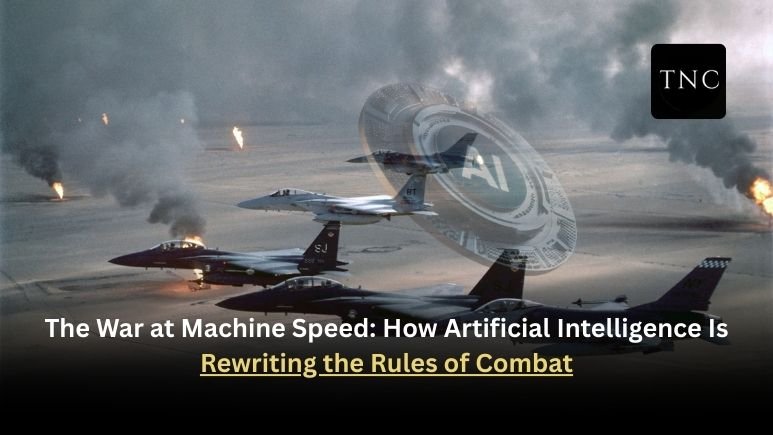
Artificial intelligence is rapidly transforming how wars are fought. In recent U.S. military operations, AI systems have begun compressing what the Pentagon calls the “kill chain” the process of identifying a target, verifying it, approving a strike, and assessing damage afterward. What once took days can now happen in hours or even minutes.
The shift marks one of the most significant changes in military strategy since the advent of precision-guided weapons. AI doesn’t just make wars more efficient. It fundamentally changes the speed, scale, and psychology of combat.
Modern battlefields generate staggering amounts of data. Satellites capture imagery around the clock. Drones stream video feeds. Electronic sensors intercept signals across land, sea, and air.
Human analysts alone can’t keep up.
That’s where artificial intelligence comes in.
Systems like the Pentagon’s Project Maven use machine learning to analyze surveillance images, identify objects such as tanks or launchers, and fuse information from dozens of intelligence sources.
Instead of analysts manually reviewing thousands of images, the system highlights anomalies and potential threats instantly.
The result is a radical acceleration of military decision-making.
In some recent conflicts, AI-assisted systems reportedly helped military planners process vast intelligence streams and generate strike options far faster than traditional planning methods.
Experts describe this phenomenon as “decision compression.” Planning cycles that once required days are shrinking to minutes.
AI also plays a role far beyond targeting:
- Predictive simulations: Algorithms run thousands of battle scenarios to predict enemy responses.
- Logistics optimization: AI manages supply chains and troop movements.
- Battle damage assessment: Computer vision quickly analyzes satellite images to determine whether a strike succeeded.
The strategic advantage is obvious. Faster decisions can overwhelm an opponent before they have time to react.
But the speed comes with risks.
One concern is overreliance on automated recommendations. If commanders trust algorithms too much, human judgment could gradually become secondary to machine-generated decisions.
Another issue is accountability.
AI systems can process enormous datasets, but they are only as reliable as the data they are trained on. Errors, misidentified buildings, faulty signals, incomplete intelligence can lead to tragic outcomes.
Some recent strikes linked to AI-assisted targeting have raised alarms after civilian sites were mistakenly hit, highlighting the ethical dilemmas of machine-speed warfare.
The geopolitical implications are even larger.
As AI lowers the cost of military operations replacing human risk with autonomous systems some experts worry that governments may find it easier to initiate conflicts.
In other words, when wars rely more on algorithms and robots than soldiers, the political barrier to using force may shrink.
Artificial intelligence isn’t just another military tool. It is changing the tempo of war itself.
Battles that once unfolded over weeks are now decided in hours. Intelligence once sifted by thousands of analysts can be processed by algorithms in seconds.
The future battlefield may not belong to the largest army.
Also Read / The Global Bill for a War With Iran.














Leave a comment