

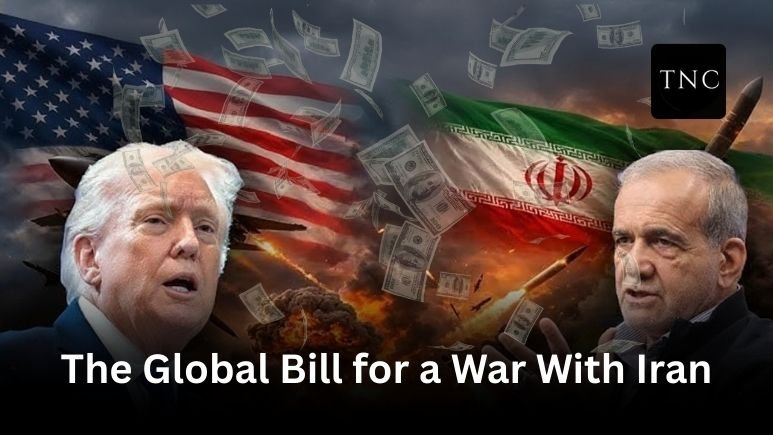

At dawn in Yokohama, the line of trucks at a fuel depot stretches around the block. Drivers sit in silence, engines off, watching the price board flicker higher. A shipping company manager checks his phone again. Overnight, crude oil crossed $100 a barrel. The message from headquarters is blunt: delay deliveries, fuel costs have doubled projections.
Half a world away, a textile factory in Gujarat recalculates its monthly electricity bill. In Berlin, economists at the European Central Bank run new inflation scenarios. What started as missile strikes in the Middle East has begun rewriting balance sheets across the globe.
War rarely stops at borders. This one travels through oil pipelines, shipping lanes, and financial markets.
The escalating conflict involving Iran has sent shockwaves through the global economy because the Middle East remains the heart of the world’s energy supply. Nearly 20 percent of global oil passes through the Strait of Hormuz, a narrow waterway that acts as a chokepoint for energy markets.
When that artery is threatened, oil prices surge, inflation rises, and governments scramble to protect their economies. Recent disruptions have already pushed crude prices toward or above $100 per barrel, reviving fears of an energy shock similar to past oil crises.
The real question isn’t whether the war will hurt the global economy it already is. The question is which economies will pay the highest price.
1. Asia: The Most Exposed Region
Asia is the world’s manufacturing hub and its energy Achilles’ heel. Countries like India, Japan, and South Korea depend heavily on oil and liquefied natural gas shipped through the Persian Gulf.
More than 80 percent of the crude moving through Hormuz heads to Asian markets, making the region extremely vulnerable to supply disruptions.
Japan, for example, is already considering emergency measures to soften the blow from rising fuel prices. Economists warn that sustained oil prices above $100 could slow growth and push the country toward stagflation.
India faces similar risks. Higher oil prices increase inflation, weaken the currency, and expand the country’s trade deficit. Manufacturing-heavy economies across Asia feel the shock first because energy costs ripple through transportation, factories, and consumer prices.
2. Europe: Inflation’s New Enemy
Europe thought it had already weathered its worst energy crisis after Russia’s invasion of Ukraine. A prolonged Iran conflict could reopen that wound.
Energy price spikes are likely to raise inflation across the eurozone and complicate the European Central Bank’s monetary policy.
For countries such as Germany, Italy, and the United Kingdom economies that depend on imported energy the result could be a familiar and uncomfortable mix: slow growth and stubbornly high prices.
3. The United States: Less Vulnerable, But Not Immune
The United States sits in a different position. As one of the world’s largest oil producers, it is somewhat insulated from supply shocks.
But American consumers still feel the effects at the gas pump. Fuel prices have already jumped sharply amid the conflict, and economists warn that sustained oil above $125 per barrel could shave nearly a percentage point off U.S. GDP growth.
In other words, even energy-rich economies can’t escape global oil markets.
4. The Unexpected Winners
Every crisis has beneficiaries.
Countries that export oil such as Norway, Canada, and Russia may see revenues surge as prices climb. Higher global energy prices have already increased the value of Russian oil exports, boosting government revenues despite sanctions.
Oil companies are also benefiting. Shares of energy producers have climbed as markets anticipate higher profits from rising crude prices.
But these gains come with geopolitical complications. Higher energy revenues can reshape alliances and finance ongoing conflicts.
Wars in the Middle East rarely stay local. They travel through oil tankers, currency markets, and household budgets.
If the Iran conflict drags on, Asia will likely bear the heaviest economic burden, Europe will struggle with inflation again, and the United States will feel the pressure through higher fuel costs.
Meanwhile, oil exporters will quietly count the profits.
The lesson is as old as the modern energy economy: when the Persian Gulf shakes, the entire world pays the bill.
Also Read / Why the U.S. Is Letting India Buy Russian Oil, and What It Means for Global Fuel Prices.












Leave a comment