

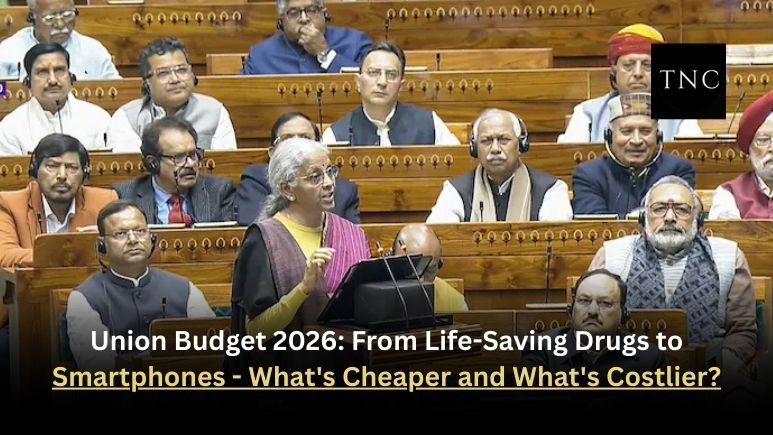

Cancer patients getting treatment will save thousands of rupees. Parents sending kids abroad for education face lower taxes. Smartphone manufacturers get cheaper components to boost local assembly. But smoke a cigarette or trade stock options, and the government’s coming for your wallet with significantly higher taxes. Finance Minister Nirmala Sitharaman’s Union Budget 2026-27 is making clear choices about what India should encourage and what it wants to discourage, with your cost of living hanging in the balance depending on which side of those choices you fall.
NEW DELHI — On Sunday, February 1, 2026, Finance Minister Nirmala Sitharaman presented a Budget focused on what she’s calling “Kartavya” (Duty), signalling a major shift toward healthcare affordability, high-tech self-reliance, and domestic manufacturing. With the fiscal deficit targeted at 4.3% of GDP and a massive ₹12.2 lakh crore capital expenditure plan, this Budget is trying to ease cost-of-living pressures through targeted customs duty cuts while simultaneously tightening the screws on speculative trading and “sin” products.
The healthcare wins: cancer drugs and rare disease treatments
The most celebrated part of this Budget is the aggressive push to lower critical medical care costs. Sitharaman announced complete exemption of Basic Customs Duty on 17 life-saving cancer drugs, a move that will save families thousands of rupees in treatment costs.
Anyone who’s watched a loved one battle cancer knows the financial devastation that comes with it. Chemotherapy drugs, targeted therapies, immunotherapy treatments cost lakhs of rupees, often requiring families to sell property, exhaust savings, or borrow at high interest rates just to afford treatment. Removing customs duty on these drugs won’t make cancer treatment cheap, but it makes it meaningfully more affordable.
Beyond cancer drugs, seven rare disease treatments were added to the duty-exempt list. Rare diseases affect small patient populations but often require extremely expensive specialized medications. Families dealing with these conditions have been bankrupted by treatment costs. This relief, while it won’t help millions of people, will be life-changing for the thousands it does affect.
Electronics and manufacturing: making “Make in India” actually work
Building on the Semiconductor Mission 2.0, the government slashed duties on specific components for mobile phones, tablets, and microwave ovens to boost local assembly.
This is part of the broader strategy to turn India into a manufacturing hub rather than just an assembly point for imported components. Lower duties on components make it cheaper for companies to manufacture domestically, which theoretically creates jobs, builds technical expertise, and reduces dependence on imports.
For consumers, this should translate to cheaper smartphones and electronics over time as local manufacturing scales up. For the industry, it’s a signal that the government is serious about supporting domestic production.
Green energy gets cheaper
Basic Customs Duty has been waived on lithium-ion cells and solar glass ingredients to make Electric Vehicles and solar panels more affordable.
EVs remain expensive for most Indian consumers, with prices that put them out of reach for middle-class buyers. Reducing component costs is essential if the government wants mass EV adoption rather than just luxury car buyers switching to electric. Similarly, making solar panels more affordable helps both large-scale renewable energy projects and individual homeowners wanting to install rooftop solar.
Travel and education abroad just got more accessible
For the middle class with international aspirations, this Budget offers significant relief:
Foreign travel: Tax Collected at Source (TCS) on overseas tour packages has been dramatically reduced from 5-20% down to just 2%, regardless of amount. That’s a huge cut. A family spending ₹5 lakh on an international vacation was previously paying up to ₹1 lakh in TCS. Now it’s ₹10,000.
Education and healthcare abroad: Remittances for foreign education and medical treatment under the Liberalised Remittance Scheme also saw TCS cut to 2%. Parents sending children abroad for university or families seeking specialized medical treatment overseas will face significantly lower upfront tax burdens.
Shopping from overseas: Duty on goods imported for personal use has been halved from 20% to 10%. Ordering electronics, clothing, or specialty items from international retailers just became notably cheaper.
These changes recognize that many Indians travel internationally, seek education abroad, and shop from global retailers. The previous high TCS rates were seen as punitive and didn’t significantly reduce such spending, just made it more expensive.
The sin tax hammer falls hard
To fund welfare schemes and infrastructure, the government increased taxes on what it considers “non-essential” and “sin” goods. This is where smokers, drinkers, and day traders get hit.
| What Got Taxed | How Much | What It Means |
| Tobacco & Gutkha | NCCD raised to 60% | Steep price increases for all chewing tobacco products |
| Alcohol & Scrap | TCS increased to 2% | Higher upfront costs for liquor purchases and industrial scrap |
| Stock Market Futures | STT hiked to 0.05% | Increased transaction costs for F&O traders |
| Stock Market Options | STT on Options Premium to 0.15% | Significant cost increase for retail option buyers |
The tobacco tax is classic sin tax policy: discourage harmful behavior while generating revenue. A 60% NCCD (National Calamity Contingent Duty) means tobacco products will see substantial price increases. The public health justification is sound, but it disproportionately affects lower-income users who are more price-sensitive.
The market transaction taxes are more interesting. The government is clearly trying to discourage retail speculation in derivatives. By hiking Securities Transaction Tax (STT) on futures and options, they’re making day trading and short-term speculation more expensive. This will hit retail traders hard, particularly those doing high-frequency trading with small margins.
Manish Jain, CEO of Bajaj Broking, framed it positively: “This Budget is about building confidence. By focusing on manufacturing-driven growth and healthcare, we are broadening India’s investment universe beyond short-term momentum.”
Translation: the government wants people investing in productive economic activity, not gambling on derivatives. Whether you agree depends on your view of market speculation’s role in price discovery versus its potential for retail investor losses.
The random items getting costlier
Some Budget changes seem almost arbitrary:
- Low-cost imported umbrellas (protecting domestic umbrella manufacturers?)
- ATM and cash dispenser machines (discouraging cash economy?)
- Imported luxury watches and high-end alcohol (classic luxury tax)
- Coffee roasting, brewing, and vending machines (unclear rationale)
These feel like targeted protections for specific domestic industries or revenue grabs from luxury consumption. The umbrella duty is particularly odd it’s not exactly a luxury item, and making cheap imported umbrellas more expensive just means people pay more for basic rain protection.
The tax system overhaul nobody’s talking about
Beyond specific duty changes, Sitharaman announced that the New Income Tax Act, 2025 will take effect from April 1, 2026, promising simplified rules and redesigned forms to reduce compliance burden for individual taxpayers.
This is potentially the most significant long-term change in the Budget. India’s tax code has been notoriously complex, with multiple exemptions, deductions, and provisions that make filing confusing and create opportunities for disputes. If the new act genuinely simplifies compliance, it could reduce the friction and cost of tax payment for millions of people.
The skepticism is whether “simplified” will actually mean simpler or just different. Previous attempts at tax simplification have sometimes created new complexities while claiming to reduce old ones.
Who wins and who loses
Winners:
- Cancer patients and families dealing with rare diseases
- Students going abroad for education
- Families traveling internationally
- People buying smartphones and electronics
- EV buyers and solar panel installers
- Anyone importing personal goods from abroad
Losers:
- Tobacco users facing 60% higher costs
- Day traders and options speculators hit with higher STT
- Alcohol consumers
- Anyone buying the random items that got costlier
The bigger picture
This Budget makes clear value choices: healthcare and education are priorities worth subsidizing. Manufacturing and green energy deserve support. International engagement for legitimate purposes should be facilitated. But speculation, sin products, and luxury consumption should be taxed heavily.
Whether you think this is good policy depends on your perspective. If you believe government should use tax policy to shape behavior, encourage productive activity, and discourage harmful consumption, this Budget does exactly that. If you believe government should minimize interference in personal choices and market activity, the sin taxes and speculation disincentives look like overreach.
For most middle-class Indians, the net effect is probably positive if you don’t smoke or day-trade. Healthcare costs down, travel costs down, electronics costs down, education remittance costs down. That’s meaningful relief on major expense categories.
For smokers and traders, you’re funding everyone else’s relief through significantly higher costs on your activities.
The ₹12.2 lakh crore capital expenditure target suggests the government is betting on infrastructure investment to drive growth. The 4.3% fiscal deficit target shows they’re trying to maintain some fiscal discipline while making these investments. Whether they can actually hit both targets while delivering the promised relief remains to be seen.
But at least cancer patients will pay less for life-saving drugs. In a Budget full of trade-offs, that’s one choice that’s hard to argue with.
Also Read / Nirmala Sitharaman’s Take on Trading: What India’s Finance Minister Wants Youth to Know About Responsible Investing.










Leave a comment