

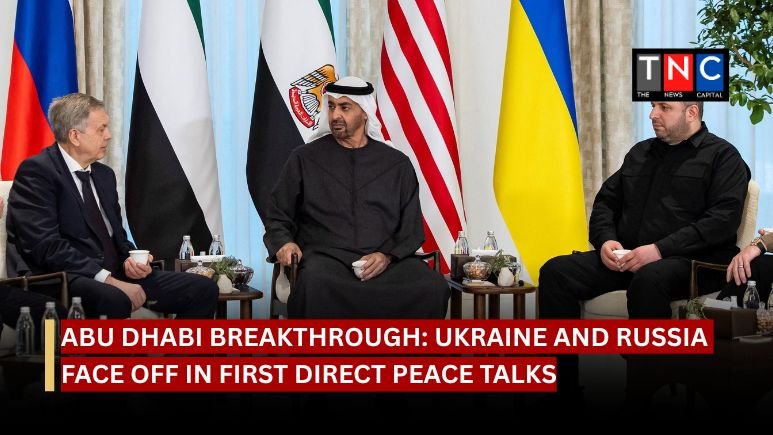

In a historic shift for the four-year conflict, negotiators from Kyiv and Moscow have sat down in the same room for the first time since 2022, with the Trump administration facilitating the Abu Dhabi summit aimed at bridging the “impossible gap” between Ukrainian sovereignty and Russian territorial demands. High-level negotiators from Ukraine, Russia, and the United States opened the first direct trilateral talks on Friday, January 23, 2026, to discuss a comprehensive peace plan spearheaded by President Donald Trump, with the summit continuing into Saturday and marking the most significant diplomatic effort to end the war since the full-scale invasion began in February 2022.
The Abu Dhabi meeting is the culmination of a frantic 72-hour diplomatic sprint across three continents that saw simultaneous high-level engagements designed to create conditions for direct negotiations.
- The Davos Spark: On Thursday, President Trump met with Ukrainian President Volodymyr Zelenskyy at the World Economic Forum in Davos, where Zelenskyy announced that a peace document was “nearly ready,” signalling Ukrainian willingness to engage despite previous scepticism about Trump’s approach.
- The Kremlin Connection: Simultaneously, U.S. special envoy Steve Witkoff and Jared Kushner held a four-hour marathon session with Vladimir Putin in Moscow to finalize the “logic of the negotiation” and secure Russian commitment to direct talks.
- The Trilateral Format: Unlike previous “proximity talks” where intermediaries moved between rooms, the Abu Dhabi sessions led by Ukrainian negotiator Rustem Umerov have included joint sessions to define the parameters of a ceasefire, representing a significant diplomatic advancement.
- UAE Mediation: The choice of Abu Dhabi as venue reflects the UAE’s careful balancing between Western partnerships and Russian relationships, positioning it as one of few neutral grounds acceptable to both sides.
Despite the optimism generated by the mere fact of direct talks, the core issue remains a territorial zero-sum game with fundamentally incompatible positions.
- Russia’s Red Line: The Kremlin insists that for any deal to move forward, Kyiv must cede the roughly 20% of the Donbas region it still successfully defends. Kremlin spokesman Dmitry Peskov reiterated that Ukrainian withdrawal is a “non-negotiable condition” for proceeding with broader negotiations.
- Ukraine’s Counter-Proposal: Zelenskyy has flatly rejected land-for-peace swaps, maintaining that Ukraine cannot surrender territory conquered by force without abandoning fundamental sovereignty principles and encouraging future Russian aggression.
- The Free Economic Zone Proposal: The current U.S. proposal reportedly floats the idea of a demilitarized free economic zone in the disputed eastern regions, allowing for administrative autonomy without a formal change in sovereignty a creative attempt to bridge incompatible positions.
- Security Guarantees: A key pillar of the talks is a bilateral security pact between Washington and Kyiv, which Zelenskyy claims is already drafted and “ready for signature” should a territorial compromise be reached, providing Ukraine with reassurance against future Russian attacks.
The Trump Plan: Expanding Beyond Territory
The “Trump Plan” is believed to be an evolution of an earlier 20-point draft, now expanded to address broader geopolitical tensions beyond the immediate territorial dispute.
| Core Pillar | Proposed Mechanism |
| Energy Ceasefire | Mutual halt on attacks against Ukrainian power grids and Russian oil refineries |
| NATO Status | A potential “moratorium” on Ukrainian membership for 20 years |
| The ‘Board of Peace’ | Use of frozen Russian assets to pay a $1 billion fee for Russia to join the BoP |
| Frozen Assets | Reallocation of $300B in seized Russian reserves toward a “Marshall Plan” for Ukraine |
| Donbas Status | Demilitarized free economic zone with administrative autonomy |
| Crimea | [Status unclear likely deferred or subject to separate negotiation] |
While negotiators meet in the luxury of the UAE, the situation on the ground remains dire, with energy infrastructure becoming both a humanitarian crisis and a negotiating card.
- Winter Weaponization: The talks opened as thousands in Kyiv and Kharkiv endured sub-zero temperatures without heating or water following a fresh wave of Russian drone strikes targeting energy infrastructure.
- EU Accusations: The European Union has accused Moscow of “weaponizing the winter” to force concessions at the negotiating table, using civilian suffering as leverage to extract territorial and political concessions.
- Mutual Vulnerability: The proposed energy ceasefire acknowledges mutual vulnerability Ukraine depends on power grids for civilian survival during winter, while Russia’s oil refineries are critical economic infrastructure vulnerable to Ukrainian drone strikes.
- First Test: Whether both sides can implement even a limited energy infrastructure ceasefire will test their willingness to make concessions and ability to control forces that may not want the fighting to stop.
Zelenskyy faces the impossible task of balancing territorial integrity principles with the practical need for security guarantees that could prevent future Russian aggression.
- No Land for Peace: The Ukrainian president has repeatedly stated that trading land for peace is unacceptable, both as a matter of principle and because it would reward Russian aggression while encouraging future territorial revision.
- Security Pact Priority: For Ukraine, meaningful security guarantees from the U.S. and potentially other powers are essential to compensate for any compromise on NATO membership or territorial control.
- Domestic Constraints: Zelenskyy faces a Ukrainian population that has endured four years of war and will view any territorial concessions as betrayal unless accompanied by ironclad security arrangements.
- Reconstruction Funding: Access to the $300 billion in frozen Russian assets for reconstruction provides economic incentive to negotiate, but cannot substitute for security concerns.
Putin’s demands reflect his war aims of securing territorial gains while ensuring Ukraine never joins NATO or hosts Western military infrastructure.
- Territorial Maximalism: Moscow’s insistence on Ukrainian withdrawal from remaining Donbas territory suggests Putin views territorial gains as essential to justify the war’s costs to the Russian population.
- NATO Exclusion: The 20-year moratorium on Ukrainian NATO membership addresses Russia’s stated security concerns about Western military infrastructure approaching its borders.
- Sanctions Relief: Russia likely seeks sanctions relief as part of any comprehensive deal, though this is not explicitly mentioned in the disclosed pillars the Board of Peace membership fee structure may provide a mechanism.
- Legitimacy Recognition: Putin needs an outcome that can be portrayed domestically as victory or at minimum strategic success rather than humiliating retreat.
The $300 billion in frozen Russian reserves represents both a potential reconstruction funding source and a major complication in negotiations.
- Marshall Plan Vision: Reallocating seized assets toward Ukrainian reconstruction creates a justice narrative Russia pays for the damage it caused while providing essential funding for recovery.
- Legal Complexity: Actually seizing sovereign assets (as opposed to freezing them) raises complex international law questions about precedent and future investment security in Western financial systems.
- Board of Peace Fee: Using frozen assets to pay Russia’s $1 billion Board of Peace membership fee represents creative diplomacy Russia “pays” but doesn’t actually lose money, making the fee more acceptable.
- Russian Leverage: Control over $300 billion in frozen assets gives the West significant leverage over Russian behaviour, but only if Moscow values access to those funds more than territorial or security demands.
The proposed 20-year NATO membership moratorium attempts to address Russian security concerns while preserving Ukrainian sovereignty and future options.
- Russian Reassurance: A two-decade moratorium provides Putin with concrete evidence that Ukraine won’t immediately join NATO, addressing his stated security concerns about encirclement.
- Ukrainian Flexibility: The time limit preserves Ukraine’s theoretical right to join NATO eventually, while bilateral security pacts with the U.S. provide more immediate protection.
- Precedent Concerns: NATO allies worry that accepting Russian veto power over membership creates dangerous precedent, though the moratorium framing suggests Ukrainian choice rather than Russian diktat.
- Article 5 Substitute: The bilateral U.S.-Ukraine security pact would need to approximate NATO Article 5 collective defence guarantees to make the moratorium acceptable to Kyiv.
Despite the historic nature of direct talks, numerous obstacles could derail negotiations before substantive progress occurs.
- Trust Deficit: Four years of brutal warfare, documented atrocities, and broken ceasefires create profound mutual distrust that makes any agreement difficult to reach and harder to implement.
- Verification Challenges: Ensuring compliance with energy ceasefires, territorial arrangements, and demilitarization requires robust verification mechanisms that both sides will resist as intrusive.
- Spoiler Threats: Hardliners in both Russia and Ukraine may seek to sabotage negotiations through provocations or refusal to implement agreed measures.
- Territorial Details: The devil is in the details of any “demilitarized free economic zone” who controls security, administration, courts, taxation, borders, and other sovereignty attributes?
The Abu Dhabi talks could produce multiple outcomes ranging from comprehensive peace to complete failure.
- Energy Ceasefire Only: A limited agreement halting attacks on civilian infrastructure while deferring territorial questions might be achievable as a first step and immediate humanitarian relief.
- Framework Agreement: A broad framework outlining principles for future detailed negotiations without resolving core territorial disputes could maintain momentum while acknowledging complexity.
- Comprehensive Deal: Full resolution of territorial status, NATO membership, security guarantees, and frozen assets remains possible but unlikely given the wide gap between positions.
- Collapse: Failure to find common ground could lead to talks breaking down, potentially triggering renewed military escalation as both sides abandon diplomacy.
The Abu Dhabi talks represent the first time since 2022 that Ukrainian and Russian negotiators sat in the same room for direct discussions, a diplomatic milestone facilitated by Trump’s simultaneous engagement with both Zelenskyy and Putin but the fundamental contradiction between Russia’s non-negotiable demand for Ukrainian territorial withdrawal and Zelenskyy’s flat rejection of land-for-peace swaps remains unbridged, with creative proposals like demilitarized economic zones and frozen asset reallocation attempting to square the circle while thousands of Ukrainians endure another winter without heat as Russia weaponizes cold to extract concessions at the negotiating table.
Also Read / Greenland Thaw: Trump Rescinds Tariff Threats After NATO ‘Arctic Framework’ Breakthrough.










Leave a comment