

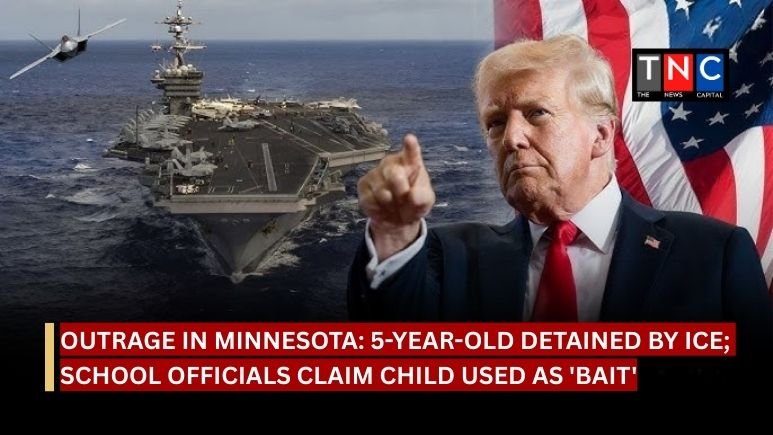

In a significant escalation of Middle Eastern tensions, President Donald Trump has confirmed a massive U.S. naval deployment to the Gulf region as a direct response to Iranian “miscalculations” and chilling warnings from Tehran’s Revolutionary Guards that their forces are ready to strike. President Trump announced on Thursday night, January 22, 2026, that a “massive fleet” and an “armada” of U.S. warships are heading toward Iran, signalling a potential showdown after months of simmering unrest and nuclear threats, with the President issuing a stark warning: “We have a lot of ships going that direction just in case… we’ll see what happens.”
The U.S. deployment is reportedly one of the largest concentrated naval movements in the region since the mid-2020s, representing a massive show of force designed to deter Iranian actions and project American power.
- Strategic Diversion: Ship-tracking data and defence officials confirm that the USS Abraham Lincoln aircraft carrier strike group has been diverted from the South China Sea toward West Asia, abandoning Indo-Pacific patrol missions to focus on the Iranian threat.
- Carrier Strike Group Components: A carrier strike group typically includes the aircraft carrier itself, 60-80 combat aircraft, guided-missile cruisers, destroyers with advanced air defence systems, attack submarines, and support vessels representing massive firepower.
- Potential Reinforcements: Unconfirmed reports suggest the USS George H.W. Bush carrier strike group, which left Norfolk on January 13, may also be heading to the region, adding hundreds of missile tubes and advanced fighter wings to the U.S. posture.
- Surveillance Emphasis: Trump emphasized that Iran is under “close watch,” noting that the deployment serves as a deterrent against the “thousand-year-old” practice of executing peaceful protesters framing military deployment in humanitarian terms.
Tehran responded with equal bellicosity, marking its National Day of the Guards with a high-alert warning that Iranian forces are prepared for immediate conflict.
- The IRGC Warning: General Mohammad Pakpour, commander of the Islamic Revolutionary Guard Corps, stated that his forces have their “finger on the trigger” and are more prepared than ever to carry out the orders of Supreme Leader Ayatollah Ali Khamenei.
- Readiness Posture: The “finger on the trigger” language suggests Iranian forces are at heightened alert levels, potentially with pre-delegated authority to respond to American attacks without waiting for central command authorization.
- Potential Targets: General Ali Abdollahi Aliabadi warned that in the event of a U.S. strike, all American interests, bases, and “centres of influence” in the region would become legitimate targets for retaliation threatening U.S. forces across the Middle East.
- Ferocious War Warning: Iranian Foreign Minister Abbas Araghchi warned that an all-out confrontation would be “ferocious” and would drag on far longer than “fantasy timelines” suggested by U.S. or Israeli officials, preparing Iranian domestic audiences for prolonged conflict.
The Nuclear Dimension: Enrichment and Red Lines
The current standoff is inextricably linked to the revival of Iran’s nuclear ambitions and the aftermath of the “12-day war” in June 2025, which remains a reference point for both sides.
| Strategic Factor | Current Status |
| US Military Goal | Deterrence of protester executions & nuclear resumption |
| Iranian Casualties | Official death toll of 3,117 in recent protests |
| Nuclear Enrichment | Trump warned: “They can’t do the nuclear… If they do, it’s going to happen again” |
| June 2025 Precedent | “12-day war” established templates for potential conflict |
| Board of Peace Angle | Russia reportedly offered $1B to join Trump’s Gaza reconstruction body |
- Nuclear Red Line: Trump’s statement “They can’t do the nuclear… If they do, it’s going to happen again” suggests that Iranian advancement toward weapons-grade enrichment would trigger military strikes similar to the June 2025 operation.
- Enrichment Status: While Iran has not publicly announced weapons-grade enrichment (90%+ purity), intelligence assessments likely indicate progress that has triggered American alarm.
- Breakout Timeline: The concern centers on Iran’s “breakout timeline”—how quickly they could produce weapons-grade material if they made the decision, with estimates potentially now measured in weeks rather than months.
President Trump claimed his aggressive posturing has already saved lives, asserting that he forced Tehran to cancel the planned executions of 837 protesters through credible military threats.
- The Threat: “I said, if you hang those people, you’re going to be hit harder than you’ve ever been hit,” Trump told reporters, characterizing the naval deployment as backing up his ultimatum with credible force.
- Execution Pause: Earlier reports indicated Iran did halt a mass execution of approximately 800 protesters after Trump’s warnings and the initial announcement of the halt in executions from the UN Security Council emergency session.
- “Locked and Loaded”: Trump added that the U.S. military is “locked and loaded” to protect the Iranian people, framing potential military action as humanitarian intervention rather than aggression.
- Lives Saved Claim: The President is using the execution pause as evidence that his maximum pressure approach works, arguing that military threats save lives by deterring regime violence.
As the fleet approaches the Strait of Hormuz, the international community remains on edge, with oil prices showing sensitivity to the prospect of a “rupture” in global energy supply chains.
- Chokepoint Significance: The Strait of Hormuz is the world’s most important oil transit chokepoint, with roughly 21 million barrels per day (about 21% of global petroleum liquids consumption) passing through in normal conditions.
- Iranian Closure Threats: Iran has previously threatened to close the strait in response to military action, which would immediately spike global oil prices and create supply shortages.
- Mine Warfare: Iranian capabilities include naval mines, anti-ship missiles, fast attack craft, and other asymmetric weapons designed to threaten commercial shipping and military vessels in the confined waters.
- Economic Impact: Any sustained disruption to Strait of Hormuz traffic would create global economic shock, affecting not just oil prices but transportation costs, inflation, and economic growth worldwide.
Energy markets are already responding to the escalating military tensions with price movements reflecting supply disruption concerns.
- Price Volatility: Oil prices are showing increased volatility as traders assess the probability of conflict that could disrupt Gulf exports or close the Strait of Hormuz.
- Risk Premium: The “risk premium” built into oil prices the additional cost reflecting geopolitical uncertainty is rising as naval forces approach potential conflict zones.
- Strategic Reserve Considerations: Governments with strategic petroleum reserves are likely assessing whether to release stocks if conflict disrupts supply, potentially moderating price spikes.
- Alternative Routes: There are limited alternative routes for Gulf oil exports, making the Strait of Hormuz nearly impossible to bypass in the event of closure or significant conflict.
The U.S. naval deployment and Iranian threats create ripple effects throughout the Middle East, affecting allies, adversaries, and neutral parties.
- Israeli Coordination: Israel likely coordinated with the U.S. on the deployment and may have shared intelligence about Iranian nuclear progress that triggered the escalation.
- Gulf Arab Concerns: Saudi Arabia, UAE, and other Gulf states host American bases that would become Iranian targets in any conflict, creating tension between supporting the U.S. and avoiding Iranian retaliation.
- Russian Interests: The reported Russian offer of $1 billion to join the Board of Peace suggests Moscow is seeking influence over Middle Eastern dynamics while managing its Iran relationship.
- European Anxiety: European nations fear being drawn into a U.S.-Iran conflict that could disrupt energy supplies and create refugee flows without having been consulted on American escalation decisions.
The naval deployment and Trump’s threats raise fundamental questions about legal authority, strategic wisdom, and potential consequences.
- Congressional Authorization: Trump’s ability to conduct military strikes on Iran without congressional authorization is questionable, though presidents have claimed broad authority for defensive actions and protecting American interests.
- Humanitarian vs. Strategic: The framing as protecting Iranian protesters obscures strategic objectives around nuclear weapons and regional influence, potentially creating mission confusion.
- Escalation Dynamics: Each side’s threats create pressure to follow through if challenged, establishing dynamics where backing down appears weak and miscalculation can trigger conflict neither side necessarily wants.
- Exit Strategy: Trump’s “locked and loaded” rhetoric and carrier deployments create expectations of action that may be difficult to walk back without appearing to have blinked.
As the armada approaches the Gulf, multiple potential outcomes remain possible, ranging from successful deterrence to catastrophic conflict.
- Successful Deterrence: Iran refrains from executing protesters and halts nuclear weapons work, Trump claims victory through strength, and the crisis de-escalates without kinetic conflict.
- Limited Strikes: The U.S. conducts surgical strikes on nuclear facilities or IRGC targets, Iran retaliates against regional targets, and both sides escalate or negotiate depending on damage assessment and domestic pressures.
- Full-Scale War: Miscalculation or deliberate escalation triggers sustained conflict involving closing the Strait of Hormuz, attacks on Gulf oil infrastructure, Israeli involvement, and potential ground force deployment.
- Proxy Escalation: Rather than direct conflict, Iran increases attacks via proxies (Hezbollah, Houthis, Iraqi militias) against U.S. and allied targets throughout the region.
Trump’s “armada” deployment and Iran’s “finger on the trigger” warnings create the most dangerous U.S.-Iran confrontation in years, with massive naval forces converging on the Gulf while both sides issue threats they may feel compelled to execute the President claims his aggression already saved 837 protesters from execution, but the nuclear enrichment red line and IRGC readiness posture suggest the underlying drivers of conflict remain unresolved, making the Strait of Hormuz a potential flashpoint where miscalculation could trigger the “ferocious” war Iran’s foreign minister warns would exceed American “fantasy timelines” for quick victory.
Also Read / Halt at the Gallows: Iran Pauses 800 Executions After Trump’s ‘Grave Consequences’ Warning.












Leave a comment