

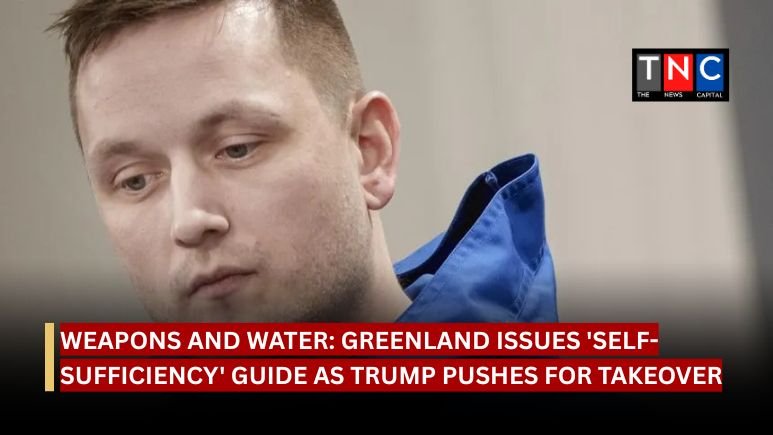

When a government tells its citizens to stockpile weapons and ammunition alongside food and water, you know something has fundamentally shifted. On the surface, Greenland’s new emergency preparedness guide talks about power outages and extreme weather standard crisis planning for an Arctic territory. But everyone understands what’s really happening: a population of 57,000 people, living on the world’s largest island, is being told to prepare for the possibility that a superpower might try to take their homeland, and they might need to survive on their own while the world figures out what to do about it.
The government of Greenland (Naalakkersuisut) on Wednesday (January 21, 2026) unveiled a comprehensive new emergency preparedness brochure titled “Prepared for Crises Be Self-Sufficient for Five Days.” The document, which notably advises citizens to maintain stockpiles of hunting weapons and ammunition alongside traditional emergency supplies like water, food, and medical kits, arrives at a moment of unprecedented geopolitical tension as the island finds itself trapped at the centre of an escalating confrontation between the United States and the Kingdom of Denmark over its future sovereignty.
The timing is impossible to ignore. This isn’t routine civil defence planning it’s a survivalist response to a genuine existential threat from the world’s most powerful military, delivered in the bureaucratic language of disaster preparedness to avoid panic while still conveying urgency.
At a press conference in Nuuk, Greenland’s capital, Self-Sufficiency Minister Peter Borg carefully framed the handbook as a prudent measure for any modern Arctic state facing the realities of climate change, geographic isolation, and global instability:
“This is an insurance policy,” Borg stated, choosing his words with obvious care. “We don’t expect to have to use it, but we are strengthening the security and resilience of our population against a backdrop of profound global uncertainty.” The subtext was clear to everyone in the room: that “global uncertainty” has a name, and it’s currently threatening to annex your country.
Beyond standard emergency supplies recommended by civil defense agencies worldwide, the guide emphasizes Greenland’s unique subsistence culture and the practical realities of survival in one of Earth’s most remote and harsh environments. It urges households to maintain a minimum five-day supply of essentials for every person, including:
- Water Security: 3 liters of potable water per person per day (15 liters total per person for the five-day period) critical in a region where infrastructure is fragile and water treatment facilities could fail during crises.
- Hunting Weapons and Ammunition: Perhaps the guide’s most striking recommendation, reflecting both Greenland’s Indigenous subsistence traditions and the grim reality that if supply chains are severed whether by conflict, blockade, or political chaos many Greenlanders will need to harvest local wildlife (seals, caribou, fish) to survive. This isn’t symbolic; it’s practical survival advice for a population where traditional hunting remains a crucial food source even in normal times.
- Communication Equipment: Battery-powered or hand-crank emergency radios to maintain contact with authorities and receive updates if electrical grids fail or are deliberately targeted during any conflict scenario.
- Subsistence Tools: Fishing equipment, nets, and hooks again emphasizing that Greenlanders may need to rely on traditional food-gathering methods if modern supply chains collapse.
- Arctic Survival Gear: Warm emergency clothing suitable for extended periods in extreme cold, recognizing that heated buildings might become uninhabitable if power infrastructure is damaged or fuel supplies are interrupted.
The release of these guidelines coincided almost certainly not by accident with President Trump’s appearance at the World Economic Forum in Davos, Switzerland, where he delivered characteristically contradictory messages about Greenland that managed to be both de-escalatory and threatening simultaneously.
Trump’s mixed signals from Davos:
- The Tactical Retreat: Trump declared on Wednesday that he “won’t use military force” to acquire Greenland, appearing to walk back earlier inflammatory rhetoric that had explicitly refused to rule out invasion as a policy option. The statement brought sighs of relief in European capitals that had been genuinely alarmed by the prospect of intra-NATO military conflict.
- The Continuing Pressure: However, Trump immediately undermined his own de-escalation by maintaining that Greenland currently lies “virtually undefended” (a debatable claim given Denmark’s military presence and NATO commitments) and demanding “immediate good-faith negotiations” with Denmark to voluntarily transfer “right, title, and complete ownership” of the territory to the United States. In other words: I won’t invade, but you need to give it to me anyway.
- The NATO Carrot: Following a closed-door meeting with NATO Secretary-General Mark Rutte, Trump announced he was rescinding his previous threat to impose 25% tariffs on European Union goods tariffs he’d threatened as retaliation for European opposition to his Greenland ambitions. Instead, Trump cited a vague new “framework agreement” to address U.S. security concerns in the Arctic through collaborative mechanisms rather than unilateral annexation.
- Greenland’s Cautious Response: Greenlandic Prime Minister Jens-Frederik Nielsen remarked on Tuesday that while a direct U.S. military operation now appears “increasingly unlikely” given international pressure and Trump’s Davos statements, the autonomous territory’s government cannot afford complacency and must remain prepared for any scenario including economic coercion, proxy conflicts, or sudden policy reversals from Washington.
The strategic context driving U.S. interest:
While the White House frames its Greenland obsession primarily around the island’s role in America’s “Golden Dome” ballistic missile defense architecture the network of early-warning radars and interceptor systems designed to detect and destroy incoming nuclear missiles the strategic value extends far beyond missile defense:
| Metric | Details / Current Status (January 22, 2026) |
| Local Opposition to U.S. Sovereignty | 85% of Greenlanders oppose becoming part of the United States |
| Indigenous Population | Nearly 90% of the 57,000 residents are Inuit or of mixed Indigenous heritage |
| Economic Leverage | EU Parliament suspended trade negotiations with U.S. over the sovereignty dispute |
| Danish Government Position | Standing firm on “non-negotiable red lines” regarding Greenland’s right to self-determination |
| Critical Minerals | Greenland contains 25 of 34 minerals classified as strategically critical |
| Military Infrastructure | U.S. already operates Pituffik Space Base under Danish agreement |
“What we’re witnessing is colonial ambition dressed in the language of national security. The United States wants Greenland’s resources, its strategic position, and its Arctic access but doesn’t want to acknowledge that 57,000 actual people live there with their own rights and preferences,” stated Dr. Klaus Dodds, professor of geopolitics at Royal Holloway, University of London, in an interview.
“The emergency guide is our government’s way of saying: we’re serious, we’re prepared, and we’re not going to be passive victims if this escalates. Greenlanders have survived in the Arctic for thousands of years. We’ll survive whatever Washington throws at us,” said Aqqaluk Lynge, a prominent Greenlandic Indigenous rights activist and former member of the UN Permanent Forum on Indigenous Issues.
The local sentiment in Greenland remains overwhelmingly, almost uniformly, hostile to any change in sovereignty that would place the island under American control. Polling consistently shows 85% opposition to joining the United States, with support barely reaching double digits even when Americans offer vague promises of economic development and investment.
This resistance isn’t simply anti-American sentiment it reflects deep cultural identity as Indigenous Inuit people who have fought for decades to gain autonomy from Denmark and are in no mood to trade Danish oversight for American control. The Greenlandic independence movement, which has been gradually building political and economic foundations for eventual full sovereignty, views American annexation as essentially destroying everything they’ve worked toward.
For many in Nuuk and the scattered settlements across Greenland’s vast coastline, the new emergency preparedness guidelines represent something profoundly symbolic beyond their practical survival value. By explicitly including hunting weapons in official government crisis advice recommendations that go well beyond typical civil defense planning the Naalakkersuisut is acknowledging a grim reality that no government wants to state explicitly: in the event of geopolitical blockade, economic warfare, or even limited conflict arising from this sovereignty dispute, Greenlanders may genuinely need to rely on their ancient subsistence traditions to survive a thoroughly modern superpower confrontation.
It’s a message that resonates deeply in a culture where living off the land and sea isn’t nostalgic tradition but practical necessity, where hunting seals and caribou isn’t recreation but food security, and where the boundary between modern infrastructure and Stone Age survival skills remains remarkably thin.
The emergency guide is Greenland’s government telling its people: we hope diplomacy prevails, we believe conflict remains unlikely, but if the worst happens if supply ships stop coming, if infrastructure fails, if you’re suddenly cut off from the systems that sustain modern life you have the skills and tools to endure. Your ancestors survived ice ages. You can survive this.
Whether that preparation will prove necessary remains uncertain. Trump’s Davos statements suggest he’s retreating from the most extreme rhetoric, at least temporarily. European unity against American annexation appears solid. And the practical difficulties of actually seizing and holding Greenland against determined local resistance, Danish opposition, and international condemnation would be enormous even for the U.S. military.
But the fact that a government felt compelled to issue these guidelines at all that 57,000 people are being told to stockpile weapons and prepare for self-sufficiency because a superpower covets their island reveals how thoroughly the post-Cold War assumptions about sovereignty, alliances, and international law have broken down.
Greenland didn’t ask to become a geopolitical flashpoint. Its people want to continue their quiet path toward greater autonomy and eventual independence, preserving their Indigenous culture while carefully integrating beneficial aspects of modernity. Instead, they find themselves pawns in a great power competition over Arctic resources and strategic positioning, preparing for crises they didn’t create and don’t want.
The weapons are being checked. The water is being stored. The fishing gear is being inventoried. And 57,000 people in the Arctic are hoping desperately that their government’s “insurance policy” never needs to be activated while preparing for the possibility that it might.
Also Read / Greenland Thaw: Trump Rescinds Tariff Threats After NATO ‘Arctic Framework’ Breakthrough.






Leave a comment