

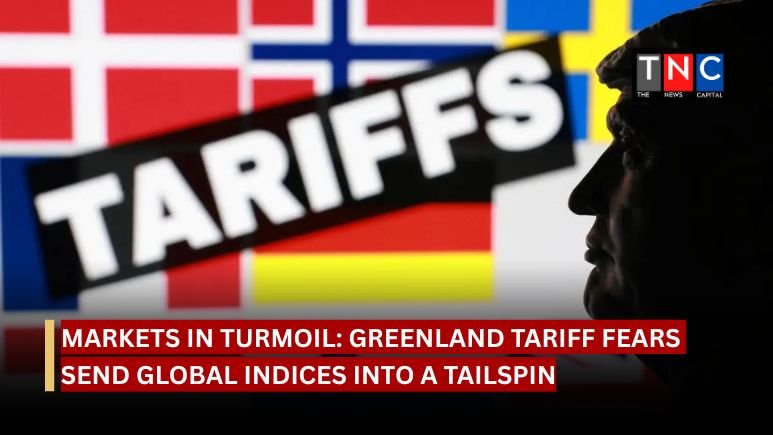

Geopolitical shockwaves from President Donald Trump’s “Greenland ultimatum” have triggered a widespread sell-off across Asia and Europe, while safe-haven assets like gold and silver surge to historic peaks amid the most significant transatlantic trade rift in decades. Global markets fell for a third straight session on Wednesday, January 21, 2026, as investors grappled with the economic fallout of Trump’s threat to impose a 25% tariff on eight European nations over the Greenland purchase standoff, with the Nifty 50 slipping below the critical 25,200 mark while Japan’s Nikkei 225 led regional losses as domestic fiscal uncertainty compounded the global risk-off mood.
The primary catalyst for the current volatility is the weekend announcement from the White House targeting Denmark, Norway, Sweden, France, Germany, the United Kingdom, the Netherlands, and Finland with escalating tariffs designed to force territorial concessions.
- The Two-Step Levy: Trump has decreed a 10% tariff starting February 1, 2026, escalating to 25% on June 1, unless these nations facilitate the “Complete and Total purchase” of Greenland from Denmark.
- Wall Street Contagion: The Asia-Pacific rout followed a brutal Tuesday session on Wall Street, where the S&P 500 and Nasdaq 100 plunged over 2%, marking their steepest single-day losses in three months.
- Trade War Escalation Risks: Analysts warn that if the EU retaliates with its “Anti-Coercion Instrument” targeting U.S. banking, technology, and agricultural exports, the conflict could shift from a contained dispute into a systemic stagflationary shock to global growth.
- Confidence Collapse: The tariff threats undermine investor confidence not just in affected European markets but globally, as traders question whether any international trade relationship remains secure from Trump’s territorial and economic demands.
📊 Asian Markets: Bloodbath with Selective Recovery
The impact was felt sharply across major Asian hubs, though some indices saw late-day recovery due to short-covering and bargain hunting after steep initial declines.
| Index | Closing Level / Status (Jan 21, 2026) | Change (%) |
| Nikkei 225 (Japan) | 52,774.64 | -0.4% |
| Nifty 50 (India) | 25,157.00 | -0.3% |
| SENSEX (India) | 81,910.00 | -0.33% |
| Kospi (S. Korea) | Trading Lower | -0.41% |
| Hang Seng (Hong Kong) | 26,584.57 (Bargain buying) | +0.4% |
- Japanese Double Whammy: In Tokyo, the “Greenland effect” was amplified by domestic political crisis, creating a perfect storm of geopolitical and fiscal concerns for investors.
- Indian Resilience: Indian markets showed relative resilience compared to regional peers, though the sub-25,200 Nifty level represents a psychologically important breach.
- Hong Kong Divergence: The Hang Seng’s positive close reflected bargain hunters emerging after steep declines in previous sessions, betting the sell-off had been overdone.
- Korea Vulnerability: South Korea’s export-dependent economy faces particular exposure to trans-Pacific trade disruptions, explaining sustained selling pressure.
Japan’s Compounding Crisis: Fiscal and Political Chaos
In Tokyo, geopolitical tariff fears combined with domestic political and fiscal turmoil to create an especially toxic environment for investors.
- Bond Market Panic: Yields on 10-year Japanese Government Bonds (JGBs) surged to 2.359%, their highest level since the late 1990s, as investors fled debt markets on fiscal sustainability concerns.
- Takaichi’s Snap Election: Prime Minister Sanae Takaichi’s call for a snap election created political uncertainty at precisely the wrong moment, with markets questioning policy continuity.
- Sales Tax Suspension: Takaichi’s proposal to suspend consumption taxes while politically popular is seen by bond markets as worsening Japan’s already massive debt burden (over 250% of GDP), the highest in the developed world.
- Currency Volatility: The Yen remained volatile around 158 per dollar, as markets anticipate the Bank of Japan’s policy meeting later this week, where officials face the impossible task of supporting bonds without crushing the currency.
As equities tumbled, capital flooded into traditional hedges in volumes not seen since the 2020 pandemic panic or 2008 financial crisis.
- Gold Rush: Gold prices shattered the $4,800 per ounce barrier for the first time in history on Wednesday, as investors sought shelter from the US-EU trade escalation and broader geopolitical instability.
- Silver Surge: Silver followed suit, crossing $95 per ounce as the “Tariff King” rhetoric revived memories of the 2025 trade disruptions that sent precious metals soaring.
- Historic Flight to Safety: The simultaneous surge in both metals reflects deep anxiety about currency stability, inflation risks from tariff-induced price increases, and fundamental questions about the sustainability of dollar dominance.
- Central Bank Buying: The rally is supported by continued central bank gold accumulation, particularly among emerging markets seeking to reduce dollar reserve exposure amid weaponization of currency relationships.
Currency markets reflected the broader flight to safety, with emerging market currencies bearing the brunt of dollar strength as investors fled risk assets.
- Rupee Record Low: In India, the currency hit an all-time low of 91.69 per USD, driven by persistent selling by Foreign Institutional Investors (FIIs) seeking safer dollar-denominated assets.
- FII Exodus: Foreign investors have been net sellers in Indian markets for weeks, reflecting broader concerns about emerging market exposure amid geopolitical uncertainty.
- RBI Intervention: The Reserve Bank of India is likely intervening to slow the rupee’s decline, but faces limited ammunition given relatively modest foreign exchange reserves compared to India’s import needs.
- Remittance Impact: The weak rupee benefits India’s massive remittance inflows (over $100 billion annually) but increases import costs, particularly for oil and critical commodities.
The market turmoil created clear winners and losers across sectors, with defensive plays and commodity producers outperforming while cyclical and trade-exposed sectors suffered.
- Export Sector Pressure: Companies dependent on European or American exports faced selling pressure on fears that tariff escalation will compress margins and reduce demand.
- Gold Miners Soar: Mining companies with gold and silver exposure saw shares surge as metal prices hit record levels, providing rare bright spots in otherwise dismal sessions.
- Tech Vulnerability: Technology stocks particularly suffered given their exposure to global supply chains and European markets, with Nasdaq’s 2%+ decline reflecting concentration in this vulnerable sector.
- Defensive Rotation: Utilities, consumer staples, and healthcare stocks saw relative outperformance as investors rotated toward sectors less exposed to trade disruptions.
All eyes are now on Davos, where President Trump is scheduled to deliver a keynote address later today that could either accelerate the market rout or provide the reassurance investors desperately seek.
- Air Force One Drama: After his initial flight was forced to return to base due to a “minor electrical issue,” the President resumed his trip on a backup C-32 aircraft, arriving hours late but in time for the scheduled address.
- Binary Outcomes: The speech is expected to either double down on the Greenland tariffs and territorial demands, accelerating market panic, or offer conciliatory language that provides the excuse investors need to buy the dip.
- Board of Peace Distraction: Trump may attempt to shift focus from Greenland to the Board of Peace Gaza reconstruction initiative, offering European leaders an “olive branch” of involvement in Middle Eastern development in exchange for cooperation.
- Market Expectations: Futures markets suggest traders are positioned for continued volatility, with options pricing indicating expectations for large moves in either direction following Trump’s remarks.
Key technical levels across global indices will determine whether Wednesday’s declines represent a healthy correction or the beginning of a more sustained downturn.
- Nifty 50 Support: The breach below 25,200 puts focus on the 25,000 psychological level, with chartists watching whether the index can reclaim the broken support or accelerates lower.
- S&P 500 Trend: Wall Street’s 2% decline broke short-term uptrend support, raising questions about whether the bull market that began in October 2022 remains intact.
- Nikkei Pressure: The Japanese index faces critical support around 52,000, with a break potentially triggering algorithmic selling that accelerates declines.
- Recovery Scenarios: Technical analysts note that late-session recoveries in some Asian markets suggest underlying demand exists, potentially limiting downside if geopolitical tensions ease.
🔮 Outlook: Stagflation Fears Return
The combination of tariff-driven inflation risks and trade war-induced growth concerns is reviving the stagflation fears that haunted markets in 2022-2023.
- Growth-Inflation Trade-off: Tariffs simultaneously threaten to reduce economic growth (by disrupting trade) and increase inflation (by raising import costs), creating a policy nightmare for central banks.
- Central Bank Paralysis: The stagflation scenario makes it nearly impossible for central banks to respond effectively—cutting rates to support growth risks inflation, while maintaining high rates to control prices risks recession.
- Earnings Pressure: Corporate earnings face compression from multiple directions: weaker demand, higher input costs from tariffs, currency volatility, and potential retaliatory measures affecting overseas revenue.
- Recession Probability: Economist estimates of recession probability in 2026 have climbed sharply, with some forecasters placing odds above 40% if the EU-U.S. trade war fully materializes.
The Greenland tariff crisis has evolved from a quirky geopolitical sideshow into a genuine threat to global economic stability, with Wednesday’s market action demonstrating that investors no longer view Trump’s territorial ambitions and tariff ultimatums as empty rhetoric but as credible risks to the post-World War II trading system. The flight to gold at $4,800 per ounce and silver above $95 reflects deep anxiety not just about specific tariff rates but about fundamental questions of currency stability, alliance reliability, and whether any trade relationship remains secure when the world’s largest economy treats territorial acquisition as negotiable and tariffs as weapons to force compliance. Japan’s compounding crisis Greenland contagion plus domestic fiscal panic illustrates how geopolitical shocks interact with existing vulnerabilities to create cascading effects that exceed the sum of individual threats. India’s rupee hitting all-time lows despite relatively stable economic fundamentals shows how emerging markets suffer collateral damage when developed economies engage in trade warfare. Trump’s Davos speech later today becomes a make-or-break moment: offer reassurance about the tariff timeline or Board of Peace alternatives, and markets may stabilize; double down on territorial demands and 25% tariff threats, and the sell-off accelerates into panic territory. The $4,800 gold price and 2.359% Japanese bond yields aren’t just market anomalies they’re distress signals from a global financial system questioning whether the rules-based economic order that Canadian PM Carney declared dead in his Tuesday Davos speech can be replaced with something functional, or whether Trump’s vision of transactional relationships based on economic coercion and territorial demands creates a world too unstable for capital to price with any confidence.
Also Read / Trump Escalates Greenland Push: Tariff Threats Issued to Nations Opposing US Takeover.












Leave a comment