

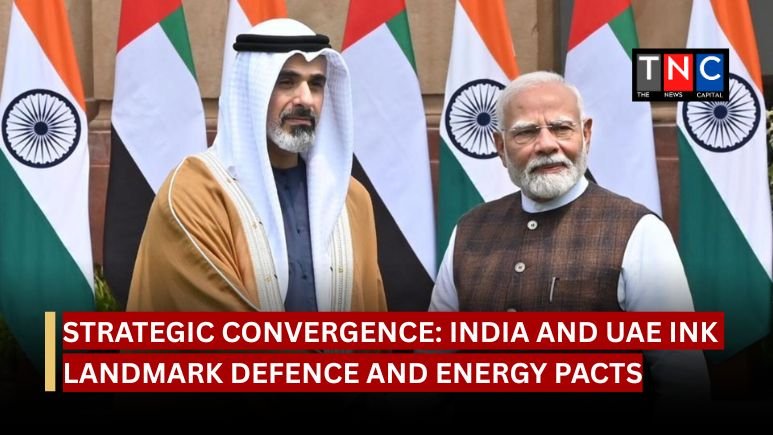

In a swift but “substantive” three-hour summit, Prime Minister Narendra Modi and UAE President Sheikh Mohamed bin Zayed Al Nahyan have elevated bilateral ties to a new strategic zenith, doubling trade targets and securing India’s energy future through a multi-billion dollar LNG deal. India and the United Arab Emirates on Monday, January 19, 2026, transformed their “Comprehensive Strategic Partnership” into a high-tech alliance, signing agreements spanning from the depths of the ocean to the heights of space, while setting a staggering bilateral trade target of $200 billion by 2032.
The visit, which lasted little over three hours, began with a warm airport reception that underscored the personal relationship between the two leaders and set the tone for substantive agreements to follow.
- Airport Reception: PM Modi greeted the UAE leader with a hug, a gesture widely noted as a sign of the deep personal rapport between the two leaders that has characterized India-UAE relations in recent years.
- Efficient Diplomacy: The compact timeframe of just over three hours reflected the mature relationship between the nations, where groundwork had been completed in advance, allowing leaders to focus on finalizing high-level commitments.
- Strategic Timing: The visit coincided with India’s Republic Day celebrations and came just days before President Sheikh Mohamed bin Zayed’s expected participation in other regional diplomatic engagements.
- Symbolism: The warm personal interaction contrasted with the more formal protocols typically associated with state visits, signaling the relationship has moved beyond transactional diplomacy to genuine strategic partnership.
The summit produced a comprehensive package of agreements and letters of intent spanning defense, energy, infrastructure, and emerging technologies.
- Strategic Defence Partnership: A new framework to expand collaboration in defence manufacturing, cyber security, and counter-terrorism, positioning the UAE as a key partner in India’s “Make in India” defense initiative.
- $3 Billion LNG Deal: ADNOC Gas will supply 0.5 million metric tonnes of liquefied natural gas annually to Hindustan Petroleum Corporation Limited (HPCL) for 10 years starting from 2028, providing long-term energy security.
- Dholera Investment: The UAE Ministry of Investment will participate in developing Gujarat’s Dholera Special Investment Region, including an international airport, greenfield port, and smart urban township, representing billions in infrastructure investment.
- Supercomputing & AI: Collaboration between C-DAC (Centre for Development of Advanced Computing) and UAE’s G42 to establish a supercomputing cluster in India, advancing computational capabilities for research and AI development.
The summit broke new ground in civil nuclear energy and emerging technologies, building on India’s recently enacted SHANTI law that opened limited private participation in the nuclear sector.
- Advanced Nuclear Technology: Both sides agreed to explore partnerships in Small Modular Reactors (SMRs) and the development of large nuclear reactors, potentially positioning UAE companies as early investors in India’s expanded nuclear sector.
- Space Commercialization: A joint initiative between IN-SPACe (Indian National Space Promotion and Authorization Centre) and the UAE Space Agency aims to develop launch complexes, satellite fabrication facilities, and joint space missions.
- Digital Sovereignty: The leaders discussed the concept of “Digital Embassies” and data center investments to protect sovereign data while enabling cross-border digital services, addressing growing concerns about data localization and security.
- Technology Transfer: The agreements emphasize not just procurement but genuine technology partnerships, with knowledge sharing and co-development rather than simple buyer-seller relationships.
Building on the success of the 2022 CEPA (Comprehensive Economic Partnership Agreement), which saw bilateral trade reach $100 billion in the 2024-25 fiscal year, the new goal seeks a 100% increase over the next six years.
| Priority Area | Strategic Initiative |
| Trade Target | $200 billion by 2032, doubling current trade levels |
| Financial Services | FAB and DP World to establish operations in GIFT City |
| MSME Growth | Rollout of Bharat Mart and Virtual Trade Corridors |
| Regional Transit | Reaffirmation of IMEC, the India–Middle East–Europe Corridor |
| Energy Security | Long-term LNG supply agreements to ensure stable imports |
| Investment Flows | UAE targeting over $50 billion in Indian infrastructure investments |
The UAE’s commitment to establishing operations in Gujarat International Finance Tec-City (GIFT City) represents a strategic bet on India’s ambitions to create a global financial center.
- First Abu Dhabi Bank (FAB): The UAE’s largest bank will establish a presence in GIFT City, providing financial services and facilitating bilateral trade and investment flows.
- DP World Operations: The global ports operator will set up facilities to support logistics and trade infrastructure connecting India to UAE and global markets.
- Financial Ecosystem: The UAE presence helps create critical mass in GIFT City, attracting additional international financial institutions and validating India’s vision for the special economic zone.
- Regulatory Framework: GIFT City’s International Financial Services Centre (IFSC) provides regulatory advantages and tax benefits designed to compete with Singapore, Dubai, and Hong Kong.
The $3 billion, 10-year LNG supply agreement addresses one of India’s most critical strategic vulnerabilities energy security amid global supply uncertainties.
- Supply Details: ADNOC Gas will provide 0.5 million metric tonnes annually to HPCL starting 2028, securing a reliable supply source for India’s growing energy needs.
- Strategic Diversification: The deal reduces India’s dependence on any single energy supplier and provides price stability through long-term contracting.
- Transition Fuel: Natural gas serves as a transition fuel for India’s journey toward renewable energy, providing cleaner-burning power than coal while renewable capacity expands.
- Broader Partnership: Beyond the immediate supply agreement, the deal positions UAE as a long-term energy partner as India’s consumption grows with economic development.
The discussions took place against a volatile backdrop of Middle Eastern tensions and U.S. tariff pressures, with both nations seeking to navigate complex regional and global dynamics.
- Gaza Peace Plan: The leaders touched upon the Trump Gaza Peace Plan, with President Trump having reportedly invited PM Modi to join a proposed “Board of Peace” to oversee Gaza’s post-war reconstruction.
- $1 Billion Commitment: The Board of Peace would require a $1 billion commitment for permanent membership, which New Delhi is currently analyzing in terms of strategic benefits versus financial costs.
- IMEC Corridor: Reaffirmation of the India-Middle East-Europe Corridor reflects both nations’ commitment to developing alternative trade routes that reduce dependence on traditional chokepoints.
- U.S. Tariff Pressure: The summit provided both nations an opportunity to discuss coordination in face of Trump’s aggressive tariff policies affecting their respective economies.
The Strategic Defence Partnership framework represents a significant expansion of military-to-military ties and defense industrial cooperation.
- Defence Manufacturing: Collaboration on joint production of defense equipment, potentially including maritime systems, drones, and cyber defense capabilities.
- Cyber Security: Sharing of intelligence and best practices for protecting critical infrastructure against cyber threats, particularly relevant given both nations’ digital transformation initiatives.
- Counter-Terrorism: Enhanced intelligence sharing and coordination on counter-terrorism efforts, building on existing cooperation in tracking terrorist financing and extremist networks.
- Training and Exercises: Potential expansion of joint military exercises and training programs, particularly in maritime domain awareness and special operations.
UAE investment in the Dholera Special Investment Region represents one of the largest bilateral infrastructure partnerships, potentially transforming Gujarat’s economic geography.
- Airport Development: Construction of an international airport to serve the region and connect to Gulf destinations, creating a new aviation hub.
- Greenfield Port: Development of modern port facilities to handle cargo and potentially compete with existing major ports in the region.
- Smart Township: Creation of an urban center incorporating cutting-edge technology, sustainable design, and quality-of-life amenities to attract global talent.
- Investment Scale: While specific figures weren’t disclosed, comparable special investment regions require $10-20 billion in development capital, suggesting massive UAE financial commitment.
The India-UAE summit reflects broader strategic alignments that extend beyond bilateral relations to reshape regional and global dynamics.
- Hedging Against China: Both nations seek to reduce dependence on Chinese manufacturing and investment, with UAE positioning India as an alternative hub for production and innovation.
- Energy Transition Partnership: The combination of UAE’s energy resources and capital with India’s technological capabilities and market size creates synergies for clean energy development.
- Middle East Pivot: India’s deepening UAE ties complement growing relationships with Israel, Saudi Arabia, and other Gulf states, positioning India as a key Asian partner for the region.
- Multilateral Leverage: The partnership strengthens both nations’ positions in multilateral forums and provides alternatives to Western-dominated institutions and frameworks.
The three-hour summit produced agreements worth billions of dollars and commitments extending decades into the future, demonstrating how mature strategic partnerships can achieve substantive outcomes efficiently when personal rapport between leaders combines with aligned national interests. The $200 billion trade target by 2032, $3 billion LNG deal, Dholera infrastructure commitments, and technology partnerships across nuclear, space, and digital domains represent a comprehensive elevation of India-UAE ties from transactional relationships to genuine strategic convergence. For India, the agreements address critical vulnerabilities in energy security, provide capital for infrastructure development, and validate its ambitions in emerging technologies. For the UAE, the partnerships diversify investments beyond traditional sectors, secure access to India’s massive market, and position Abu Dhabi as a key player in shaping Asia’s technological and economic future. As both nations navigate a world of U.S. tariff pressures, Middle Eastern instability, and China’s regional ambitions, the India-UAE partnership offers mutual insurance against uncertainty while creating opportunities that benefit both. Whether PM Modi joins Trump’s $1 billion Board of Peace for Gaza remains to be seen, but the strategic convergence with Sheikh Mohamed bin Zayed demonstrated on Monday shows India’s Middle East policy increasingly operates on multiple tracks deepening bilateral partnerships while carefully managing exposure to regional conflicts that could complicate the delicate balancing act of maintaining relationships across the deeply divided Middle East.
Also Read / Gaza Reconstruction: Trump Invites India to Join ‘Most Consequential’ Board of Peace.







Leave a comment