

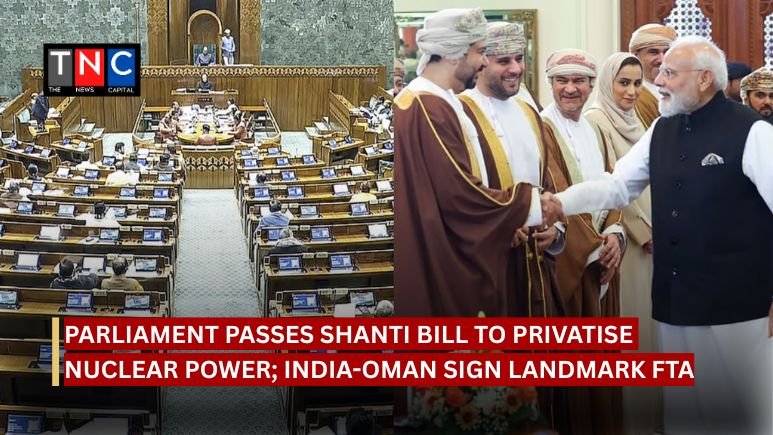

In a day of significant legislative and diplomatic breakthroughs, India has ended its 60-year state monopoly on nuclear energy and signed its sixth major free trade agreement in five years, opening new corridors for investment and trade.
The SHANTI Bill: A new era for Indian Nuclear Energy
Parliament on Thursday (18 December) passed the Sustainable Harnessing and Advancement of Nuclear Energy for Transforming India (SHANTI) Bill, 2025. The landmark legislation repeals the 1962 Atomic Energy Act, officially opening the doors for private and foreign companies to build and operate nuclear power plants for the first time in India’s history.
The bill aims to push India toward its target of 100 GW of nuclear capacity by 2047, up from the current 8.2 GW. Key provisions include:
- Private Entry: Any licensed company or joint venture can now build, own, and operate nuclear reactors.
- Liability Reform: It caps operator liability at ₹3,000 crore and removes the “right to recourse” against equipment suppliers, bringing India in line with global standards to attract foreign technology partners.
- FDI and Regulation: Allows up to 49% Foreign Direct Investment and gives statutory status to the Atomic Energy Regulatory Board.
The bill passed in the Lok Sabha on Wednesday and cleared the Rajya Sabha on Thursday, despite an opposition walkout. Critics, led by the Congress party, argued that removing liability from suppliers for faulty equipment “socialises risk while privatising profit.”
“This marks a transformational moment for our technology landscape,” Prime Minister Narendra Modi said. “It delivers a decisive boost to a clean-energy future… safely powering AI and supporting green manufacturing.”
Minister of State Jitendra Singh clarified that the government would keep absolute control over uranium enrichment, spent fuel, and heavy water management to ensure national security.
India-Oman CEPA: Strengthening the Gulf Corridor
Alongside the legislative action in New Delhi, India and Oman signed a Comprehensive Economic Partnership Agreement in Muscat on Thursday. The pact is the first bilateral trade deal Oman has signed with any country in nearly two decades, granting duty-free access to over 98% of Indian exports.
The agreement is expected to provide an immediate $2 billion boost to Indian exports over the next two years.
- Export Gains: Sectors like textiles, leather, footwear, gems and jewelry, and automobiles, which currently face a 5% duty in Oman, will now see full tariff elimination.
- Services & Investment: Oman has allowed 100% FDI for Indian companies in major service sectors. Additionally, the stay duration for Indian contractual service suppliers has been extended from 90 days to up to four years.
- India’s Concessions: New Delhi will reduce tariffs on Omani dates, marbles, and petrochemicals while protecting sensitive domestic sectors like dairy and gold.
“The sky is the limit in terms of potential, particularly with Oman opening the doors as a gateway to the Gulf, Africa, and Europe,” Commerce Minister Piyush Goyal said.
The passage of the SHANTI Bill and the signing of the Oman CEPA represent a two-pronged strategy by the Modi administration: achieving energy independence through technological reform and securing market access through strategic diplomacy. With the nuclear sector now open, the focus shifts to the upcoming Global Nuclear Investment Summit in early 2026, while the Oman trade deal is expected to come into force within the next few months.
Also Read / PM Modi unveils ‘8-point vision’ for India-Jordan ties as historic visit yields key energy pacts.













Leave a comment