

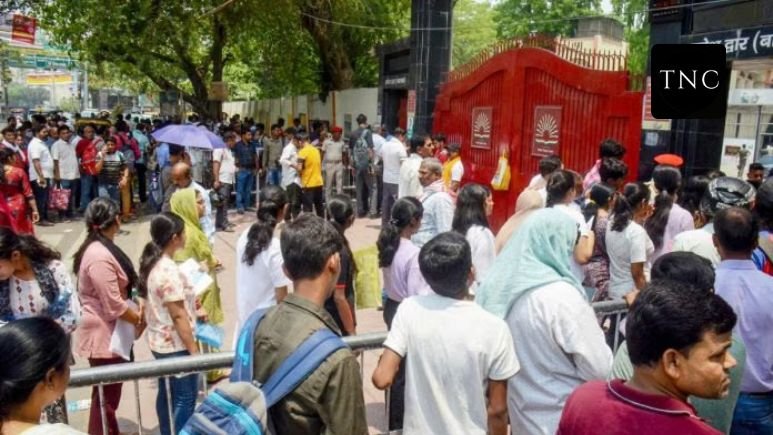

By Saturday night, the WhatsApp messages had stopped sounding like gossip.
In a cramped paying-guest hostel outside Jaipur, a group of NEET aspirants sat hunched over photocopied sheets marked “important questions.” Phones buzzed. Screens glowed blue in the dark. One student, according to investigators, noticed something strange: entire biology sequences looked too precise, too polished to be mere predictions.
Three days later, after the National Eligibility cum Entrance Test India’s most competitive medical entrance exam students began comparing the circulated material with the actual paper. The overlap was startling.
Now, Rajasthan Police’s Special Operations Group has detained two men Manish Yadav and Rakesh Mandawariya as investigators probe what may become one of the most consequential education scandals since the NEET controversy of 2024. Authorities are examining whether the material was a sophisticated “guess paper” or evidence of a deeper leak inside the examination ecosystem itself.
Every year, more than two million Indian students stake their futures on NEET. For many families, the exam is not merely a test. It is a financial gamble, a social ladder, and a years-long emotional investment compressed into a few hours inside an examination hall.
That is why allegations surrounding NEET-UG 2026 are exploding far beyond Rajasthan.
Investigators say digital evidence, including WhatsApp circulation trails, is being examined to determine how exam-related material spread before the test. Reports also suggest authorities are probing whether candidates paid money for access to the documents and whether a wider interstate network was involved.
The scandal cuts to the heart of a question India has failed to answer for years: Can the country still guarantee fairness in high-stakes examinations?
A System Under Siege
Paper leaks in India are no longer isolated crimes. They have evolved into organized operations blending coaching centers, middlemen, encrypted messaging groups, and sometimes insiders within the system.
The NEET-UG 2026 investigation appears to follow that pattern.
According to reports, police are analyzing how a question bank containing more than 100 allegedly matching questions circulated before the exam. Investigators are also exploring connections stretching beyond Jaipur into multiple states.
The National Testing Agency has acknowledged that allegations are under investigation but has not officially confirmed a paper leak.
Yet public trust is already eroding.
For students, the distinction between a “guess paper” and a “leaked paper” feels academic. If hundreds of questions resemble the final exam, confidence in merit collapses either way.
That collapse carries consequences far beyond admissions.
India’s coaching economy worth thousands of crores thrives on desperation. In cities like Kota, Jaipur, Patna, and Hyderabad, entire neighborhoods revolve around competitive exams. Families borrow money. Teenagers endure punishing schedules. Some spend years preparing for a single attempt.
When leaks happen, the emotional damage spreads faster than any FIR.
Students begin to believe hard work is secondary to access. Parents start viewing the system as rigged. Honest candidates feel cheated before results are even declared.
And institutions lose credibility one scandal at a time.
The Ghost of 2024
The current controversy also reopens wounds from the NEET-UG 2024 scandal, when allegations of leaked papers, inflated marks, and irregular rank distributions triggered nationwide protests and legal battles. That controversy eventually reached the Supreme Court and forced multiple investigations.
Officials had promised stronger safeguards after that crisis.
Yet two years later, investigators are once again tracing WhatsApp forwards and coaching-network links.
The repetition is becoming the story.
Opposition leaders have already begun attacking the government over examination integrity, arguing that repeated failures are destroying faith in public institutions.
Meanwhile, students remain trapped in uncertainty. Some reports suggest the examination could face cancellation or re-conduct if evidence of large-scale compromise is established.
That possibility terrifies candidates almost as much as the leak itself.
For aspirants who spent years preparing, a re-exam means another cycle of anxiety, coaching fees, hostel rents, and sleepless nights.
The NEET-UG 2026 probe is no longer just about two detained men in Rajasthan.
It is about whether India’s most important examinations can survive an era of instant messaging, organized cheating networks, and industrial-scale academic pressure.
Because once students stop believing the exam is fair, the damage cannot be measured in leaked papers alone. It spreads into classrooms, careers, and the fragile idea that merit still matters.
Also Read / Model Youth Gram Sabha: How India’s Young Leaders Are Transforming Rural Democracy.












Leave a comment