

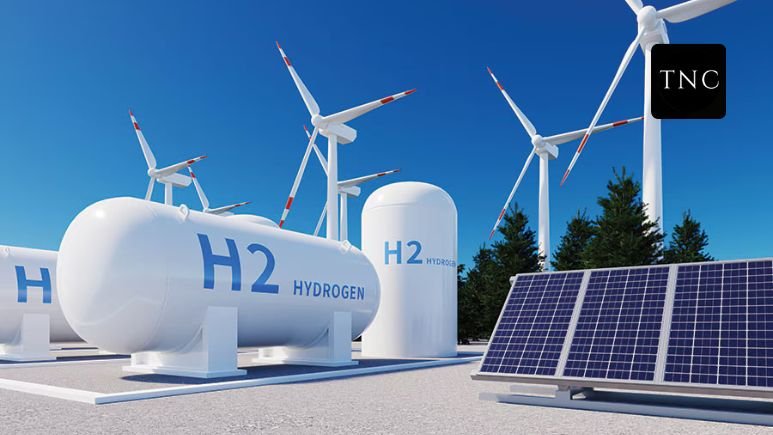

At a refinery on India’s western coast, the hum of machinery hasn’t changed but the fuel running through its future might. Engineers in hard hats huddle over control panels, not to optimize crude oil, but to test something far less visible: hydrogen stripped from water using solar power. It is quiet work, almost invisible. Yet the stakes are enormous. If it succeeds, the same pipelines that once carried fossil fuels could soon carry a cleaner promise, one that could reshape India’s industrial backbone.
India is betting big on green hydrogen aiming to produce 5 million tonnes annually by 2030, a figure that would dwarf today’s global output and position the country as a clean energy powerhouse. This isn’t just about climate ambition. It’s a strategic play: to cut energy imports, dominate emerging global markets, and redefine industrial growth. But as India accelerates, it faces a familiar tension between bold targets and the hard realities of cost, infrastructure, and global demand.
Start with scale. India’s target of 5 million tonnes isn’t incremental, it’s transformative. It implies building massive renewable capacity, expanding electrolyser manufacturing, and creating entirely new supply chains. The government is backing this push with subsidies worth roughly $2.1 billion, signaling long-term commitment.
Then there’s the cost curve, the make-or-break factor. Green hydrogen production costs have already fallen to around $3 per kilogram, with a goal of reaching $2 by 2032. That decline matters because green hydrogen still struggles to compete with cheaper, fossil-fuel-based alternatives. Globally, it remains one of the most expensive clean fuels, even as technology improves.
India’s strategy hinges on solving that equation faster than anyone else.
The industrial case is compelling. Green hydrogen could decarbonize sectors that electricity alone cannot steel, fertilizers, refining. These are the backbone industries of a developing economy, and also its biggest emitters. Replacing fossil fuels here isn’t optional; it’s essential for meeting climate targets without slowing growth.
But ambition collides with friction.
Infrastructure is the first bottleneck. Producing hydrogen is one challenge; transporting and storing it safely is another. Pipelines, storage facilities, and export terminals require billions in investment and years of planning.
Demand is the second. India is counting on exports potentially sending a large share of its output overseas. Yet global markets remain uncertain. Policy delays in Europe and shifting clean energy priorities have already raised doubts about near-term demand, potentially pushing timelines beyond 2030.
And then there’s competition.
China is investing heavily, pouring billions into hydrogen projects and scaling manufacturing aggressively. The global race is no longer about who adopts clean energy, it’s about who controls its supply chains.
India’s advantage lies in its renewable resources and lower-cost labor. Its risk lies in execution.
India’s green hydrogen push is less about fuel and more about power, economic, industrial, and geopolitical. If costs fall and infrastructure catches up, the country could lead the next energy revolution. If not, it risks building ambition faster than it can build reality.
Also Read / India’s Wholesale Inflation Climbs Again What the Numbers Reveal About the Economy.














Leave a comment