

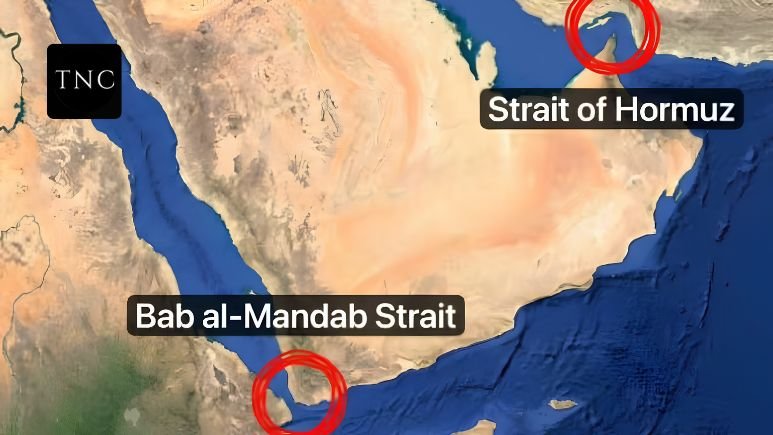

At 3:40 a.m., the tanker’s engines idled in uneasy silence. Captain Rajesh Nair stood on the bridge, staring at a radar screen that showed nothing but congestion and hundreds of vessels frozen in place. The crew had been told to wait. No one knew for how long. Outside, the narrow waters of the Strait of Hormuz, usually a highway of oil, had turned into a geopolitical chokehold. Radios crackled with rumors: threats, blockades, insurance withdrawals. Somewhere beyond the horizon, decisions made in Tehran and Washington were rewriting the fate of ships like his.
The standoff unfolding across the Middle East is not just about military posturing, it’s about control of a handful of maritime “chokepoints” that keep the global economy alive. Iran has repeatedly signaled that if diplomacy collapses, it could target three critical arteries of global trade: the Strait of Hormuz, the Bab el-Mandeb Strait, and the broader Red Sea–Suez corridor. Together, these routes carry a massive share of the world’s oil and commerce. Disrupting them wouldn’t just escalate a regional conflict, it would ripple through fuel prices, supply chains, and economies worldwide.
Start with Hormuz, the crown jewel. Roughly one-fifth of the world’s oil flows through this narrow passage between Iran and Oman. It is the only sea exit for major Gulf producers, making it less a shipping lane and more a pressure point. Even brief disruptions here can send oil prices surging and paralyze trade. Recent tensions have already shown how fragile it is: traffic has collapsed, and hundreds of ships have been stranded amid threats and blockades.
But Hormuz is only the first domino.
Further west lies the Bab el-Mandeb Strait often called the “Gate of Tears.” This narrow corridor links the Indian Ocean to the Red Sea and ultimately to the Suez Canal. It carries about 12% of global trade and millions of barrels of oil daily. If Hormuz is the exit valve of Gulf النفط, Bab el-Mandeb is the bridge to Europe. Close both, and the impact compounds: analysts warn that a dual shutdown could choke off up to a quarter of global oil and gas supply.
Then comes the wider Red Sea–Suez route. It’s not just about oil it’s about everything from electronics to food. This corridor connects Asia to Europe, forming one of the busiest trade highways on Earth. When disruptions hit here whether from conflict, piracy, or proxy groups ships are forced to reroute around Africa, adding weeks of delay and sharply increasing costs.
Iran’s strategy is not necessarily to shut these routes permanently. It doesn’t have to. The threat alone can be enough. Insurance premiums spike. Shipping companies hesitate. Energy markets react instantly. Control of chokepoints leverages economic warfare without firing a shot.
And that leverage is growing more visible. Gulf states worry that even diplomatic outcomes may leave Iran with lasting influence over Hormuz, effectively embedding instability into the system. Meanwhile, proxy actors like groups operating near Bab el-Mandeb expand the battlefield beyond Iran’s borders, turning multiple chokepoints into interconnected flashpoints.
This is the new geography of power: not territory, but transit.
The world doesn’t run on oil alone, it runs on the narrow waterways that move it. If ceasefire talks fail, Iran doesn’t need to strike cities or bases to make its point. It can squeeze the arteries of global trade. And when those arteries tighten, the shock won’t stay in the Middle East; it will show up at petrol pumps, shipping ports, and grocery bills across the world.
Also Read / Open on Paper, Uncertain at Sea: The Strait of Hormuz’s Fragile Return to Life.









Leave a comment