


The ceiling fan rattled above Sharmila Das as she folded her ration card back into a plastic sleeve. Outside her home in North 24 Parganas, a loudspeaker crackled with campaign slogans. Someone mentioned “Didi’s 10 promises,” and the lane went quiet for a moment.
Sharmila didn’t look up. She had heard promises before cash transfers, free rations, student stipends. Some had reached her. Others hadn’t.
“What matters,” she said, almost to herself, “is whether the money comes before the next bill.”
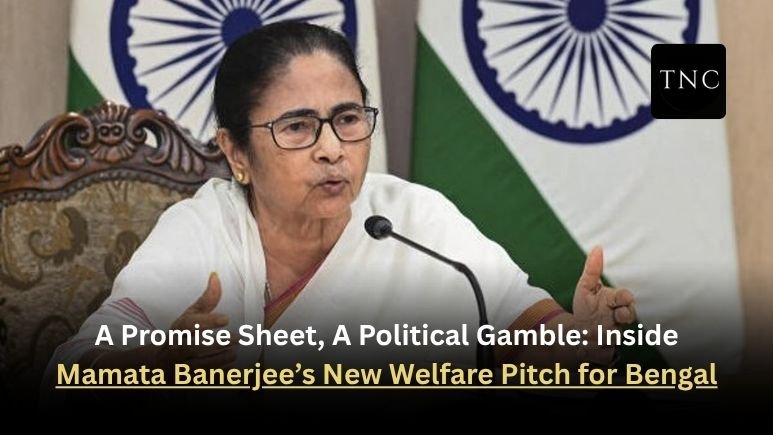
That tension between promise and delivery is at the heart of Mamata Banerjee’s newly unveiled manifesto, branded as “Banglar Jonno Didir 10 Protigya.” Released ahead of the 2026 West Bengal assembly elections, the document leans heavily on welfare expansion, economic support, and targeted benefits for women, youth, and farmers.
But this isn’t just another list of campaign assurances. It is a calculated political strategy one that seeks to reinforce trust among beneficiaries while countering rising economic anxieties and electoral competition.
At its core, the manifesto doubles down on a model that has defined Banerjee’s governance: direct benefit transfers and welfare-first politics.
The promises span multiple fronts: expanded financial aid schemes, job creation initiatives, skill development programs, and increased support for farmers and women. The message is clear: continuity, not disruption.
But continuity can cut both ways.
On one hand, welfare schemes like cash assistance programs have created a loyal voter base. For many households, these are not abstract policies; they are monthly lifelines. That’s political capital no opponent can easily dismantle.
On the other hand, critics argue the model skirts deeper structural issues. Job creation remains uneven. Industrial growth has lagged behind expectations. A manifesto rich in subsidies risks raising an uncomfortable question: Can the state sustain this level of spending long-term?
There’s also the timing. Inflation pressures, youth unemployment, and rural distress have sharpened voter expectations. Promises alone won’t suffice. Delivery speed, transparency, and scale will define credibility.
Banerjee’s strategy, then, is less about reinvention and more about reinforcement tightening her grip on welfare politics while attempting to expand its reach. It’s a familiar playbook, but executed in a more competitive and economically strained environment.
For voters like Sharmila, the manifesto isn’t about ideology or political narratives. It’s about something far simpler: Will the next installment arrive on time?
Because in Bengal’s election, the real contest isn’t just between parties it’s between promises made and promises kept.
Also Read / The Quiet Challenger in Nandigram.











Leave a comment